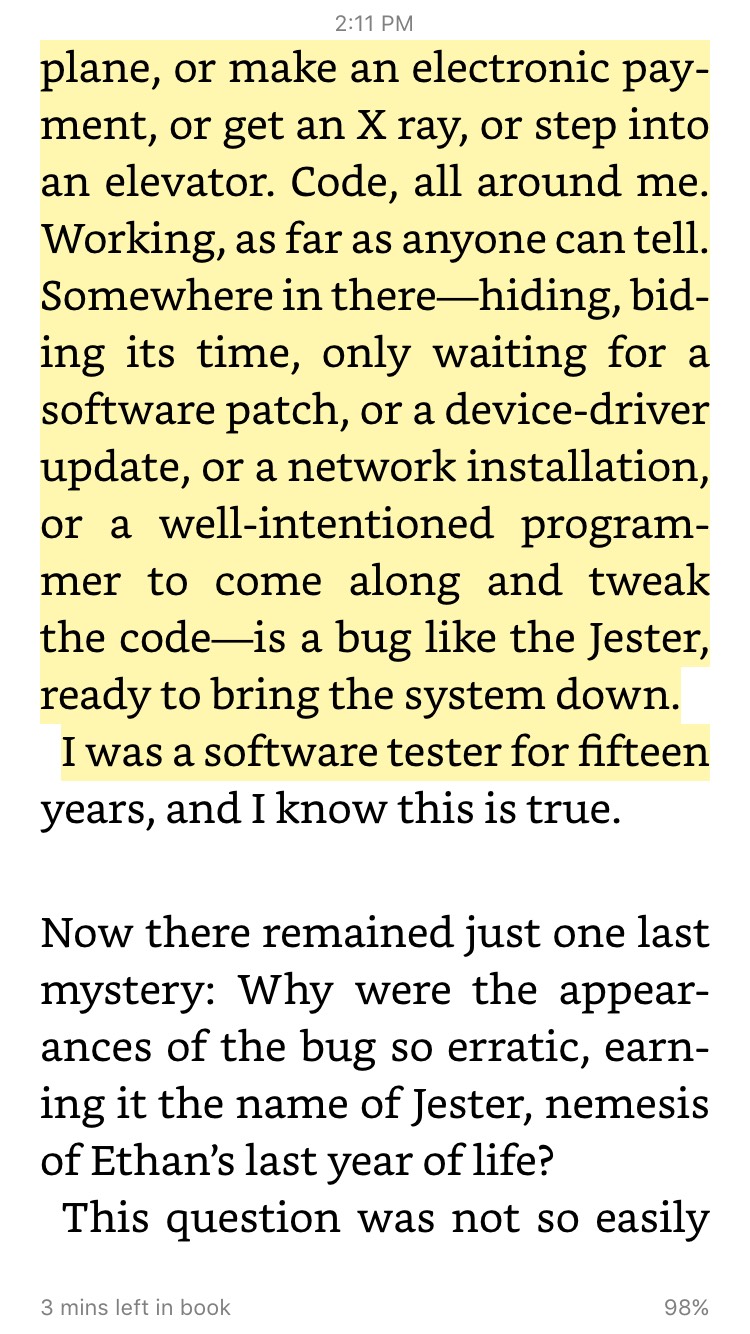
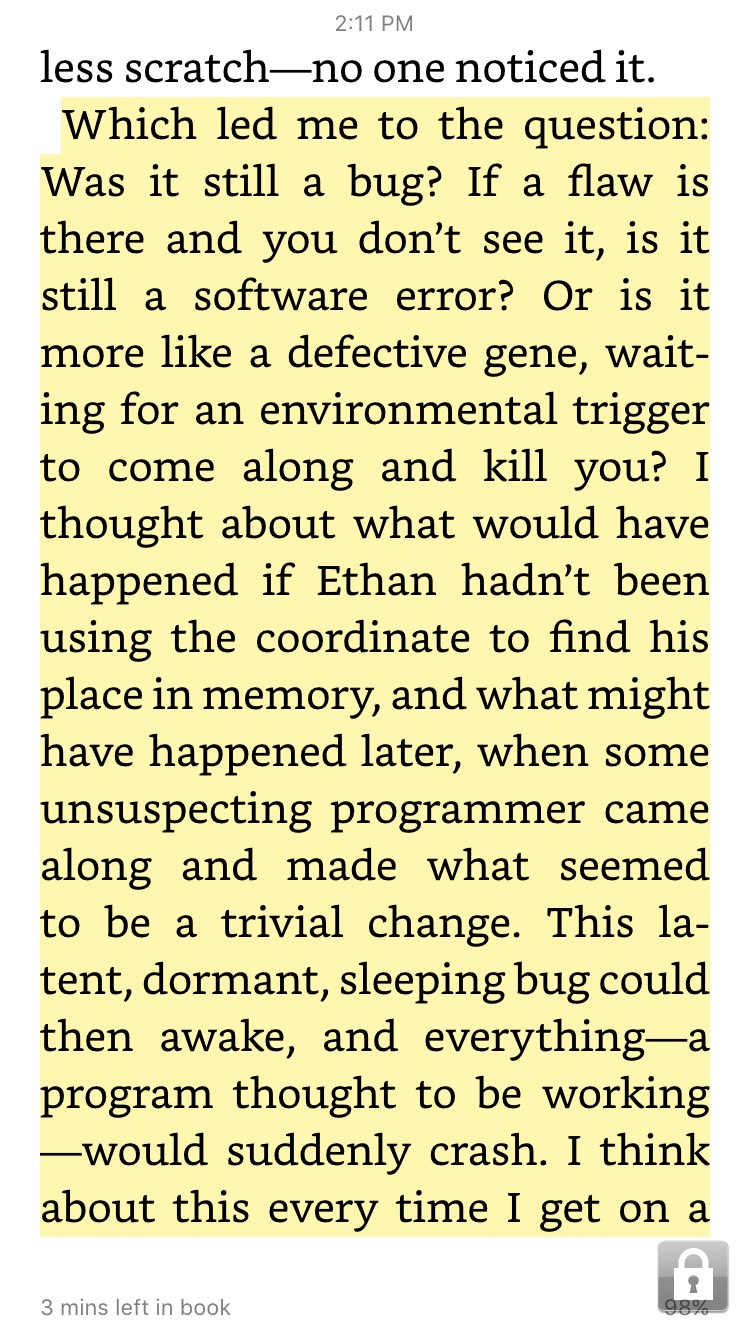
I'd like to thank everyone on the list who has responded so generously to my query, both here and back channel. Tom's posts are, as always, marvels. There's a lot for me to work with here. List members might enjoy going back to Ellen Ullman's 2002 novel *The Bug*, which is a dark but loving recreation early programmer culture from someone who was there. Here's a snippet to enjoy, just as a small thank you: On Sat, Jul 4, 2020 at 1:27 PM Johannah Rodgers <johannah.rodgers@gmail.com> wrote:
If you are interested in the human side of the discussion of error, I'd suggest taking a look at chapter 4 of Otte and Mlynarczyk's 2010 book on Basic Writing <https://wac.colostate.edu/books/referenceguides/basicwriting/> and Stuart Moultrhop's essay "Error 1337" in the collection edited by Mark Nunes entitled "Error: Glitch, Noise, and Jam in New Media <https://books.google.com/books?id=tvGoAwAAQBAJ&newbks=1&newbks_redir=0&dq=nunes+error&source=gbs_navlinks_s>" (Bloomsbury, 2010). For a 19th c. perspective, you might want to take a look at Kuno Fischer's chapter on "The Origin of Error" in his History of Modern Philosophy <https://books.google.com/books?id=JmANAAAAIAAJ&pg=PA360&dq=error+and+philosophy&hl=en&newbks=1&newbks_redir=0&sa=X&ved=2ahUKEwjL7LDXjLTqAhVLg3IEHRNiAwsQ6AEwAHoECAAQAg#v=snippet&q=error%20&f=false> (1854–77; the link is to an 1887 English translation).
All best,
Johannah
On Sat, Jul 4, 2020 at 10:04 AM Richard Vahrenkamp <vahrenkamp2@gmx.de> wrote:
Although physicists often use rules of thumb, the precision of calculation became an important point in John von Neumann's policy against the analogue computer. The precision of individual calculations on analog machines is lower than on digital machines. But the final results of integrating a differential equation were the same on analog machines as on digital ones, as comparisons in the 1950s showed, see my paper The Computing Boom in the US Aeronautical Industry, 1945–1965, in: ICON – The Journal of the International Committee for the History of Technology, volume 24, 2019, pp. 127–149.
Best, Richard
On 03.07.2020 22:18, Paul N. Edwards wrote:
Rounding error is ubiquitous and unavoidable in digital computers, but with high precision computing (64-bit, 128-bit) it’s so small as to be negligible.
However, in cases where the same computation is performed many thousands or millions of times, it can still accumulate to a point that it’s significant.
MacKenzie, D. (1993). Negotiating Arithmetic, Constructing Proof: The Sociology of Mathematics and Information Technology. Social Studies of Science, 23(1), 37-65.
Also see the short examples of this in my book A Vast Machine: Computer Models, Climate Data, and the Politics of Global Warming (MIT Press, 2010), pages 177-178.
Best,
Paul
On Jul 3, 2020, at 10:54, Matthew Kirschenbaum <mkirschenbaum@gmail.com<mailto:mkirschenbaum@gmail.com> <mkirschenbaum@gmail.com>> wrote:
Hello all,
I am interested in a better understanding of the nature of computational error. My sense is that actual, literal (mathematical) mistakes in modern computers are quite rare; the notorious Pentium bug of the early 1990s is the exception that proves the rule. Most bugs are, rather, code proceeding to a perfectly correct logical outcome that just so happens to be inimical or intractable to the user and/or other dependent elements of the system. The Y2K "bug," for instance, was actually code executing in ways that were entirely internally self-consistent, however much havoc the code would wreak (or was expected to wreak).
Can anyone recommend reading that will help me formulate such thoughts with greater confidence and accuracy? Or serve as a corrective? I'd like to read something fundamental and even philosophical about, as my subject line has it, the nature of computational error. I'd also be interested in collecting other instances comparable to the Pentium bug--bugs that were actual flaws and mistakes hardwired at the deepest levels of a system.
Thank you-- Matt
-- Matthew Kirschenbaum Professor of English and Digital Studies Director, Graduate Certificate in Digital Studies Printer's Devil, BookLab University of Marylandmgk@umd.edu<mailto:mgk@umd.edu> <mgk@umd.edu> _______________________________________________ This email is relayed from members at sigcis.org<http://sigcis.org> <http://sigcis.org>, the email discussion list of SHOT SIGCIS. Opinions expressed here are those of the member posting and are not reviewed, edited, or endorsed by SIGCIS. The list archives are at http://lists.sigcis.org/pipermail/members-sigcis.org/ and you can change your subscription options at http://lists.sigcis.org/listinfo.cgi/members-sigcis.org
________________________ Paul N. Edwards<https://profiles.stanford.edu/paul-edwards> <https://profiles.stanford.edu/paul-edwards>
Director, Program on Science, Technology & Society<http://sts.stanford.edu> <http://sts.stanford.edu> William J. Perry Fellow in International Security and Senior Research Scholar Center for International Security and Cooperation<http://cisac.fsi.stanford.edu/> <http://cisac.fsi.stanford.edu/> Co-Director, Stanford Existential Risks Initiative<https://cisac.fsi.stanford.edu/stanford-existential-risks-initiative> <https://cisac.fsi.stanford.edu/stanford-existential-risks-initiative> Stanford University
Professor of Information<http://www.si.umich.edu/> <http://www.si.umich.edu/> and History<http://www.lsa.umich.edu/history/> <http://www.lsa.umich.edu/history/> (Emeritus) University of Michigan
_______________________________________________ This email is relayed from members at sigcis.org, the email discussion list of SHOT SIGCIS. Opinions expressed here are those of the member posting and are not reviewed, edited, or endorsed by SIGCIS. The list archives are at http://lists.sigcis.org/pipermail/members-sigcis.org/ and you can change your subscription options at http://lists.sigcis.org/listinfo.cgi/members-sigcis.org
-- ******************************************** Prof. Dr. Richard Vahrenkamp Logistik Consulting Berlin Phone 0177- 628 3325 E-Mail: Vahrenkamp2016@gmx.de Web: www.vahrenkamp.orgTrendelenburgstr. 16 14057 Berlin <https://www.google.com/maps/search/Trendelenburgstr.+16%0D%0A14057+Berlin?entry=gmail&source=g>
*********************************************
_______________________________________________ This email is relayed from members at sigcis.org, the email discussion list of SHOT SIGCIS. Opinions expressed here are those of the member posting and are not reviewed, edited, or endorsed by SIGCIS. The list archives are at http://lists.sigcis.org/pipermail/members-sigcis.org/ and you can change your subscription options at http://lists.sigcis.org/listinfo.cgi/members-sigcis.org
-- johannahrodgers@gmail.com www.johannahrodgers.net
-- Matthew Kirschenbaum Professor of English and Digital Studies Director, Graduate Certificate in Digital Studies Printer's Devil, BookLab University of Maryland mgk@umd.edu