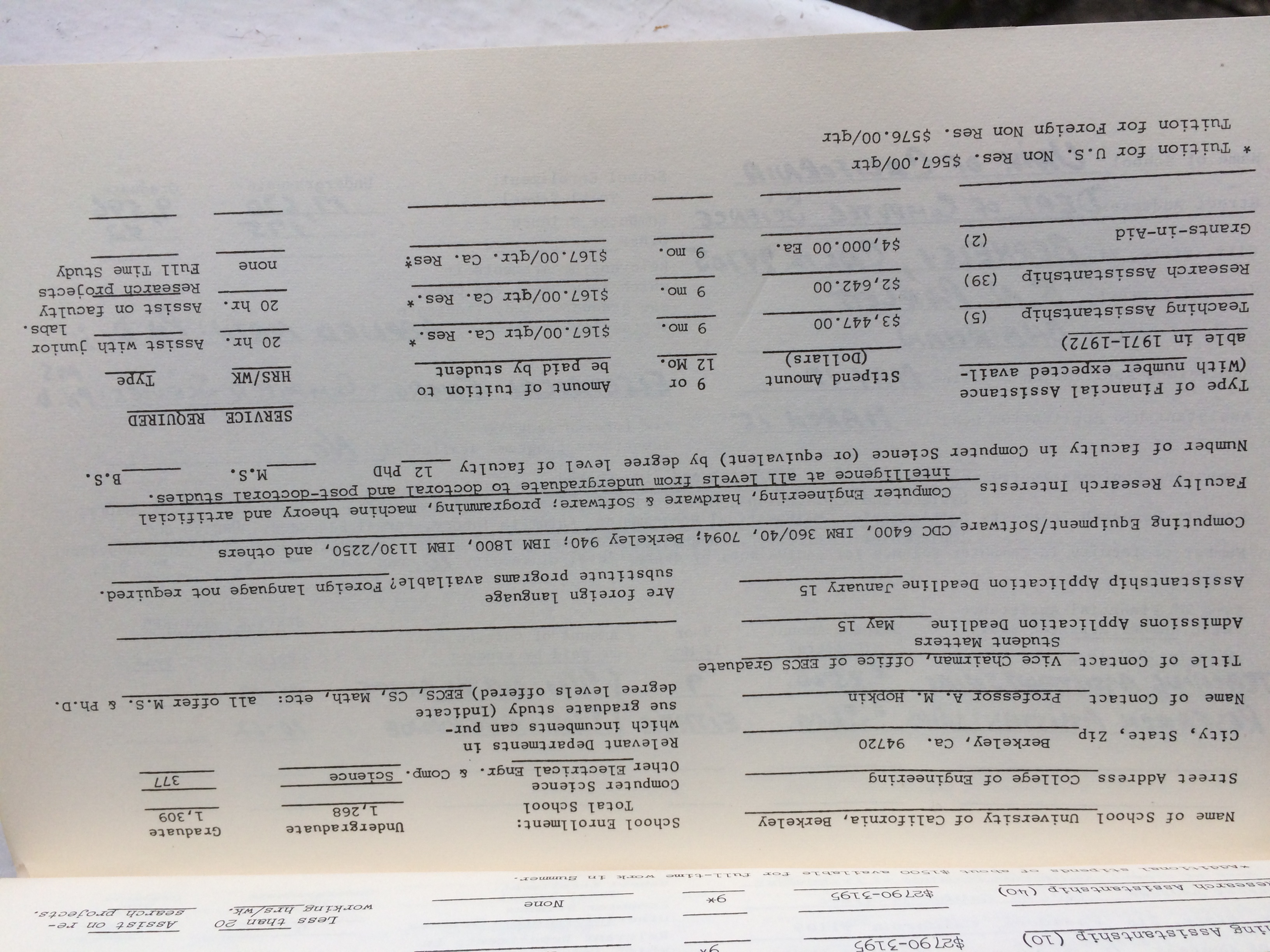
Exactly – that's what I did for France, mapping the emergence of computer science measured in terms of equipment, labs, chairs, diplomas, doctorates, etc. The social/institutional construction of a "normal science". According to a California n library site, there is even a Graduate Assistantship Directory in the Computer Sciences , dated 1900… [ https://catalog.hathitrust.org/Record/001832431 | https://catalog.hathitrust.org/Record/001832431 ] More seriously, the Directory was published from 1968 tà 1995: [ https://searchworks.stanford.edu/view/361791 | https://searchworks.stanford.edu/view/361791 ] Attached, a page sample. Regards, Pierre De: "Nabeel Siddiqui" <nabsiddiqui2@gmail.com> À: "Pierre Mounier-Kuhn" <mounier@msh-paris.fr> Cc: "members" <members@sigcis.org> Envoyé: Lundi 17 Février 2025 21:01:48 Objet: Re: [SIGCIS-Members] Directory in the Computer Sciences, 1971-1972 Does anyone know if there are directories for other years? I think it may be interesting to map to see the growth of the discipline over time. On Monday, February 17, 2025, Pierre Mounier-Kuhn via Members < [ mailto:members@lists.sigcis.org | members@lists.sigcis.org ] > wrote: Dear SIGCIS, A little gem found among my archives: Graduate Assistantship Directory in the Computer Sciences , 1971-1972, published by the ACM. It lists 102 universities (95 US, 5 in Canada, 1 in England and 1 in Holland), with their computing equipment, their teaching & research programs, name of contact (typically the head of the computer department), tuitions, etc. Unsurprisingly, the details of computing equipments reveal a wealth of large mainframes and sometimes of supercomputers, well above those possessed then by European universities. 45 of these universities had teaching or research programs on AI and Pattern Recognition. Best, Pierre Mounier-Kuhn