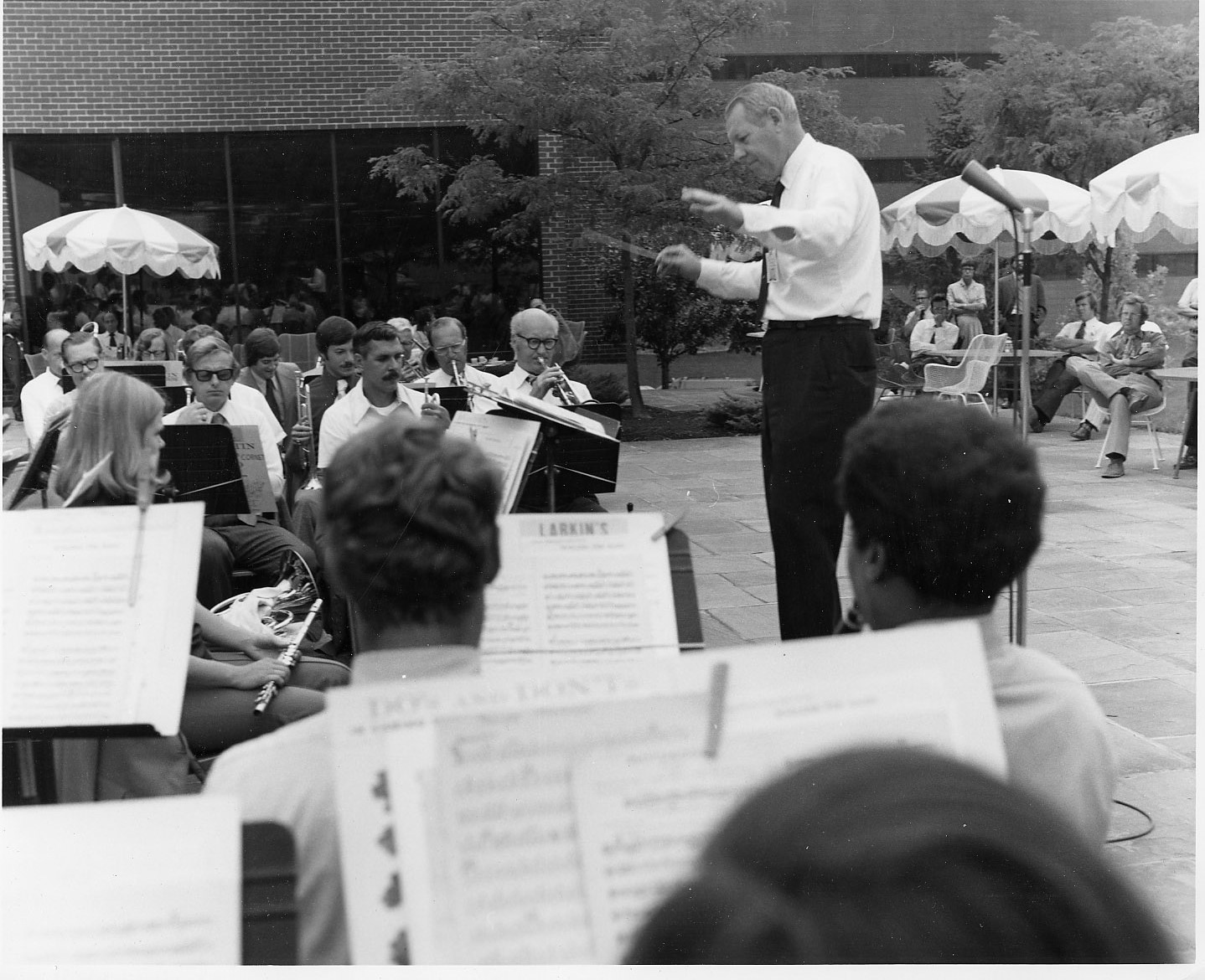
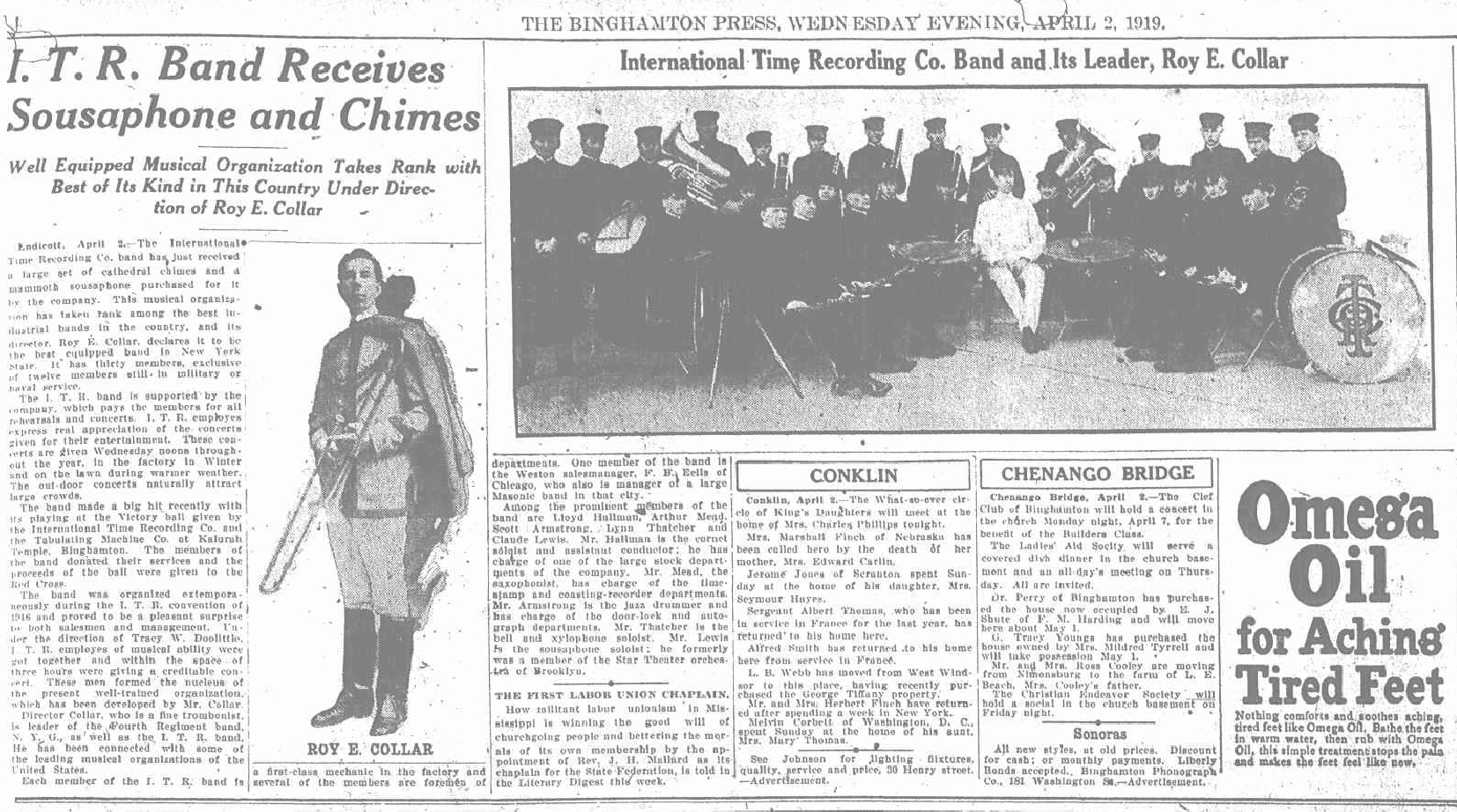
Don Rex, IBM San Jose original ME, has a good memory - still intact as he approaches his 91st birthday. I'd be happy to ask for Don's input if you think he might have been associated with the 610 effort at San Jose. I don't have a good feel for how quickly the San Jose lab grew from a handful of folks to many departments and multiple buildings. We have recordings of the IBM band with chorus at Endicott and Glendale, the longest running corporate band in the US - started at ITR. Alas the originals were recorded by a boom box on a chair; we have cleaned up the files (removing street noise from lunch time plaza concerts), but there is no sparkle in the sound. If anyone is interested in low quality audio files, please let me know. Playlist attached. Susan On Thu, Mar 3, 2016 at 12:05 PM, Murray Turoff <murray.turoff@gmail.com> wrote:
Ahhh! I worked on the IBM 1620 for IBM in san jose for a year 1960-1961. It was a "personal computer" about the size of a desk. It had a continuous memory and you could set up the word length you wanted. Memory was based upon our standard digital system to the base 10. At that point in time there was only three machines at the San Jose plant and a group of us were working on applications. I wrote a guide to machine level programming and debugging and worked with others on a Fortran System as well a numerical control application package. It was a fun machine to work with.
At the San Jose plant a lot of sales people were brought in to be educated in new but not yet released products. They always sang IBM songs to start the meeting. I think somehwere i have burried an IBM song book. They were extremely loyal as some them were with IBM in 1929 and it was only IBM and ATT that did not fire any professional during that recession. Many had nothing much to do so they started a song writing contest which resulted in the song book. I have never checked if the song book is online anywhere.
On Thu, Mar 3, 2016 at 4:52 AM, Mounier Kuhn <mounier@msh-paris.fr> wrote:
Thanks for this discussion. Bashe et al., in their book *IBM's Early Computers,* explain that the IBM 610 was not developed to answer any market demand ; it reflected the internal needs of IBM’s growing staff of engineers and scientists who used desk calculators. Being not a priority, its development was delayed, but it inspired the successful IBM 1620… and perhaps many small computers marketed by competitors in the late 1950s. So we have a faily good idea of what use was envisioned : A scientist or engineer who needed to perform relatively simple calculations which did not justify the cost of waiting in line to use a mainframe.
It would be interesting to know :
- what competitive advantage the IBM 610 had over a good desk calculator ;
- how the IBM 610 was renamed from Personal Automatic Calculator to Auto-Point Computer (the choice of *Computer* makes sense, but *Auto-Point*?)
I have an alternative question (sorry if it is half off-topic !). In the early 1970s, the term* micro-ordinateur* [*micro-computer*] appeared in various development projects within the French Plan Calcul. It designated any « very small computer », whatever the technology – it was not necessarily related with microprocessors. Was the term *micro-computer *used in this broad sense in other locations, before 1975 when microprocessor-based micro-computers became the mainstream concept in this market segment ?
Best, Pierre
Pierre Mounier-Kuhn CNRS & Université Paris-Sorbonne L’Emergence d’une science: l’informatique <http://pups.paris-sorbonne.fr/catalogue/centre-roland-mousnier/linformatique-en-france-de-la-seconde-guerre-mondiale-au-plan-calcul> http://koyre.ehess.fr/docannexe/file/1203/mounier_kuhn_cv_anglais.pdf <http://koyre.ehess.fr/docannexe/file/400/cv_mounier_kuhn.pdf> https://cnrs.academia.edu/PierreMounierKuhn
Le 3 mars 2016 à 01:38, Hansen Hsu <hansnhsu@gmail.com> a écrit :
I’ve noticed this too. Gordon Bell, Wes Clark, and Alan Kay have all been on record saying that they considered the LINC the first personal computer, as it was also designed for use by an individual (a biomedical researcher). Joe November’s excellent book goes into some detail on this. LINC inspired some of the creators of the Alto, both in terms of the user’s experience of controlling the entire machine, but also in some aspects of its hardware architecture. I certainly think LINC belongs in the pre-history of the personal computer, as does Engelbart’s NLS, but I would hesitate to call it a “personal computer” for precisely the reasons you’ve outlined for the IBM 610, which is even earlier. If one took the criteria to be that an individual had complete control over the machine while in use, then TX-0 or even Whirlwind might count as personal computers. The term begins to lack meaning at that point.
On Mar 2, 2016, at 4:11 PM, Allan Olley <allan.olley@utoronto.ca> wrote:
Hello, http://www.columbia.edu/cu/computinghistory/610.html The 610 was under development as the Personal Automatic Computer (acording to this website and according to Bashe et al. in the MIT book IBM's Early Computer, a prototype was operating by 1954 with commercial release by 1957) it was intended as a more real time less batch modey sort of machine unlike other machines of that time, but no one really seriously seems to claim it has any relation to any other "personal computer" either in terms of hardware details (it apparently had very ideosyncratic hardware) or even as vague inspiration. The key point I guess is that it pretty clearly has nothing to do with the microprocessor based computers of the 1970s and later that are usually called personal computers.
I have noticed that the idea of a personal computer and personal computing gets used to describe machines before the microprocessor machines of the 1970s. The website mentions the Bendix G-15 as another example of this (some apparently claim it as the first personal computer and it was released commercially in 1956). The issue here is that any computer an individual has complete control of regardless of its characteristics (size, intended use etc.) can become a personal computer in terms of how that user feels about it and interacts with it. So any computer can be a personal computer in that ambigious sense it seems to me. It also gets complicated because people's interactions with earlier transistor and vacuum tube machines influenced them in designing and using the microprocessor machines that are unambigiously personal computers. So there are connections that should be made that make it complicated.
-- Yours Truly, Allan Olley, PhD
http://individual.utoronto.ca/fofound/
On Wed, 2 Mar 2016, John Impagliazzo wrote:
Hi All,
Allegedly, some consider the IBM 610 Auto-Point computer (1959) the ‘first personal computer’. http://www.columbia.edu/cu/computinghistory/plugboard.html Is this true – even slightly true??
John
John Impagliazzo, Ph.D. Professor Emeritus, Hofstra University IEEE Life Fellow ACM Distinguished Educator
_______________________________________________ This email is relayed from members at sigcis.org, the email discussion list of SHOT SIGCIS. Opinions expressed here are those of the member posting and are not reviewed, edited, or endorsed by SIGCIS. The list archives are at http://lists.sigcis.org/pipermail/members-sigcis.org/ and you can change your subscription options at http://lists.sigcis.org/listinfo.cgi/members-sigcis.org
_______________________________________________ This email is relayed from members at sigcis.org, the email discussion list of SHOT SIGCIS. Opinions expressed here are those of the member posting and are not reviewed, edited, or endorsed by SIGCIS. The list archives are at http://lists.sigcis.org/pipermail/members-sigcis.org/ and you can change your subscription options at http://lists.sigcis.org/listinfo.cgi/members-sigcis.org
_______________________________________________ This email is relayed from members at sigcis.org, the email discussion list of SHOT SIGCIS. Opinions expressed here are those of the member posting and are not reviewed, edited, or endorsed by SIGCIS. The list archives are at http://lists.sigcis.org/pipermail/members-sigcis.org/ and you can change your subscription options at http://lists.sigcis.org/listinfo.cgi/members-sigcis.org
--
*please send messages to murray.turoff@gmail.com <murray.turoff@gmail.com> do not use @njit.edu <http://njit.edu> addressDistinguished Professor EmeritusInformation Systems, NJIThomepage: http://is.njit.edu/turoff <http://is.njit.edu/turoff>*
_______________________________________________ This email is relayed from members at sigcis.org, the email discussion list of SHOT SIGCIS. Opinions expressed here are those of the member posting and are not reviewed, edited, or endorsed by SIGCIS. The list archives are at http://lists.sigcis.org/pipermail/members-sigcis.org/ and you can change your subscription options at http://lists.sigcis.org/listinfo.cgi/members-sigcis.org
-- Susan Sherwood, Executive Director Center for Technology & Innovation 321 Water Street, Binghamton, NY 13901 Future home of TechWorks! Experience Innovation - past, present, & future Telephone 607-723-8600 Website www.ctandi.org