Candidate World Records -- Biggest Hard Drive, Tape and Portable Computer

Hello SIGCIS, I have agreed to a fun little consulting job of helping the Guinness World Records people update and improve their computer-related records. Although the Encyclopedia Britannica and other traditional authorities have fallen by the wayside, the records book is still going strong and is perhaps the last published authority standing. Also, somebody once tried to prove me wrong by invoking it. So now I can make sure that doesn't happen again. I'll be dribbling out a couple of additional requests over the next week or so, not to overwhelm the list. I have some fun candidate records, but would like to see if they hold up among this expert body. BTW, If you have an idea for a good record feel free to pitch it to me, but to avoid overwhelming the list better to send it directly. We are trying to avoid firsts, which have traditionally accounted for the majority of the computer-related records. BIGGEST HARD DISK: First up, the biggest hard disk. Not the largest capacity, the BIGGEST. I figure records like that will illustrate better than finding some boring box with a high capacity, and are less likely to be out of date by the time the book is published. Plus where do you draw the line between a drive and an array? Everyone knows RAMAC, which apparently had 24 inch platters. Platters generally shrank over the years, as everything else being equal smaller platters can be spun faster, so I believe later mainstream IBM systems were smaller. But third parties offered higher performance, higher capacity drives. The best candidate appears to be the Bryant Model 2 Disk File from the early 1960s. That had 39 inch platters. The image below is from a brochure online at CHM: https://archive.computerhistory.org/resources/text/Bryant/Bryant.Model2.1965 .102646212.pdf. According to Wikipedia, "Also in 1961, Bryant Computer Products introduced its 4000 series disk drives. These massive units stood 52 inches (1.3 m) tall, 70 inches (1.8 m) long, and 70 inches (1.8 m) wide, and had up to 26 platters, each 39 inches (0.99 m) in diameter, rotating at up to 1,200 rpm." This Computer History Museum page seems to be hedging bets by calling the Bryant units "among the physically largest drives ever built": <https://nam10.safelinks.protection.outlook.com/?url=https%3A%2F%2Fwww.compu terhistory.org%2Fstorageengine%2Fhdd-competitors-enter-the-market%2F&data=01 %7C01%7Cdbrock%40computerhistory.org%7Cf8b06045c05145c54c2108d83d4f6a76%7Cb6 a9c12a29ee4c5f8f93f0d7a8e2db2f%7C0&sdata=vDoH7Oha71xW1pQ22YRSIk2D0FXI%2Bblt% 2BCpVisUSJck%3D&reserved=0> https://www.computerhistory.org/storageengine/hdd-competitors-enter-the-mark et/ I'm fairly sure that the Bryant platters were the largest in a standard commercial product. Can anyone prove differently? Or know of a special-purpose system with even larger platters? BONUS - HEAVIEST TAPE REEL: I am pretty sure that the IBM SSEC had the heaviest tape reel, at 400 pounds, which was a roll of the paper stock cards were cut from. I believe this was run in an endless loop to used as a high speed lookup table. It had to be lifted with a special mechanism. But if anyone knows of a bulkier tape, let me know. The SSEC tape is documented at http://www.columbia.edu/cu/computinghistory/ssec-tape.html. That includes this description from Herb Grosch: "About those tapes: the card plant in Endicott got enormous rolls of card stock from the paper mills. For regular card manufacturing they slit the rolls to three-inch width (card height). For the SSEC they furnished rolls eight inches wide (card length). The resulting rolls weighed 400 pounds, and had to be hoisted onto the SSEC with a thoughtfully-provided chain fall! For the Stallion, we pushed the rolls up a ramp. "The punch stations, slightly modified from standard IBM reproducer components, punched two round sprocket holes at the edges, and 78(!) regular IBM rectangular holes in between. The sprockets drove the tape one line at a time, and drives under separate program control fed the fresh or pre-punched tape under ten 78-brush reading stations. The tapes hanging down could lengthen and shorten, and for program tapes and the table lookup unit we cemented the tape end-to-end into short loops (yes, someone had had to provide the jig). There were three of these monsters at the end of the machine room. Up to 36 of the fixed-length tape loops could be mounted on the separate table-lookup unit, which in later years was also sometimes used for program reading. For the lunar calculation, I used 24 loops to make lookup time as short as possible, and we got programming from the main tape readers." BONUS - LARGEST PORTABLE COMPUTER That appears to be DYSEAC, which makes sense as AFAIK it was the only portable full-scale vacuum tube computer. It apparently weighed 20 tons and took two 40 foot trailers to move. (Weight includes the trailers, but not the tractors to pull them). I asked Evan Koblentz, who wrote a book about portable computers, and he couldn't think of a heavier/larger one. This makes even the Osbourne and IBM PC Portable look extremely light. Read about the DYSEAC here: http://ed-thelen.org/comp-hist/SEAC <http://ed-thelen.org/comp-hist/SEAC&DYSEAC-3-150.pdf> &DYSEAC-3-150.pdf, including this image: It would be fun if official recognition of these records prompted some enterprising teams to attempt to beat them. Best wishes, Tom

Hello, So just to attempt to clarify how big the SSEC tape drive was. I've discussed this with Tom and admitted much confusion looked about started to see answers and then never nailed anything down, so let me just do this now. Anyway I am very sure the actual reels of paper tape used on the SSEC were much smaller than the 400 pounds of tape stock delivered fromt the factory. A 400 pound paper tape would have stored I am guessing about 25 times as many numbers on the tape then the contemporary accounts refer to as stored by the machine in total. The standard size of the tapes was probably more like 15 pounds of paper for all tapes on the machine and so slightly less than 5 pounds for each large tape on the main readers. They were certainly still very bulky and just looking at pictures of them I would guess they weighed somehting like 20 pounds, so I am still confused. Anyway my logic and evidence for these statements goes as follows (much unnecessary detail follows): So each number on the tape was coded in a row (78 potential punches) in binary-coded decimal (4 bits to the digit) 19 digits plus sign (so some descriptions of the SSEC describe it as using numbers of 19 digits, others as 20). For comparison a standard IBM punch card was 80 columns, 10 rows of digits 0-9 and two invisible rows (A, B or X, Y). Contemporary accounts (Wallace Eckert, "Electrons and Computation" in The Scientific Monthly, Vol 67, No 5 (Nov) 1948 pp. 315-323) say the three main tape drives of the SSEC store in total 20 000 numbers or 6 666 numbers on each tape drive. 12 numbers are 12 rows and so constitue ~1 punch card, so each main tape drive has the equivalent paper of ~556 punch cards or ~1666 cards worth of paper in total. An IBM carrynig case for 2000 cards apparently weighed 6.6 kg (14.52 lbs) according to this webpage https://nuhc.ncl.ac.uk/moca/iomedia/pc.htm and that sounds about right for the weight of 2 000 cards but I wish I had a more definite benchmark to use for the rest of my arithmetic then this one number pulled from a random webpage. Anyway, give that I don't think the tape on all three tape drives weighed more than 15 pounds, the tape on each one would have weighed a little less than 5 pounds. As mentioned there are 36 tape readers that are associated with 5 000 more stored numbers on tape. So each loop contained about 139 numbers (I've found archival sources that suggest they sometimes used loops of over 500 numbers in these configurations but I guess that was non-standard?) tha is again rows of tape, so was equivalent to a little more than 10 punched cards. So all 36 loops add less than the equivalent of 417 cards, so less than another 5 pounds, to the weight of the tapes on the SSEC. So the 25 000 numbers stored (as standard) on all the SSEC's paper tape is just a tad more (1/24th more) paper than 2 000 punched cards in the carrying case I am using as my weight unit (which would store 24 000 numbers by that method). Suggesting the paper tape of the machine amounted to about 7 kg of paper or about 15 pounds in total. I am not sure you really needed a chain hoist for that, but depending on what you are doing with the original 400 poounds of raw paper tape received from the factory to prepare it for use, the chain hoist could have been useful. On some subsidiary issues: If you want to see what the short loops of paper tape looked like there is footage of the SSEC available on the Comptuer History Museum's website Youtube channel (see 49:50 of https://youtu.be/qundvme1Tik note this portion of the video is a lecture given by Herb Grosch). You can see a good image of the main paper tape drives at the back of the SSEC in a famous of image of the SSEC where the pesky support beams for the room it is in have been removed that shows up around 50:25 into the video. They are pretty big I don't think big enough to way 400 pounds (or even 133 pounds each) but big enough that I think they would weigh more than 5 pounds (they look like more than 500 punched cards worth of paper), I would guess 15 or 20 pounds (so each tape is more than 2000 cards worth of paper). I am pretty sure the reels on the main tape readers are glued together at the end into a continous loop because John Backus describes an incident where the SSEC started to act strangely and they realized they had glued the ends of the tape together the wrong way around creating a giant mobius strip of tape (and so reversing the numeric encoding of instructions and data at various points). I can't imagine you would not notice if the short loops of tape were a mobius strip basically as you hung them up, so it must of have been one of the three master tapes and so they must operate as continuous loops at least some of the time. (Backus's memory of this comes from page 126 of The History of Computing in the Twentieth Century, ed. Nicholas Metropolis, J. Howlett and Gian-Carlo Rota, 1980 Academic Press, https://books.google.ca/books?id=AsvSBQAAQBAJ&lpg=PA126&ots=Xgj6NX9t4_&dq=Mobius%20loop%20SSEC%20tape%20Backus&pg=PA126#v=onepage&q=Mobius%20loop%20SSEC%20tape%20Backus&f=false but I also have run across descriptions of this process, but not the Mobius strip incident, in unpublished material) -- Yours Truly, Allan Olley, PhD http://individual.utoronto.ca/fofound/ On Sun, 20 Sep 2020, thomas.haigh@gmail.com wrote:
Hello SIGCIS,
I have agreed to a fun little consulting job of helping the Guinness World Records people update and improve their computer-related records. Although the Encyclopedia Britannica and other traditional authorities have fallen by the wayside, the records book is still going strong and is perhaps the last published authority standing. Also, somebody once tried to prove me wrong by invoking it. So now I can make sure that doesn’t happen again…
I’ll be dribbling out a couple of additional requests over the next week or so, not to overwhelm the list. I have some fun candidate records, but would like to see if they hold up among this expert body. BTW, If you have an idea for a good record feel free to pitch it to me, but to avoid overwhelming the list better to send it directly. We are trying to avoid firsts, which have traditionally accounted for the majority of the computer-related records.
BIGGEST HARD DISK: First up, the biggest hard disk. Not the largest capacity, the BIGGEST. I figure records like that will illustrate better than finding some boring box with a high capacity, and are less likely to be out of date by the time the book is published. Plus where do you draw the line between a drive and an array?
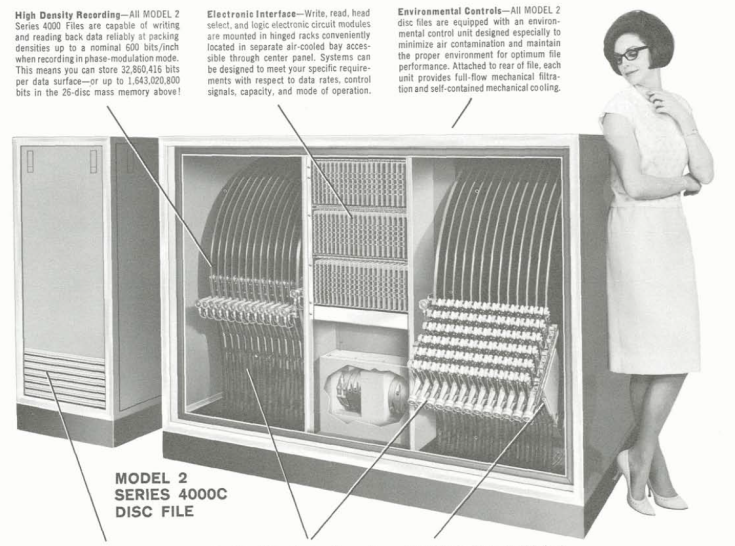
Everyone knows RAMAC, which apparently had 24 inch platters. Platters generally shrank over the years, as everything else being equal smaller platters can be spun faster, so I believe later mainstream IBM systems were smaller. But third parties offered higher performance, higher capacity drives. The best candidate appears to be the Bryant Model 2 Disk File from the early 1960s. That had 39 inch platters. The image below is from a brochure online at CHM:https://archive.computerhistory.org/resources/text/Bryant/Bryant.Model2.19 65.102646212.pdf.
[IMAGE]
According to Wikipedia, “Also in 1961, Bryant Computer Products introduced its 4000 series disk drives. These massive units stood 52 inches (1.3 m) tall, 70 inches (1.8 m) long, and 70 inches (1.8 m) wide, and had up to 26 platters, each 39 inches (0.99 m) in diameter, rotating at up to 1,200 rpm.” This Computer History Museum page seems to be hedging bets by calling the Bryant units “among the physically largest drives everbuilt”: https://www.computerhistory.org/storageengine/hdd-competitors-ente r-the-market/
I’m fairly sure that the Bryant platters were the largest in a standard commercial product. Can anyone prove differently? Or know of a special-purpose system with even larger platters?
BONUS – HEAVIEST TAPE REEL: I am pretty sure that the IBM SSEC had the heaviest tape reel, at 400 pounds, which was a roll of the paper stock cards were cut from. I believe this was run in an endless loop to used as a high speed lookup table. It had to be lifted with a special mechanism. But if anyone knows of a bulkier tape, let me know. The SSEC tape is documented at http://www.columbia.edu/cu/computinghistory/ssec-tape.html. That includes this description from Herb Grosch:
"About those tapes: the card plant in Endicott got enormous rolls of card stock from the paper mills. For regular card manufacturing they slit the rolls to three-inch width (card height). For the SSEC they furnished rolls eight inches wide (card length). The resulting rolls weighed 400 pounds, and had to be hoisted onto the SSEC with a thoughtfully-provided chain fall! For the Stallion, we pushed the rolls up a ramp.
"The punch stations, slightly modified from standard IBM reproducer components, punched two round sprocket holes at the edges, and 78(!) regular IBM rectangular holes in between. The sprockets drove the tape one line at a time, and drives under separate program control fed the fresh or pre-punched tape under ten 78-brush reading stations. The tapes hanging down could lengthen and shorten, and for program tapes and the table lookup unit we cemented the tape end-to-end into short loops (yes, someone had had to provide the jig). There were three of these monsters at the end of the machine room. Up to 36 of the fixed-length tape loops could be mounted on the separate table-lookup unit, which in later years was also sometimes used for program reading. For the lunar calculation, I used 24 loops to make lookup time as short as possible, and we got programming from the main tape readers."
BONUS – LARGEST PORTABLE COMPUTER
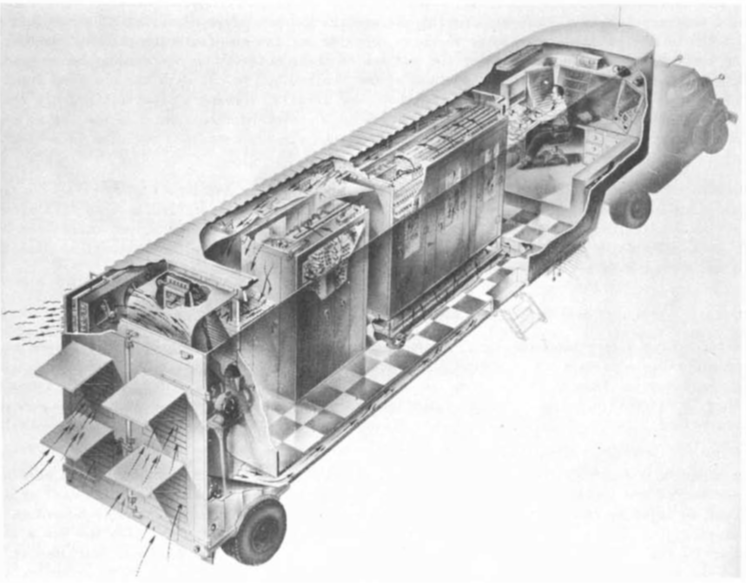
That appears to be DYSEAC, which makes sense as AFAIK it was the only portable full-scale vacuum tube computer. It apparently weighed 20 tons and took two 40 foot trailers to move. (Weight includes the trailers, but not the tractors to pull them). I asked Evan Koblentz, who wrote a book about portable computers, and he couldn’t think of a heavier/larger one. This makes even the Osbourne and IBM PC Portable look extremely light. Read about the DYSEAC here: http://ed-thelen.org/comp-hist/SEAC&DYSEAC-3-150.pdf, including this image:
[IMAGE]
It would be fun if official recognition of these records prompted some enterprising teams to attempt to beat them.
Best wishes,
Tom

See http://ibm-1401.info/CrownPaperIBM/B09V01S0201.pdf if you want to know the weight of IBM cards and http://ibm-1401.info/CardStockSpecifications.html for links to further data on the cards.
-----Original Message----- From: Members [mailto:members-bounces@lists.sigcis.org] On Behalf Of Allan Olley Sent: Monday, September 21, 2020 2:13 PM To: thomas.haigh@gmail.com Cc: [SIGCIS] Subject: Re: [SIGCIS-Members] Candidate World Records -- Biggest Hard Drive, Tape and Portable Computer
Hello,
So just to attempt to clarify how big the SSEC tape drive was. I've discussed this with Tom and admitted much confusion looked about started to see answers and then never nailed anything down, so let me just do this now.
Anyway I am very sure the actual reels of paper tape used on the SSEC were much smaller than the 400 pounds of tape stock delivered fromt the factory. A 400 pound paper tape would have stored I am guessing about 25 times as many numbers on the tape then the contemporary accounts refer to as stored by the machine in total. The standard size of the tapes was probably more like 15 pounds of paper for all tapes on the machine and so slightly less than 5 pounds for each large tape on the main readers. They were certainly still very bulky and just looking at pictures of them I would guess they weighed somehting like 20 pounds, so I am still confused. Anyway my logic and evidence for these statements goes as follows (much unnecessary detail follows):
So each number on the tape was coded in a row (78 potential punches) in binary-coded decimal (4 bits to the digit) 19 digits plus sign (so some descriptions of the SSEC describe it as using numbers of 19 digits, others as 20).
For comparison a standard IBM punch card was 80 columns, 10 rows of digits 0-9 and two invisible rows (A, B or X, Y).
Contemporary accounts (Wallace Eckert, "Electrons and Computation" in The Scientific Monthly, Vol 67, No 5 (Nov) 1948 pp. 315-323) say the three main tape drives of the SSEC store in total 20 000 numbers or 6 666 numbers on each tape drive. 12 numbers are 12 rows and so constitue ~1 punch card, so each main tape drive has the equivalent paper of ~556 punch cards or ~1666 cards worth of paper in total. An IBM carrynig case for 2000 cards apparently weighed 6.6 kg (14.52 lbs) according to this webpage https://nuhc.ncl.ac.uk/moca/iomedia/pc.htm and that sounds about right for the weight of 2 000 cards but I wish I had a more definite benchmark to use for the rest of my arithmetic then this one number pulled from a random webpage. Anyway, give that I don't think the tape on all three tape drives weighed more than 15 pounds, the tape on each one would have weighed a little less than 5 pounds.
As mentioned there are 36 tape readers that are associated with 5 000 more stored numbers on tape. So each loop contained about 139 numbers (I've found archival sources that suggest they sometimes used loops of over 500 numbers in these configurations but I guess that was non-standard?) tha is again rows of tape, so was equivalent to a little more than 10 punched cards. So all 36 loops add less than the equivalent of 417 cards, so less than another 5 pounds, to the weight of the tapes on the SSEC.
So the 25 000 numbers stored (as standard) on all the SSEC's paper tape is just a tad more (1/24th more) paper than 2 000 punched cards in the carrying case I am using as my weight unit (which would store 24 000 numbers by that method). Suggesting the paper tape of the machine amounted to about 7 kg of paper or about 15 pounds in total. I am not sure you really needed a chain hoist for that, but depending on what you are doing with the original 400 poounds of raw paper tape received from the factory to prepare it for use, the chain hoist could have been useful.
On some subsidiary issues:
If you want to see what the short loops of paper tape looked like there is footage of the SSEC available on the Comptuer History Museum's website Youtube channel (see 49:50 of https://youtu.be/qundvme1Tik note this portion of the video is a lecture given by Herb Grosch). You can see a good image of the main paper tape drives at the back of the SSEC in a famous of image of the SSEC where the pesky support beams for the room it is in have been removed that shows up around 50:25 into the video. They are pretty big I don't think big enough to way 400 pounds (or even 133 pounds each) but big enough that I think they would weigh more than 5 pounds (they look like more than 500 punched cards worth of paper), I would guess 15 or 20 pounds (so each tape is more than 2000 cards worth of paper).
I am pretty sure the reels on the main tape readers are glued together at the end into a continous loop because John Backus describes an incident where the SSEC started to act strangely and they realized they had glued the ends of the tape together the wrong way around creating a giant mobius strip of tape (and so reversing the numeric encoding of instructions and data at various points). I can't imagine you would not notice if the short loops of tape were a mobius strip basically as you hung them up, so it must of have been one of the three master tapes and so they must operate as continuous loops at least some of the time.
(Backus's memory of this comes from page 126 of The History of Computing in the Twentieth Century, ed. Nicholas Metropolis, J. Howlett and Gian-Carlo Rota, 1980 Academic Press, https://books.google.ca/books?id=AsvSBQAAQBAJ&lpg=PA126&ots=Xgj6NX9t4 _&dq=Mobius%20loop%20SSEC%20tape%20Backus&pg=PA126#v=onepage&q =Mobius%20loop%20SSEC%20tape%20Backus&f=false but I also have run across descriptions of this process, but not the Mobius strip incident, in unpublished material)
-- Yours Truly, Allan Olley, PhD
http://individual.utoronto.ca/fofound/
On Sun, 20 Sep 2020, thomas.haigh@gmail.com wrote:
Hello SIGCIS,
I have agreed to a fun little consulting job of helping the Guinness World Records people update and improve their computer-related records. Although the Encyclopedia Britannica and other traditional authorities have fallen by the wayside, the records book is still going strong and is perhaps the last published authority standing. Also, somebody once tried to prove me wrong by invoking it. So now I can make sure that doesn't happen again.
I'll be dribbling out a couple of additional requests over the next week or so, not to overwhelm the list. I have some fun candidate records, but would like to see if they hold up among this expert body. BTW, If you have an idea for a good record feel free to pitch it to me, but to avoid overwhelming the list better to send it directly. We are trying to avoid firsts, which have traditionally accounted for the majority of the computer-related records.
BIGGEST HARD DISK: First up, the biggest hard disk. Not the largest capacity, the BIGGEST. I figure records like that will illustrate better than finding some boring box with a high capacity, and are less likely to be out of date by the time the book is published. Plus where do you draw the line between a drive and an array?
Everyone knows RAMAC, which apparently had 24 inch platters. Platters generally shrank over the years, as everything else being equal smaller platters can be spun faster, so I believe later mainstream IBM systems were smaller. But third parties offered higher performance, higher capacity drives. The best candidate appears to be the Bryant Model 2 Disk File from the early 1960s. That had 39 inch platters. The image below is from a brochure online at CHM:https://archive.computerhistory.org/resources/text/Bryant/Bryant.M odel2.19 65.102646212.pdf.
[IMAGE]
According to Wikipedia, "Also in 1961, Bryant Computer Products introduced its 4000 series disk drives. These massive units stood 52 inches (1.3 m) tall, 70 inches (1.8 m) long, and 70 inches (1.8 m) wide, and had up to 26 platters, each 39 inches (0.99 m) in diameter, rotating at up to 1,200 rpm." This Computer History Museum page seems to be hedging bets by calling the Bryant units "among the physically largest drives everbuilt": https://www.computerhistory.org/storageengine/hdd-competitors-ente r-the-market/
I'm fairly sure that the Bryant platters were the largest in a standard commercial product. Can anyone prove differently? Or know of a special-purpose system with even larger platters?
BONUS - HEAVIEST TAPE REEL: I am pretty sure that the IBM SSEC had the heaviest tape reel, at 400 pounds, which was a roll of the paper stock cards were cut from. I believe this was run in an endless loop to used as a high speed lookup table. It had to be lifted with a special mechanism. But if anyone knows of a bulkier tape, let me know. The SSEC tape is documented at http://www.columbia.edu/cu/computinghistory/ssec-tape.html. That
includes this description from Herb Grosch:
"About those tapes: the card plant in Endicott got enormous rolls of card stock from the paper mills. For regular card manufacturing they slit the rolls to three-inch width (card height). For the SSEC they furnished rolls eight inches wide (card length). The resulting rolls weighed 400 pounds, and had to be hoisted onto the SSEC with a thoughtfully-provided chain fall! For the Stallion, we pushed the rolls up a
ramp.
"The punch stations, slightly modified from standard IBM reproducer components, punched two round sprocket holes at the edges, and 78(!) regular IBM rectangular holes in between. The sprockets drove the tape one line at a time, and drives under separate program control fed the fresh or pre-punched tape under ten 78-brush reading stations. The tapes hanging down could lengthen and shorten, and for program tapes and the table lookup unit we cemented the tape end-to-end into short loops (yes, someone had had to provide the jig). There were three of these monsters at the end of the machine room. Up to 36 of the fixed-length tape loops could be mounted on the separate table-lookup unit, which in later years was also sometimes used for program reading. For the lunar calculation, I used 24 loops to make lookup time as short as possible, and we got programming from the main tape
readers."
BONUS - LARGEST PORTABLE COMPUTER
That appears to be DYSEAC, which makes sense as AFAIK it was the only portable full-scale vacuum tube computer. It apparently weighed 20 tons and took two 40 foot trailers to move. (Weight includes the trailers, but not the tractors to pull them). I asked Evan Koblentz, who wrote a book about portable computers, and he couldn't think of a heavier/larger one. This makes even the Osbourne and IBM PC Portable look extremely light. Read about the DYSEAC here: http://ed-thelen.org/comp-hist/SEAC&DYSEAC-3-150.pdf, including this
image:
[IMAGE]
It would be fun if official recognition of these records prompted some enterprising teams to attempt to beat them.
Best wishes,
Tom
participants (3)
-
 Allan Olley
 -
 Ken Strauss
 -
 thomas.haigh@gmail.com