Announcement: New Book and Book Launch

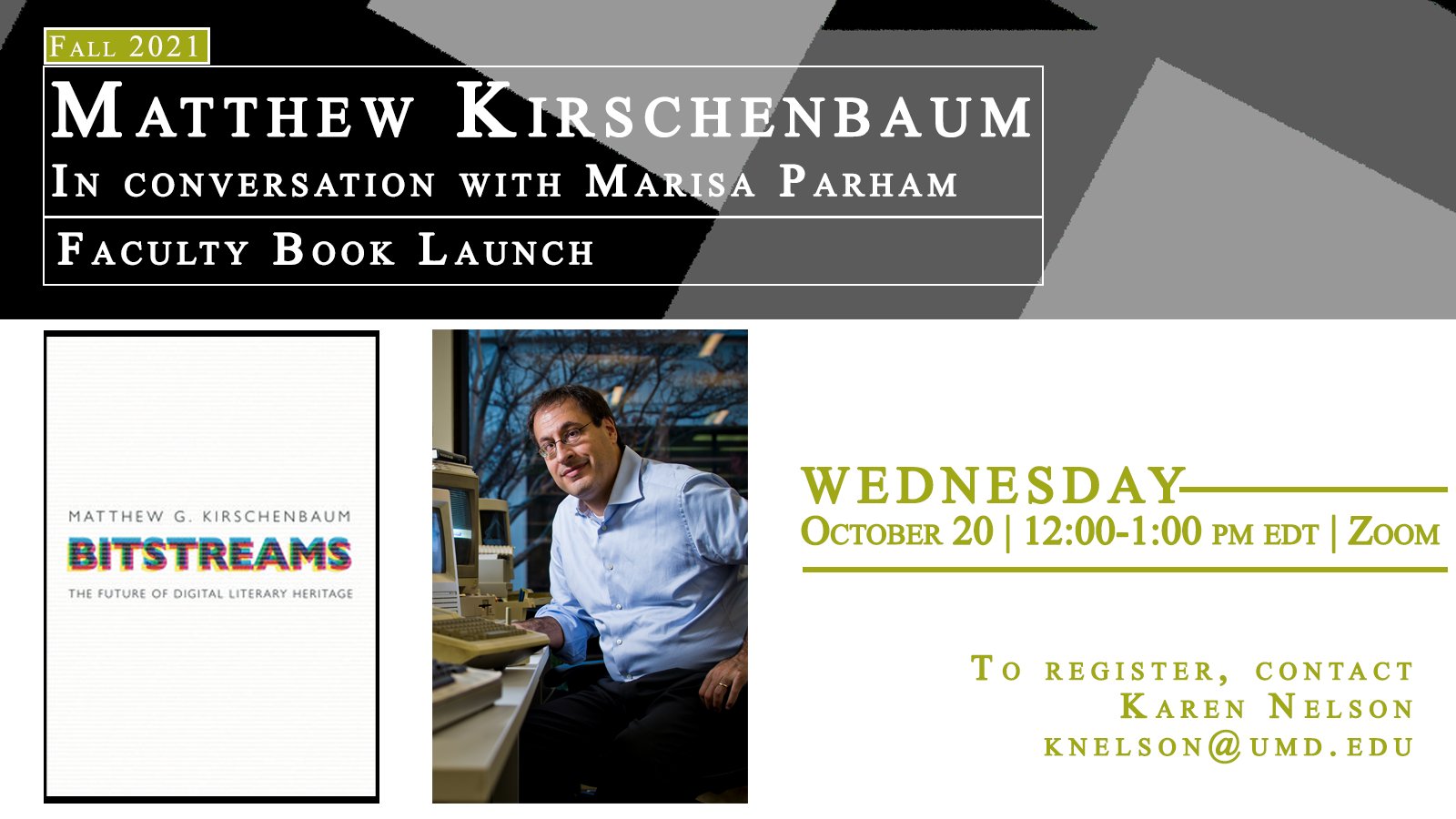
Dear SIGCIS, I am happy to announce the release of my book *Bitstreams: The Future of Digital Literary Digital Heritage* <https://www.upenn.edu/pennpress/book/16248.html> from the University of Pennsylvania Press.The ad copy is below, and attached you’ll also find a flyer with a 20% off discount code— the book is simultaneous paperback, so with the discount it is $20 US + shipping. While there is little in this one that breaks new ground in terms of Actual Computer History (tm), I hope the book does succeed in showing the extent to which fields like literary studies and media studies increasingly *depend* on computer history. Chapter 2, in particular, juxtaposes the careers of two poets (William Dickey and Kamau Brathwaite) with the rise of desktop publishing in the 1980s. The English Department at Maryland is hosting a virtual book launch on *Wed., Oct 20 at 12 noon EDT* (see banner below). I will be in conversation about the book with my colleague, *Dr. Marisa Parham*. Registration for the event (free) is here: https://t.co/X8fInonF6N?amp=1 All are welcome! Thank you-- Best, Matt *Bitstreams: The Future of Digital Literary HeritageMatthew G. Kirschenbaum* 160 pages | 6 x 9 | 12 halftones Cloth Oct 2021 | ISBN 9780812253412 | $65.00s | Outside the Americas £52.00 Paper Oct 2021 | ISBN 9780812224955 | $24.95s | Outside the Americas £18.99 Ebook editions are available from selected online vendors A volume in the series Material Texts Table of Contents Preface. Actual Facts Introduction. The Bitstream Chapter 1. Archives Without Dust Chapter 2. The Poetics of Macintosh Chapter 3. The Story of S. Coda. The Postulate of Normality in Exceptional Times Notes Acknowledgments Index * "Matthew Kirschenbaum has almost single-handedly taught us how to read digital objects as material texts. Now, in this field-defining achievement, he shows us the future of bibliography. Like the works of D. F. McKenzie before it, Bitstreams will be required reading for generations to come."*—Whitney Trettien, University of Pennsylvania What are the future prospects for literary knowledge now that literary texts—and the material remains of authorship, publishing, and reading—are reduced to bitstreams, strings of digital ones and zeros? What are the opportunities and obligations for book history, textual criticism, and bibliography when literary texts are distributed across digital platforms, devices, formats, and networks? Indeed, what is textual scholarship when the "text" of our everyday speech is a verb as often as it is a noun? These are the questions that motivate Matthew G. Kirschenbaum in *Bitstreams*, a distillation of twenty years of thinking about the intersection of digital media, textual studies, and literary archives. With an intimate narrative style that belies the cold technics of computing, Kirschenbaum takes the reader into the library where all access to Toni Morrison's "papers" is mediated by digital technology; to the bitmapped fonts of Kamau Brathwaite's Macintosh; to the process of recovering and restoring fourteen lost "HyperPoems" by the noted poet William Dickey; and finally, into the offices of Melcher Media, a small boutique design studio reimagining the future of the codex. A persistent theme is that bits—the ubiquitous ones and zeros of computing—are never self-identical, but always inflected by the material realities of particular systems, platforms, and protocols. These materialities are not liabilities: they are the very bulwark on which we stake the enterprise for preserving the future of literary heritage. Matthew G. Kirschenbaum is author of Mechanisms: New Media and the Forensic Imagination and Track Changes: A Literary History of Word Processing. He is Professor of English and Digital Studies at the University of Maryland, College Park. [image: FA3YeARWYAUk4HQ.jpg] -- Matthew Kirschenbaum Professor of English and Digital Studies Director, Graduate Certificate in Digital Studies Printer's Devil, BookLab University of Maryland mgk@umd.edu

I need help finding a home for a Cogent XTM that is eating up my storage money. It was donated to LO*OP Center a couple of years ago by Ronald Tennison, an emeritus professor from Linfield College, and it currently sits in a unit near Portland, OR. I've never seen it, don't know its condition or whether there is any documentation. We saved it from the dumpster once and would not like to see that be its final fate. I've already offered it to the Computer History Museum but they have not pursued the opportunity. Hopefully one of the smaller collecting institutions would be delighted to have it. If you have any information about, interested in, or proximity to this early parallel processing, desktop, supercomputer, please contact me. Many thanks, Liza -- Liza Loop Executive Director, LO*OP Center, Inc. Guerneville, CA 95446 www.loopcenter.org Vision Keeper and Founder, History of Computing in Learning and Education www.hcle.org 650 619 1099 (between 8 am and 10 pm Pacific time only please, text ok)
participants (2)
-
 LO*OP CENTER, INC.
 -
 Matthew Kirschenbaum