job opening for Museum director

I have visited this museum many times and have a high regard for it. I can give details (off line) if anyone is interested in the job. Paul Ceruzzi Curator Emeritus, Department of Space History National Air and Space Museum Smithsonian Institution Washington, DC 20013-7012 202-633-2414 __________________________________ Opportunity in Bozeman, Montana The American Computer & Robotics Museum (ACRM) in Bozeman, Montana is seeking an Executive Director. The ACRM is a unique and important institution with one of the finest collections ever amassed on the history of technology and is the oldest continuously operating museum of its kind. Its mission is to collect, preserve, interpret, and display the artifacts and history of the information age. The museum has received glowing reviews from luminaries like E.O. Wilson of Harvard ("Inch for inch the best museum in the world"), been voted one of the 10 Best Free Museums in the US by USA Today, and is the #1 thing to do in Bozeman according to TripAdvisor. Locally, the Museum has become an important resource for school visits and the involvement of Montana State University students. The ACRM is located in beautiful Bozeman, Montana. Located 90 minutes from Yellowstone National Park, Bozeman frequently secures top ranking as one of the best places to live in the nation due to its proximity to year round outdoor recreational opportunities, vibrant culture, thriving economy as a high tech hub, and the home to Montana State University which is highly renowned for its engineering and research focus The ACRM is now about to undertake a major campaign to evolve into a significantly larger and more established institution. The new Executive Director, in conjunction with a newly expanded Board of Directors, will be central to developing a Strategic Plan, growing the staff and scale of the institution, major fundraising, and overall operations. The ACRM is currently a fairly small organization with a minimal staff. The Board feels that this is the time to grow the museum into its next form which will include a new location and facility, increased staffing and programming, and an endowment to aid in sustainable operations. The Executive Director will have a broad range of responsibilities and authorities to help the ACRM realize its goals. Some of the key functions are: * Oversees all aspects of Museum operations including administration, budget, and staff. * Oversees exhibition planning and delivery * Oversees handling, conservation, insurance, and loans of collections * Ensures the Museum has proper security and facility maintenance * Leads outreach and public programs including educational programs with local schools * Oversees advertising and social media programs * Oversees the transition to, and future maintenance of, an updated collections management system * Leads the overhaul of the Museum digital and web presence, including the provision of open access catalogues and high-resolution images of the Museum collections * Engages with local stakeholders to ensure the Museum is meeting local needs * Coordinates with Montana State University on all joint interests * Leads the Strategic Planning effort to push the ACRM into the next level of operational effectiveness and social impact * Grows the staff from a few volunteers to a small professional team * Leads fundraising activities for annual operations and capital projects * Ensures proper communication with the Board of Directors and coordinates policy decisions for the Board Required Qualifications: * Experience or demonstrated interest in the history of technology * Minimum three (3) years of experience in Museum management * Administrative experience with non-profit organizations * Experience growing an institution or staff * Excellent communication skills * Self-starter: able to conceive of tasks and see them through with little to no guidance * Supervisory experience of three (3) or more employees Desired Qualifications: * Fundraising experience for capital and operational support * Previous experience in a technical or scientific museum * Connections to the Museum field, tech industries, and corporate sponsors Salary Range: $55,000 - $80,000 For current information on the ACRM, see www.compustory.com<http://www.compustory.com> For updates to the position, see www.acrmuseum.org/employment<file:///F:/Documents/ACRM/www.acrmuseum.org/employment> To Apply: Send Letter of Interest, Resume/C.V., and the names of three (3) References with contact information to: ACRM.jobs@gmail.com<mailto:ACRM.jobs@gmail.com>. Note, references will not be contacted without prior applicant notification. Deadline: March 22, 2019

How did the Romans calculate? https://cacm.acm.org/blogs/blog-cacm/234881-how-did-the-romans-calculate/ful... Hi all: Does anyone know how the Romans calculated with the Roman numeral system? What is the meaning of the right-most slot of the Roman hand abacus? Do you have Roman hand abaci (original devices or replicas) in your collection? Thank you very much for your help. Best wishes, Herbert Bruderer

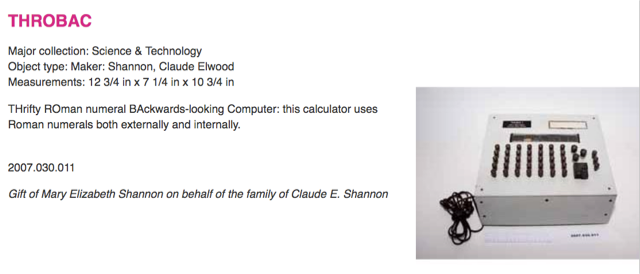
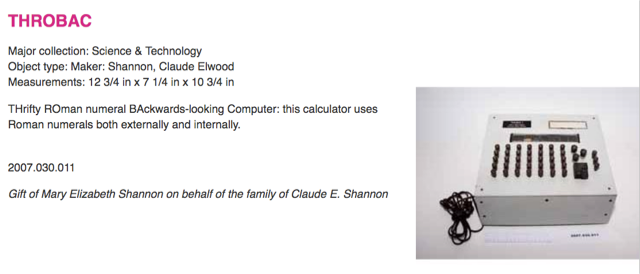
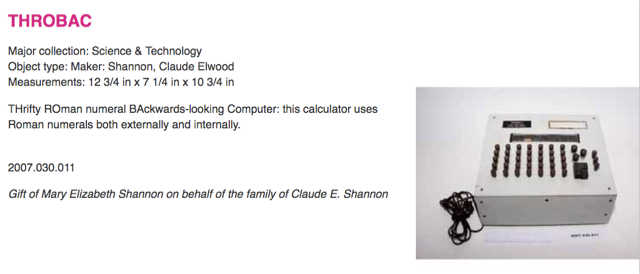
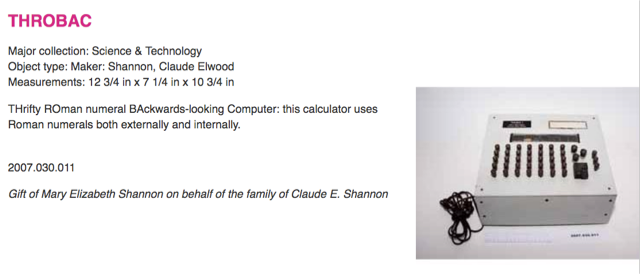
Herbert, I don’t know about the Romans but the late Claude Shannon decided to create a Roman numeral calculator (part of our collections - see https://webmuseum.mit.edu/detail.php?term=Throbac&module=objects&type=keyword&x=0&y=0&kv=75603&record=0&module=objects) he called THRoBAC for Thrifty Roman numeral BAckwards-looking Computer. Debbie Douglas On Feb 20, 2019, at 3:36 PM, herbert.bruderer@bluewin.ch<mailto:herbert.bruderer@bluewin.ch> wrote: How did the Romans calculate? https://cacm.acm.org/blogs/blog-cacm/234881-how-did-the-romans-calculate/ful... Hi all: Does anyone know how the Romans calculated with the Roman numeral system? What is the meaning of the right-most slot of the Roman hand abacus? Do you have Roman hand abaci (original devices or replicas) in your collection? Thank you very much for your help. Best wishes, Herbert Bruderer _______________________________________________ This email is relayed from members at sigcis.org<http://sigcis.org>, the email discussion list of SHOT SIGCIS. Opinions expressed here are those of the member posting and are not reviewed, edited, or endorsed by SIGCIS. The list archives are at http://lists.sigcis.org/pipermail/members-sigcis.org/ and you can change your subscription options at http://lists.sigcis.org/listinfo.cgi/members-sigcis.org Deborah G. Douglas, PhD • Director of Collections and Curator of Science and Technology, MIT Museum; Research Associate, Program in Science, Technology, and Society • Room N51-209 • 265 Massachusetts Avenue • Cambridge, MA 02139-4307 • ddouglas@mit.edu<mailto:ddouglas@mit.edu> • 617-253-1766 telephone • 617-253-8994 facsimile • http://mitmuseum.mit.edu • http://museum.mit.edu/150

Obviously, they used the Throbac;-) https://webmuseum.mit.edu/detail.php?term=shannon&module=objects&type=keyword&x=8&y=4&kv=75603&record=15&page=1 <https://webmuseum.mit.edu/detail.php?term=shannon&module=objects&type=keyword&x=8&y=4&kv=75603&record=15&page=1>
On Feb 20, 2019, at 12:36, herbert.bruderer@bluewin.ch wrote:
How did the Romans calculate?
https://cacm.acm.org/blogs/blog-cacm/234881-how-did-the-romans-calculate/ful... <https://cacm.acm.org/blogs/blog-cacm/234881-how-did-the-romans-calculate/fulltext>
Hi all:
Does anyone know how the Romans calculated with the Roman numeral system?
What is the meaning of the right-most slot of the Roman hand abacus?
Do you have Roman hand abaci (original devices or replicas) in your collection?
Thank you very much for your help.
Best wishes,
Herbert Bruderer
_______________________________________________ This email is relayed from members at sigcis.org, the email discussion list of SHOT SIGCIS. Opinions expressed here are those of the member posting and are not reviewed, edited, or endorsed by SIGCIS. The list archives are at http://lists.sigcis.org/pipermail/members-sigcis.org/ and you can change your subscription options at http://lists.sigcis.org/listinfo.cgi/members-sigcis.org

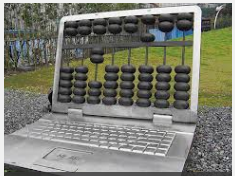
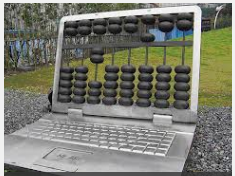
Well, if we going retro, I theorize it is the following that they used since new thinking in Roman historiography suggests the Romans had contact with Asian markets. Jim [image: Screen Shot 2013-08-04 at 10.40.00 AM.png] On Wed, Feb 20, 2019 at 3:07 PM Marc Weber <marcweber@att.net> wrote:
Obviously, they used the Throbac;-)
On Feb 20, 2019, at 12:36, herbert.bruderer@bluewin.ch wrote:
*How did the Romans calculate?*
https://cacm.acm.org/blogs/blog-cacm/234881-how-did-the-romans-calculate/ful...
Hi all:
Does anyone know how the Romans calculated with the Roman numeral system?
What is the meaning of the right-most slot of the Roman hand abacus?
Do you have Roman hand abaci (original devices or replicas) in your collection?
Thank you very much for your help.
Best wishes,
Herbert Bruderer _______________________________________________ This email is relayed from members at sigcis.org, the email discussion list of SHOT SIGCIS. Opinions expressed here are those of the member posting and are not reviewed, edited, or endorsed by SIGCIS. The list archives are at http://lists.sigcis.org/pipermail/members-sigcis.org/ and you can change your subscription options at http://lists.sigcis.org/listinfo.cgi/members-sigcis.org
_______________________________________________ This email is relayed from members at sigcis.org, the email discussion list of SHOT SIGCIS. Opinions expressed here are those of the member posting and are not reviewed, edited, or endorsed by SIGCIS. The list archives are at http://lists.sigcis.org/pipermail/members-sigcis.org/ and you can change your subscription options at http://lists.sigcis.org/listinfo.cgi/members-sigcis.org
-- James W. Cortada Senior Research Fellow Charles Babbage Institute University of Minnesota jcortada@umn.edu 608-274-6382
Thanks. Possibly the Chinese took over the Roman abacus. There were indeed trade relations (e.g. Asia minor: Antikythera mechanism; silk road). ----Ursprüngliche Nachricht---- Von : jcortada@umn.edu Datum : 20/02/2019 - 22:11 (MZ) An : marcweber@att.net Cc : herbert.bruderer@bluewin.ch, members@sigcis.org, members@lists.sigcis.org Betreff : Re: [SIGCIS-Members] History of Rome. How did they calculate? Well, if we going retro, I theorize it is the following that they used since new thinking in Roman historiography suggests the Romans had contact with Asian markets. Jim On Wed, Feb 20, 2019 at 3:07 PM Marc Weber < marcweber@att.net> wrote: Obviously, they used the Throbac;-) https://webmuseum.mit.edu/detail.php?term=shannon&module=objects&type=keyword&x=8&y=4&kv=75603&record=15&page=1 On Feb 20, 2019, at 12:36, herbert.bruderer@bluewin.ch wrote: How did the Romans calculate? https://cacm.acm.org/blogs/blog-cacm/234881-how-did-the-romans-calculate/ful... Hi all: Does anyone know how the Romans calculated with the Roman numeral system? What is the meaning of the right-most slot of the Roman hand abacus? Do you have Roman hand abaci (original devices or replicas) in your collection? Thank you very much for your help. Best wishes, Herbert Bruderer_______________________________________________ This email is relayed from members at sigcis.org, the email discussion list of SHOT SIGCIS. Opinions expressed here are those of the member posting and are not reviewed, edited, or endorsed by SIGCIS. The list archives are at http://lists.sigcis.org/pipermail/members-sigcis.org/ and you can change your subscription options at http://lists.sigcis.org/listinfo.cgi/members-sigcis.org _______________________________________________ This email is relayed from members at sigcis.org, the email discussion list of SHOT SIGCIS. Opinions expressed here are those of the member posting and are not reviewed, edited, or endorsed by SIGCIS. The list archives are at http://lists.sigcis.org/pipermail/members-sigcis.org/ and you can change your subscription options at http://lists.sigcis.org/listinfo.cgi/members-sigcis.org -- James W. Cortada Senior Research Fellow Charles Babbage Institute University of Minnesota jcortada@umn.edu 608-274-6382

Obviously, they used the Throbac;-) https://webmuseum.mit.edu/detail.php?term=shannon&module=objects&type=keyword&x=8&y=4&kv=75603&record=15&page=1 <https://webmuseum.mit.edu/detail.php?term=shannon&module=objects&type=keyword&x=8&y=4&kv=75603&record=15&page=1>
On Feb 20, 2019, at 12:36, herbert.bruderer@bluewin.ch <mailto:herbert.bruderer@bluewin.ch> wrote:
How did the Romans calculate?
https://cacm.acm.org/blogs/blog-cacm/234881-how-did-the-romans-calculate/ful... <https://cacm.acm.org/blogs/blog-cacm/234881-how-did-the-romans-calculate/fulltext>
Hi all:
Does anyone know how the Romans calculated with the Roman numeral system?
What is the meaning of the right-most slot of the Roman hand abacus?
Do you have Roman hand abaci (original devices or replicas) in your collection?
Thank you very much for your help.
Best wishes,
Herbert Bruderer
_______________________________________________ This email is relayed from members at sigcis.org <http://sigcis.org/>, the email discussion list of SHOT SIGCIS. Opinions expressed here are those of the member posting and are not reviewed, edited, or endorsed by SIGCIS. The list archives are at http://lists.sigcis.org/pipermail/members-sigcis.org/ <http://lists.sigcis.org/pipermail/members-sigcis.org/> and you can change your subscription options at http://lists.sigcis.org/listinfo.cgi/members-sigcis.org <http://lists.sigcis.org/listinfo.cgi/members-sigcis.org>
Marc Weber <http://www.computerhistory.org/staff/Marc,Weber/> | marc@webhistory.org | +1 415 282 6868 Internet History Program Curatorial Director, Computer History Museum 1401 N Shoreline Blvd., Mountain View CA 94043 computerhistory.org/nethistory <http://computerhistory.org/nethistory> Co-founder, Web History Center and Project, webhistory.org

The THROBAC and Jim’s MacAbacus are great - but more seriously, there is a useful discussion on the origins of the abacus in Williams, M. R. 1985. A History of Computing Technology. Englewood Cliffs: Prentice-Hall, Inc. - pp 53-66. Williams focuses mainly on the table abacus used by the Greeks and Romans - not the hand abacus discussed in this intriguing blog post, which I did not know about. On p 56, Williams reproduces a drawing of the Greek abacus in use, copied from an ancient vase. Williams is referring to the obvious table abacus in the drawing — but the man in that same drawing is holding something in one hand that might conceivably be a hand abacus like the one Herbert identifies. No further information is given. Herbert, please let us know what you find out! Best, Paul On Feb 20, 2019, at 12:36, herbert.bruderer@bluewin.ch<mailto:herbert.bruderer@bluewin.ch> wrote: How did the Romans calculate? https://cacm.acm.org/blogs/blog-cacm/234881-how-did-the-romans-calculate/ful... Hi all: Does anyone know how the Romans calculated with the Roman numeral system? What is the meaning of the right-most slot of the Roman hand abacus? Do you have Roman hand abaci (original devices or replicas) in your collection? Thank you very much for your help. Best wishes, Herbert Bruderer _______________________________________________ This email is relayed from members at sigcis.org<http://sigcis.org>, the email discussion list of SHOT SIGCIS. Opinions expressed here are those of the member posting and are not reviewed, edited, or endorsed by SIGCIS. The list archives are at http://lists.sigcis.org/pipermail/members-sigcis.org/ and you can change your subscription options at http://lists.sigcis.org/listinfo.cgi/members-sigcis.org ___________________________ Paul N. Edwards William J. Perry Fellow in International Security Center for International Security and Cooperation<http://cisac.fsi.stanford.edu/> Stanford University Professor of Information<http://www.si.umich.edu/> and History<http://www.lsa.umich.edu/history/> (Emeritus) University of Michigan Contact: m: pedwards@stanford.edu<mailto:pedwards@stanford.edu> w: pne.people.si.umich.edu<http://pne.people.si.umich.edu> t: @AVastMachine
Paul, Thanks! I have read Williams's book some time ago and I will have a look at it again. Perhaps the world's best specialist on Greek and Roman table abaci is Alain Schärlig (University of Lausanne, retired). He has written several books on the subject (two are mentioned in my blog post). In my book "Milestones in Analog and Digital Computing" (English translation in preparation) you find a (mostly) comprehensive list of medieval (and later) table abaci with beautiful pictures. Most of them are preserved in Switzerland, some in Germany, France and other countries. There are also step-by-step instructions for their usage. The book includes a list of museums with information where which artifact has survived (e.g. Darius vase, Salamis tablet, original Roman abaci in Italy and France, etc.). Best, Herbert Meilensteine der Rechentechnik, Band 1 https://www.degruyter.com/view/product/480555 Meilensteine der Rechentechnik, Band 2 https://www.degruyter.com/view/product/503373 Amazon https://tinyurl.com/y9upwagp -- Bruderer Informatik Seehaldenstraße 26 Postfach 47 CH-9401 Rorschach Schweiz/Switzerland Telefon +41 71 855 77 11 ----Ursprüngliche Nachricht---- Von : pedwards@stanford.edu Datum : 20/02/2019 - 23:00 (MZ) An : herbert.bruderer@bluewin.ch Cc : members@sigcis.org, members@lists.sigcis.org Betreff : Re: [SIGCIS-Members] History of Rome. How did they calculate? The THROBAC and Jim’s MacAbacus are great - but more seriously, there is a useful discussion on the origins of the abacus in Williams, M. R. 1985. A History of Computing Technology. Englewood Cliffs: Prentice-Hall, Inc. - pp 53-66. Williams focuses mainly on the table abacus used by the Greeks and Romans - not the hand abacus discussed in this intriguing blog post, which I did not know about. On p 56, Williams reproduces a drawing of the Greek abacus in use, copied from an ancient vase. Williams is referring to the obvious table abacus in the drawing — but the man in that same drawing is holding something in one hand that might conceivably be a hand abacus like the one Herbert identifies. No further information is given. Herbert, please let us know what you find out! Best, Paul On Feb 20, 2019, at 12:36, herbert.bruderer@bluewin.ch wrote: How did the Romans calculate? https://cacm.acm.org/blogs/blog-cacm/234881-how-did-the-romans-calculate/ful... Hi all: Does anyone know how the Romans calculated with the Roman numeral system? What is the meaning of the right-most slot of the Roman hand abacus? Do you have Roman hand abaci (original devices or replicas) in your collection? Thank you very much for your help. Best wishes, Herbert Bruderer _______________________________________________ This email is relayed from members at sigcis.org, the email discussion list of SHOT SIGCIS. Opinions expressed here are those of the member posting and are not reviewed, edited, or endorsed by SIGCIS. The list archives are at http://lists.sigcis.org/pipermail/members-sigcis.org/ and you can change your subscription options at http://lists.sigcis.org/listinfo.cgi/members-sigcis.org ___________________________ Paul N. Edwards William J. Perry Fellow in International Security Center for International Security and Cooperation Stanford University Professor of Information and History (Emeritus) University of Michigan Contact: m: pedwards@stanford.edu w: pne.people.si.umich.edu t: @AVastMachine

Dear Herbert It is at least 10 years since I looked at this topic n detail and I am writing this from memory without going back to original sources although I hope I can still find them amongst y papers if needed. You ask about the righthand most column on an abacus. My recollection is that Romans did not use the concept of fractions as we do today where we teach schoolchildren to add 5/8 to 7/12 etc. The Romans understood subdivisions of a unit such as a coin or of a unit of area. Until 1971 in the UK we had sterling based on pounds shillings and pence, denoted (following Roman practice) by the letters L (£), s and d. The penny was divided into 4 farthings (1/4 of a penny). I remember as a boy that 4 farthings made a penny, 12 pennies made a shilling and 20 shillings made a pound. The different currency units were essentially treated arithmetically as just having different bases. 12 pennies was one shilling etc. They were not treated as fractions. In particular adding half a shilling and three-quarters of a penny would have made no sense so arithmetic on fractions was not needed. (If readers in France or USA think this is all very odd – please remember the same system operated in France until the Revolution and it continued in the USA into the very early 19th century – around 1790 the value of a pound differed between states and I have exchange rate tables between a pound in Rhode Island, a Boston pound and from memory the first of the states adopting the US dollar. Some Pascal adding machines are for currency based on LSD and some for arithmetic). Thus the right hand column on an abacus was, as I understand it, often just for counting quarters. I also recollect that surviving artefacts and pictures suggest several different arrangements on different devices when dealing with less than the unit. Possibly for different applications. I have never been convinced that the hand abacus was used for largescale multiplication. What was used were the table abacus. I would commend Mike Williams’ chapter for a short summary of this interesting field. Barnard in his massive tomb on “The Casting Counter and the Counting Board” shows how easy it is to do multiplication of integers, even large ones, using counting tables. They seem to have been used in the view of the parties to the transactions and having demonstrated one to students it is very easy to cheat by sleight of hand. Hence the king (and the taxpayer) may well have watched as his court officials calculated and collected the taxes for his Exchequer ! On the inability of Roman numbers to handle fractions. Specifically I believe there is a good argument that it is not coincidental that the spread of early banking such as developed by the Lombards and the spread of Indo-Arabic numbers took place across Europe from south (in Italy) to the north (Britain) over several centuries. Personally I believe that interest calculations on loans could well have been a major driver on changing the commercial sector from Roman to Indo-Arabic numbers. In the 18th century in the UK dates were often written in Roman notation while money items were in Indo-Arabic in the same document. Another interesting aspect is demonstrated by the Early English Books Online project which looks at early printed books in the UK. The book by Robert Recorde on arithmetic which Mike Williams illustrates is an early example of hundreds of such books published mainly in the 17th century to teach arithmetic and multiplication in particular. As long as the table abacus was sufficient for performing calculations all multiplication could be done without any knowledge of multiplication tables because the table abacus relied on left shifts to multiply by 5 and 10 and multiple addition for up to 4. With practice it is easy and quick. However as soon as someone wishes to charge a merchant 10% per year interest on a loan that runs for 240 days we are all in trouble – enter Indo-Arabic and decimal fractions. For similar reasons, pre-printed pocket size sets of tables usually called Ready Reckoners, were printed in millions in Europe and USA and were carried by merchants so that they could look up what 127 articles at 3 pence and 3 farthings should cost. Again this reflected partly ease of use but also a lack of ability to do multiplication. In passing it was the special software and printing features needed for sterling that acted as a major barrier to the advance of the US computer companies into the British “Empire” and its “sterling zone”. COBOL-60 had a sterling currency field – although my commercial coding career started one year too late to have used it! Herbert – far too long so my apologies Good wishes Roger Johnson From: Members <members-bounces@lists.sigcis.org> On Behalf Of herbert.bruderer@bluewin.ch Sent: 20 February 2019 20:36 To: members@sigcis.org Cc: members@lists.sigcis.org Subject: [SIGCIS-Members] History of Rome. How did they calculate? How did the Romans calculate? https://cacm.acm.org/blogs/blog-cacm/234881-how-did-the-romans-calculate/ful... Hi all: Does anyone know how the Romans calculated with the Roman numeral system? What is the meaning of the right-most slot of the Roman hand abacus? Do you have Roman hand abaci (original devices or replicas) in your collection? Thank you very much for your help. Best wishes, Herbert Bruderer
Dear Roger Thank you very much for your helpful comment! In 1970/1971 I was teaching at two London state grammar schools (later transformed to comprehensive schools) and recollect the British currency and D day (decimal day). A video of the Deutsches Museum, Munich, shows that all four basic operations can be done very quickly on a school abacus: https://www.youtube.com/watch?v=jwabVzlobZI I think there was no real fractional arithmetic, the Roman number system was not suitable for this purpose. Thus the right hand column on an abacus was, as I understand it, often just for counting quarters. What about the 1/2 and 1/3 slots? I have never been convinced that the hand abacus was used for largescale multiplication. What was used were the table abacus.I believe that you are right. Unfortunately, to my knowledge no Roman table abacus has survived. Best wishes, Herbert ----Ursprüngliche Nachricht---- Von : rgj@dcs.bbk.ac.uk Datum : 21/02/2019 - 11:02 (MZ) An : herbert.bruderer@bluewin.ch, members@sigcis.org Cc : members@lists.sigcis.org Betreff : RE: [SIGCIS-Members] History of Rome. How did they calculate? p.MsoNormal, li.MsoNormal, div.MsoNormal { margin: 0.0cm; margin-bottom: 1.0E-4pt; font-size: 11.0pt; font-family: Calibri , sans-serif; } a:link, span.MsoHyperlink { mso-style-priority: 99; color: blue; text-decoration: underline; } a:visited, span.MsoHyperlinkFollowed { mso-style-priority: 99; color: purple; text-decoration: underline; } p.msonormal0, li.msonormal0, div.msonormal0 { mso-style-name: msonormal; mso-margin-top-alt: auto; margin-right: 0.0cm; mso-margin-bottom-alt: auto; margin-left: 0.0cm; font-size: 11.0pt; font-family: Calibri , sans-serif; } span.EmailStyle19 { mso-style-type: personal-reply; font-family: Calibri , sans-serif; color: windowtext; } *.MsoChpDefault { mso-style-type: export-only; font-family: Calibri , sans-serif; mso-fareast-language: EN-US; } div.WordSection1 { page: WordSection1; } Dear Herbert It is at least 10 years since I looked at this topic n detail and I am writing this from memory without going back to original sources although I hope I can still find them amongst y papers if needed. You ask about the righthand most column on an abacus. My recollection is that Romans did not use the concept of fractions as we do today where we teach schoolchildren to add 5/8 to 7/12 etc. The Romans understood subdivisions of a unit such as a coin or of a unit of area. Until 1971 in the UK we had sterling based on pounds shillings and pence, denoted (following Roman practice) by the letters L (£), s and d. The penny was divided into 4 farthings (1/4 of a penny). I remember as a boy that 4 farthings made a penny, 12 pennies made a shilling and 20 shillings made a pound. The different currency units were essentially treated arithmetically as just having different bases. 12 pennies was one shilling etc. They were not treated as fractions. In particular adding half a shilling and three-quarters of a penny would have made no sense so arithmetic on fractions was not needed. (If readers in France or USA think this is all very odd – please remember the same system operated in France until the Revolution and it continued in the USA into the very early 19th century – around 1790 the value of a pound differed between states and I have exchange rate tables between a pound in Rhode Island, a Boston pound and from memory the first of the states adopting the US dollar. Some Pascal adding machines are for currency based on LSD and some for arithmetic). Thus the right hand column on an abacus was, as I understand it, often just for counting quarters. I also recollect that surviving artefacts and pictures suggest several different arrangements on different devices when dealing with less than the unit. Possibly for different applications. I have never been convinced that the hand abacus was used for largescale multiplication. What was used were the table abacus. I would commend Mike Williams’ chapter for a short summary of this interesting field. Barnard in his massive tomb on “The Casting Counter and the Counting Board” shows how easy it is to do multiplication of integers, even large ones, using counting tables. They seem to have been used in the view of the parties to the transactions and having demonstrated one to students it is very easy to cheat by sleight of hand. Hence the king (and the taxpayer) may well have watched as his court officials calculated and collected the taxes for his Exchequer ! On the inability of Roman numbers to handle fractions. Specifically I believe there is a good argument that it is not coincidental that the spread of early banking such as developed by the Lombards and the spread of Indo-Arabic numbers took place across Europe from south (in Italy) to the north (Britain) over several centuries. Personally I believe that interest calculations on loans could well have been a major driver on changing the commercial sector from Roman to Indo-Arabic numbers. In the 18th century in the UK dates were often written in Roman notation while money items were in Indo-Arabic in the same document. Another interesting aspect is demonstrated by the Early English Books Online project which looks at early printed books in the UK. The book by Robert Recorde on arithmetic which Mike Williams illustrates is an early example of hundreds of such books published mainly in the 17th century to teach arithmetic and multiplication in particular. As long as the table abacus was sufficient for performing calculations all multiplication could be done without any knowledge of multiplication tables because the table abacus relied on left shifts to multiply by 5 and 10 and multiple addition for up to 4. With practice it is easy and quick. However as soon as someone wishes to charge a merchant 10% per year interest on a loan that runs for 240 days we are all in trouble – enter Indo-Arabic and decimal fractions. For similar reasons, pre-printed pocket size sets of tables usually called Ready Reckoners, were printed in millions in Europe and USA and were carried by merchants so that they could look up what 127 articles at 3 pence and 3 farthings should cost. Again this reflected partly ease of use but also a lack of ability to do multiplication. In passing it was the special software and printing features needed for sterling that acted as a major barrier to the advance of the US computer companies into the British “Empire” and its “sterling zone”. COBOL-60 had a sterling currency field – although my commercial coding career started one year too late to have used it! Herbert – far too long so my apologies Good wishes Roger Johnson From: Members <members-bounces@lists.sigcis.org> On Behalf Of herbert.bruderer@bluewin.ch Sent: 20 February 2019 20:36 To: members@sigcis.org Cc: members@lists.sigcis.org Subject: [SIGCIS-Members] History of Rome. How did they calculate? How did the Romans calculate? https://cacm.acm.org/blogs/blog-cacm/234881-how-did-the-romans-calculate/ful... Hi all: Does anyone know how the Romans calculated with the Roman numeral system? What is the meaning of the right-most slot of the Roman hand abacus? Do you have Roman hand abaci (original devices or replicas) in your collection? Thank you very much for your help. Best wishes, Herbert Bruderer
Dear Herbert I think there is a small table abacus in a Roman fast food outlet on the counter in Pompeii Roger Sent from my Samsung device -------- Original message -------- From: herbert.bruderer@bluewin.ch Date: 21/02/2019 11:00 (GMT+00:00) To: Roger Johnson <rgj@dcs.bbk.ac.uk> Cc: members@sigcis.org, members@lists.sigcis.org Subject: Re: RE: [SIGCIS-Members] History of Rome. How did they calculate? Dear Roger Thank you very much for your helpful comment! In 1970/1971 I was teaching at two London state grammar schools (later transformed to comprehensive schools) and recollect the British currency and D day (decimal day). A video of the Deutsches Museum, Munich, shows that all four basic operations can be done very quickly on a school abacus: https://www.youtube.com/watch?v=jwabVzlobZI I think there was no real fractional arithmetic, the Roman number system was not suitable for this purpose. Thus the right hand column on an abacus was, as I understand it, often just for counting quarters. What about the 1/2 and 1/3 slots? I have never been convinced that the hand abacus was used for largescale multiplication. What was used were the table abacus. I believe that you are right. Unfortunately, to my knowledge no Roman table abacus has survived. Best wishes, Herbert ----Ursprüngliche Nachricht---- Von : rgj@dcs.bbk.ac.uk Datum : 21/02/2019 - 11:02 (MZ) An : herbert.bruderer@bluewin.ch, members@sigcis.org Cc : members@lists.sigcis.org Betreff : RE: [SIGCIS-Members] History of Rome. How did they calculate? Dear Herbert It is at least 10 years since I looked at this topic n detail and I am writing this from memory without going back to original sources although I hope I can still find them amongst y papers if needed. You ask about the righthand most column on an abacus. My recollection is that Romans did not use the concept of fractions as we do today where we teach schoolchildren to add 5/8 to 7/12 etc. The Romans understood subdivisions of a unit such as a coin or of a unit of area. Until 1971 in the UK we had sterling based on pounds shillings and pence, denoted (following Roman practice) by the letters L (£), s and d. The penny was divided into 4 farthings (1/4 of a penny). I remember as a boy that 4 farthings made a penny, 12 pennies made a shilling and 20 shillings made a pound. The different currency units were essentially treated arithmetically as just having different bases. 12 pennies was one shilling etc. They were not treated as fractions. In particular adding half a shilling and three-quarters of a penny would have made no sense so arithmetic on fractions was not needed. (If readers in France or USA think this is all very odd – please remember the same system operated in France until the Revolution and it continued in the USA into the very early 19th century – around 1790 the value of a pound differed between states and I have exchange rate tables between a pound in Rhode Island, a Boston pound and from memory the first of the states adopting the US dollar. Some Pascal adding machines are for currency based on LSD and some for arithmetic). Thus the right hand column on an abacus was, as I understand it, often just for counting quarters. I also recollect that surviving artefacts and pictures suggest several different arrangements on different devices when dealing with less than the unit. Possibly for different applications. I have never been convinced that the hand abacus was used for largescale multiplication. What was used were the table abacus. I would commend Mike Williams’ chapter for a short summary of this interesting field. Barnard in his massive tomb on “The Casting Counter and the Counting Board” shows how easy it is to do multiplication of integers, even large ones, using counting tables. They seem to have been used in the view of the parties to the transactions and having demonstrated one to students it is very easy to cheat by sleight of hand. Hence the king (and the taxpayer) may well have watched as his court officials calculated and collected the taxes for his Exchequer ! On the inability of Roman numbers to handle fractions. Specifically I believe there is a good argument that it is not coincidental that the spread of early banking such as developed by the Lombards and the spread of Indo-Arabic numbers took place across Europe from south (in Italy) to the north (Britain) over several centuries. Personally I believe that interest calculations on loans could well have been a major driver on changing the commercial sector from Roman to Indo-Arabic numbers. In the 18th century in the UK dates were often written in Roman notation while money items were in Indo-Arabic in the same document. Another interesting aspect is demonstrated by the Early English Books Online project which looks at early printed books in the UK. The book by Robert Recorde on arithmetic which Mike Williams illustrates is an early example of hundreds of such books published mainly in the 17th century to teach arithmetic and multiplication in particular. As long as the table abacus was sufficient for performing calculations all multiplication could be done without any knowledge of multiplication tables because the table abacus relied on left shifts to multiply by 5 and 10 and multiple addition for up to 4. With practice it is easy and quick. However as soon as someone wishes to charge a merchant 10% per year interest on a loan that runs for 240 days we are all in trouble – enter Indo-Arabic and decimal fractions. For similar reasons, pre-printed pocket size sets of tables usually called Ready Reckoners, were printed in millions in Europe and USA and were carried by merchants so that they could look up what 127 articles at 3 pence and 3 farthings should cost. Again this reflected partly ease of use but also a lack of ability to do multiplication. In passing it was the special software and printing features needed for sterling that acted as a major barrier to the advance of the US computer companies into the British “Empire” and its “sterling zone”. COBOL-60 had a sterling currency field – although my commercial coding career started one year too late to have used it! Herbert – far too long so my apologies Good wishes Roger Johnson From: Members <members-bounces@lists.sigcis.org> On Behalf Of herbert.bruderer@bluewin.ch Sent: 20 February 2019 20:36 To: members@sigcis.org Cc: members@lists.sigcis.org Subject: [SIGCIS-Members] History of Rome. How did they calculate? How did the Romans calculate? https://cacm.acm.org/blogs/blog-cacm/234881-how-did-the-romans-calculate/ful... Hi all: Does anyone know how the Romans calculated with the Roman numeral system? What is the meaning of the right-most slot of the Roman hand abacus? Do you have Roman hand abaci (original devices or replicas) in your collection? Thank you very much for your help. Best wishes, Herbert Bruderer

Floating point is the most common way to represent fractional numbers in computers. I’d like to point out that for various reasons, usually related to performance, a few modern computer platforms don’t support floating point operations. For the occasion where floating point is not supported and integer resolution is not sufficient, one common fall back is to use fixed point math. This is very similar to just dividing an integer number by some factor of 2. This is essentially the same as dividing currency by some fixed units (Pounds, Shillings, Pence) and just counting the total number of smaller units. Regards, Mike Willegal
On Feb 21, 2019, at 9:02 AM, Roger Johnson <rgj@dcs.bbk.ac.uk> wrote:
Dear Herbert
I think there is a small table abacus in a Roman fast food outlet on the counter in Pompeii
Roger
Sent from my Samsung device
-------- Original message -------- From: herbert.bruderer@bluewin.ch Date: 21/02/2019 11:00 (GMT+00:00) To: Roger Johnson <rgj@dcs.bbk.ac.uk> Cc: members@sigcis.org, members@lists.sigcis.org Subject: Re: RE: [SIGCIS-Members] History of Rome. How did they calculate?
Dear Roger
Thank you very much for your helpful comment! In 1970/1971 I was teaching at two London state grammar schools (later transformed to comprehensive schools) and recollect the British currency and D day (decimal day).
A video of the Deutsches Museum, Munich, shows that all four basic operations can be done very quickly on a school abacus: https://www.youtube.com/watch?v=jwabVzlobZI
I think there was no real fractional arithmetic, the Roman number system was not suitable for this purpose.
Thus the right hand column on an abacus was, as I understand it, often just for counting quarters. What about the 1/2 and 1/3 slots?
I have never been convinced that the hand abacus was used for largescale multiplication. What was used were the table abacus. I believe that you are right. Unfortunately, to my knowledge no Roman table abacus has survived.
Best wishes, Herbert
----Ursprüngliche Nachricht---- Von : rgj@dcs.bbk.ac.uk Datum : 21/02/2019 - 11:02 (MZ) An : herbert.bruderer@bluewin.ch, members@sigcis.org Cc : members@lists.sigcis.org Betreff : RE: [SIGCIS-Members] History of Rome. How did they calculate?
Dear Herbert
It is at least 10 years since I looked at this topic n detail and I am writing this from memory without going back to original sources although I hope I can still find them amongst y papers if needed.
You ask about the righthand most column on an abacus. My recollection is that Romans did not use the concept of fractions as we do today where we teach schoolchildren to add 5/8 to 7/12 etc. The Romans understood subdivisions of a unit such as a coin or of a unit of area. Until 1971 in the UK we had sterling based on pounds shillings and pence, denoted (following Roman practice) by the letters L (£), s and d. The penny was divided into 4 farthings (1/4 of a penny). I remember as a boy that 4 farthings made a penny, 12 pennies made a shilling and 20 shillings made a pound. The different currency units were essentially treated arithmetically as just having different bases. 12 pennies was one shilling etc. They were not treated as fractions. In particular adding half a shilling and three-quarters of a penny would have made no sense so arithmetic on fractions was not needed.
(If readers in France or USA think this is all very odd – please remember the same system operated in France until the Revolution and it continued in the USA into the very early 19th century – around 1790 the value of a pound differed between states and I have exchange rate tables between a pound in Rhode Island, a Boston pound and from memory the first of the states adopting the US dollar. Some Pascal adding machines are for currency based on LSD and some for arithmetic).
Thus the right hand column on an abacus was, as I understand it, often just for counting quarters. I also recollect that surviving artefacts and pictures suggest several different arrangements on different devices when dealing with less than the unit. Possibly for different applications.
I have never been convinced that the hand abacus was used for largescale multiplication. What was used were the table abacus. I would commend Mike Williams’ chapter for a short summary of this interesting field. Barnard in his massive tomb on “The Casting Counter and the Counting Board” shows how easy it is to do multiplication of integers, even large ones, using counting tables. They seem to have been used in the view of the parties to the transactions and having demonstrated one to students it is very easy to cheat by sleight of hand. Hence the king (and the taxpayer) may well have watched as his court officials calculated and collected the taxes for his Exchequer !
On the inability of Roman numbers to handle fractions. Specifically I believe there is a good argument that it is not coincidental that the spread of early banking such as developed by the Lombards and the spread of Indo-Arabic numbers took place across Europe from south (in Italy) to the north (Britain) over several centuries. Personally I believe that interest calculations on loans could well have been a major driver on changing the commercial sector from Roman to Indo-Arabic numbers. In the 18th century in the UK dates were often written in Roman notation while money items were in Indo-Arabic in the same document.
Another interesting aspect is demonstrated by the Early English Books Online project which looks at early printed books in the UK. The book by Robert Recorde on arithmetic which Mike Williams illustrates is an early example of hundreds of such books published mainly in the 17th century to teach arithmetic and multiplication in particular. As long as the table abacus was sufficient for performing calculations all multiplication could be done without any knowledge of multiplication tables because the table abacus relied on left shifts to multiply by 5 and 10 and multiple addition for up to 4. With practice it is easy and quick. However as soon as someone wishes to charge a merchant 10% per year interest on a loan that runs for 240 days we are all in trouble – enter Indo-Arabic and decimal fractions.
For similar reasons, pre-printed pocket size sets of tables usually called Ready Reckoners, were printed in millions in Europe and USA and were carried by merchants so that they could look up what 127 articles at 3 pence and 3 farthings should cost. Again this reflected partly ease of use but also a lack of ability to do multiplication.
In passing it was the special software and printing features needed for sterling that acted as a major barrier to the advance of the US computer companies into the British “Empire” and its “sterling zone”. COBOL-60 had a sterling currency field – although my commercial coding career started one year too late to have used it!
Herbert – far too long so my apologies
Good wishes
Roger Johnson
From: Members <members-bounces@lists.sigcis.org> On Behalf Of herbert.bruderer@bluewin.ch Sent: 20 February 2019 20:36 To: members@sigcis.org Cc: members@lists.sigcis.org Subject: [SIGCIS-Members] History of Rome. How did they calculate?
How did the Romans calculate?
https://cacm.acm.org/blogs/blog-cacm/234881-how-did-the-romans-calculate/ful...
Hi all:
Does anyone know how the Romans calculated with the Roman numeral system?
What is the meaning of the right-most slot of the Roman hand abacus?
Do you have Roman hand abaci (original devices or replicas) in your collection?
Thank you very much for your help.
Best wishes,
Herbert Bruderer
_______________________________________________ This email is relayed from members at sigcis.org, the email discussion list of SHOT SIGCIS. Opinions expressed here are those of the member posting and are not reviewed, edited, or endorsed by SIGCIS. The list archives are at http://lists.sigcis.org/pipermail/members-sigcis.org/ and you can change your subscription options at http://lists.sigcis.org/listinfo.cgi/members-sigcis.org

Hello, I think there may be some terminological confusion (or maybe I am confused), but I sense that the terms table abacus, counting table and counting board all refer to basically the same sort of material object, but some in this conversation may think (?) they refer to different things. Anyway counting boards from the Roman era are definitely extant as one of the links in Herbert's original stories includes images of the Salamis tablet which is a Babylonian counting board from 300 BCE and the implication is other such objects from the period survive. However if I understand the claims correctly most Roman counting boards were made of wood and so did not survive the intervening millenia. https://www.ee.ryerson.ca/~elf/abacus/history.html One extant calculating aid that I know of is the written mathematical table, Ptolemy's Almaghest contains a table of chords, which would instantiate trigonometric relations and so allow one to do various trigonometric calculations as needed for Ptolemaic geometric astronomy (so would be analogous to the role of tables of functions like sine, cosine and tangent in modern mathematics). In addition to looking at how these tables were used one might look at how they were calculated (any tell tale errors, how rounding and allied operations were used etc.) to suggest how the calculations were performed. I am sorry to say I do not know enough about the literature to say whether someone has already done such investigations. Also the relationship between scientific calculation and mercantile calculations need not be very strong. I would point out that in ancient astronomy one mostly deals with degrees, minutes of arc (60 minutes to a degree) and seconds of arc (60 seconds to a muinute), so fractions are dealt with using such units. This gives Roman astronomy a sexagismal (base-60) character taken from the Babylonians and not seen I imagine in the way merchants would count. The ancient Babylonians also left us with lots of mathematical tables, as I recall there have been investigations into how and why these were calculated that might give insight into ancient arithmetic techniques. One other ancient device of interst is the Antikytheria mechanism (which models some motions of the heavenly bodies relating them to the calendar). I hesitate to say it is a calculating device since it seems to me more like a device created to agree aproximately with astronomical calculations. If you want a good starting point for this and its place in Roman era scientific culture I would suggest Alex Jones recent book a Portable Cosmos. Although again this takes us far from how Roman era merchants did arithmetic.... -- Yours Truly, Allan Olley, PhD http://individual.utoronto.ca/fofound/ On Thu, 21 Feb 2019, Roger Johnson wrote:
Dear Herbert
I think there is a small table abacus in a Roman fast food outlet on the counter in Pompeii
Roger
Sent from my Samsung device
-------- Original message -------- From: herbert.bruderer@bluewin.ch Date: 21/02/2019 11:00 (GMT+00:00) To: Roger Johnson <rgj@dcs.bbk.ac.uk> Cc: members@sigcis.org, members@lists.sigcis.org Subject: Re: RE: [SIGCIS-Members] History of Rome. How did they calculate?
Dear Roger
Thank you very much for your helpful comment! In 1970/1971 I was teaching at two London state grammar schools (later transformed to comprehensive schools) and recollect the British currency and D day (decimal day).
A video of the Deutsches Museum, Munich, shows that all four basic operations can be done very quickly on a school abacus: https://www.youtube.com/watch?v=jwabVzlobZI
I think there was no real fractional arithmetic, the Roman number system was not suitable for this purpose.
Thus the right hand column on an abacus was, as I understand it, often just for counting quarters. What about the 1/2 and 1/3 slots?
I have never been convinced that the hand abacus was used for largescale multiplication. What was used were the table abacus. I believe that you are right. Unfortunately, to my knowledge no Roman table abacus has survived.
Best wishes, Herbert
----Ursprüngliche Nachricht---- Von : rgj@dcs.bbk.ac.uk Datum : 21/02/2019 - 11:02 (MZ) An : herbert.bruderer@bluewin.ch, members@sigcis.org Cc : members@lists.sigcis.org Betreff : RE: [SIGCIS-Members] History of Rome. How did they calculate?
Dear Herbert
It is at least 10 years since I looked at this topic n detail and I am writing this from memory without going back to original sources although I hope I can still find them amongst y papers if needed.
You ask about the righthand most column on an abacus. My recollection is that Romans did not use the concept of fractions as we do today where we teach schoolchildren to add 5/8 to 7/12 etc. The Romans understood subdivisions of a unit such as a coin or of a unit of area. Until 1971 in the UK we had sterling based on pounds shillings and pence, denoted (following Roman practice) by the letters L (£), s and d. The penny was divided into 4 farthings (1/4 of a penny). I remember as a boy that 4 farthings made a penny, 12 pennies made a shilling and 20 shillings made a pound. The different currency units were essentially treated arithmetically as just having different bases. 12 pennies was one shilling etc. They were not treated as fractions. In particular adding half a shilling and three-quarters of a penny would have made no sense so arithmetic on fractions was not needed.
(If readers in France or USA think this is all very odd – please remember the same system operated in France until the Revolution and it continued in the USA into the very early 19th century – around 1790 the value of a pound differed between states and I have exchange rate tables between a pound in Rhode Island, a Boston pound and from memory the first of the states adopting the US dollar. Some Pascal adding machines are for currency based on LSD and some for arithmetic).
Thus the right hand column on an abacus was, as I understand it, often just for counting quarters. I also recollect that surviving artefacts and pictures suggest several different arrangements on different devices when dealing with less than the unit. Possibly for different applications.
I have never been convinced that the hand abacus was used for largescale multiplication. What was used were the table abacus. I would commend Mike Williams’ chapter for a short summary of this interesting field. Barnard in his massive tomb on “The Casting Counter and the Counting Board” shows how easy it is to do multiplication of integers, even large ones, using counting tables. They seem to have been used in the view of the parties to the transactions and having demonstrated one to students it is very easy to cheat by sleight of hand. Hence the king (and the taxpayer) may well have watched as his court officials calculated and collected the taxes for his Exchequer !
On the inability of Roman numbers to handle fractions. Specifically I believe there is a good argument that it is not coincidental that the spread of early banking such as developed by the Lombards and the spread of Indo-Arabic numbers took place across Europe from south (in Italy) to the north (Britain) over several centuries. Personally I believe that interest calculations on loans could well have been a major driver on changing the commercial sector from Roman to Indo-Arabic numbers. In the 18th century in the UK dates were often written in Roman notation while money items were in Indo-Arabic in the same document.
Another interesting aspect is demonstrated by the Early English Books Online project which looks at early printed books in the UK. The book by Robert Recorde on arithmetic which Mike Williams illustrates is an early example of hundreds of such books published mainly in the 17th century to teach arithmetic and multiplication in particular. As long as the table abacus was sufficient for performing calculations all multiplication could be done without any knowledge of multiplication tables because the table abacus relied on left shifts to multiply by 5 and 10 and multiple addition for up to 4. With practice it is easy and quick. However as soon as someone wishes to charge a merchant 10% per year interest on a loan that runs for 240 days we are all in trouble – enter Indo-Arabic and decimal fractions.
For similar reasons, pre-printed pocket size sets of tables usually called Ready Reckoners, were printed in millions in Europe and USA and were carried by merchants so that they could look up what 127 articles at 3 pence and 3 farthings should cost. Again this reflected partly ease of use but also a lack of ability to do multiplication.
In passing it was the special software and printing features needed for sterling that acted as a major barrier to the advance of the US computer companies into the British “Empire” and its “sterling zone”. COBOL-60 had a sterling currency field – although my commercial coding career started one year too late to have used it!
Herbert – far too long so my apologies
Good wishes
Roger Johnson
From: Members <members-bounces@lists.sigcis.org> On Behalf Of herbert.bruderer@bluewin.ch Sent: 20 February 2019 20:36 To: members@sigcis.org Cc: members@lists.sigcis.org Subject: [SIGCIS-Members] History of Rome. How did they calculate?
How did the Romans calculate?
https://cacm.acm.org/blogs/blog-cacm/234881-how-did-the-romans-calculate/ful...
Hi all:
Does anyone know how the Romans calculated with the Roman numeral system?
What is the meaning of the right-most slot of the Roman hand abacus?
Do you have Roman hand abaci (original devices or replicas) in your collection?
Thank you very much for your help.
Best wishes,
Herbert Bruderer
_______________________________________________ This email is relayed from members at sigcis.org, the email discussion list of SHOT SIGCIS. Opinions expressed here are those of the member posting and are not reviewed, edited, or endorsed by SIGCIS. The list archives are at http://lists.sigcis.org/pipermail/members-sigcis.org/ and you can change your subscription options at http://lists.sigcis.org/listinfo.cgi/members-sigcis.org
Hello Allan, Thank you for your comment. The terminology is indeed a bit confusing, especially in English and German. In French and Italian there are different terms for the two basic forms of the abacus. a) counting boards, e.g. Salamis tablet, medieval table abacus: lines, pebbles, calculi, counters (no rods, no beads), b) bead frames, e.g. Chinese, Japanese and Russian abacus, school abacus (rods, beads), Roman hand abacus (slots/grooves, buttons). The Antikythera mechanism is generally considered as (analog) astronomical calculating machine. Best, Herbert ----Ursprüngliche Nachricht---- Von : allan.olley@utoronto.ca Datum : 21/02/2019 - 18:03 (MZ) An : rgj@dcs.bbk.ac.uk Cc : herbert.bruderer@bluewin.ch, members@sigcis.org, members@lists.sigcis.org Betreff : Re: [SIGCIS-Members] History of Rome. How did they calculate? Hello, I think there may be some terminological confusion (or maybe I am confused), but I sense that the terms table abacus, counting table and counting board all refer to basically the same sort of material object, but some in this conversation may think (?) they refer to different things. Anyway counting boards from the Roman era are definitely extant as one of the links in Herbert's original stories includes images of the Salamis tablet which is a Babylonian counting board from 300 BCE and the implication is other such objects from the period survive. However if I understand the claims correctly most Roman counting boards were made of wood and so did not survive the intervening millenia. https://www.ee.ryerson.ca/~elf/abacus/history.html One extant calculating aid that I know of is the written mathematical table, Ptolemy's Almaghest contains a table of chords, which would instantiate trigonometric relations and so allow one to do various trigonometric calculations as needed for Ptolemaic geometric astronomy (so would be analogous to the role of tables of functions like sine, cosine and tangent in modern mathematics). In addition to looking at how these tables were used one might look at how they were calculated (any tell tale errors, how rounding and allied operations were used etc.) to suggest how the calculations were performed. I am sorry to say I do not know enough about the literature to say whether someone has already done such investigations. Also the relationship between scientific calculation and mercantile calculations need not be very strong. I would point out that in ancient astronomy one mostly deals with degrees, minutes of arc (60 minutes to a degree) and seconds of arc (60 seconds to a muinute), so fractions are dealt with using such units. This gives Roman astronomy a sexagismal (base-60) character taken from the Babylonians and not seen I imagine in the way merchants would count. The ancient Babylonians also left us with lots of mathematical tables, as I recall there have been investigations into how and why these were calculated that might give insight into ancient arithmetic techniques. One other ancient device of interst is the Antikytheria mechanism (which models some motions of the heavenly bodies relating them to the calendar). I hesitate to say it is a calculating device since it seems to me more like a device created to agree aproximately with astronomical calculations. If you want a good starting point for this and its place in Roman era scientific culture I would suggest Alex Jones recent book a Portable Cosmos. Although again this takes us far from how Roman era merchants did arithmetic.... -- Yours Truly, Allan Olley, PhD http://individual.utoronto.ca/fofound/ On Thu, 21 Feb 2019, Roger Johnson wrote:
Dear Herbert
I think there is a small table abacus in a Roman fast food outlet on the counter in Pompeii
Roger
Sent from my Samsung device
-------- Original message -------- From: herbert.bruderer@bluewin.ch Date: 21/02/2019 11:00 (GMT+00:00) To: Roger Johnson <rgj@dcs.bbk.ac.uk> Cc: members@sigcis.org, members@lists.sigcis.org Subject: Re: RE: [SIGCIS-Members] History of Rome. How did they calculate?
Dear Roger
Thank you very much for your helpful comment! In 1970/1971 I was teaching at two London state grammar schools (later transformed to comprehensive schools) and recollect the British currency and D day (decimal day).
A video of the Deutsches Museum, Munich, shows that all four basic operations can be done very quickly on a school abacus: https://www.youtube.com/watch?v=jwabVzlobZI
I think there was no real fractional arithmetic, the Roman number system was not suitable for this purpose.
Thus the right hand column on an abacus was, as I understand it, often just for counting quarters. What about the 1/2 and 1/3 slots?
I have never been convinced that the hand abacus was used for largescale multiplication. What was used were the table abacus. I believe that you are right. Unfortunately, to my knowledge no Roman table abacus has survived.
Best wishes, Herbert
----Ursprüngliche Nachricht---- Von : rgj@dcs.bbk.ac.uk Datum : 21/02/2019 - 11:02 (MZ) An : herbert.bruderer@bluewin.ch, members@sigcis.org Cc : members@lists.sigcis.org Betreff : RE: [SIGCIS-Members] History of Rome. How did they calculate?
Dear Herbert
It is at least 10 years since I looked at this topic n detail and I am writing this from memory without going back to original sources although I hope I can still find them amongst y papers if needed.
You ask about the righthand most column on an abacus. My recollection is that Romans did not use the concept of fractions as we do today where we teach schoolchildren to add 5/8 to 7/12 etc. The Romans understood subdivisions of a unit such as a coin or of a unit of area. Until 1971 in the UK we had sterling based on pounds shillings and pence, denoted (following Roman practice) by the letters L (£), s and d. The penny was divided into 4 farthings (1/4 of a penny). I remember as a boy that 4 farthings made a penny, 12 pennies made a shilling and 20 shillings made a pound. The different currency units were essentially treated arithmetically as just having different bases. 12 pennies was one shilling etc. They were not treated as fractions. In particular adding half a shilling and three-quarters of a penny would have made no sense so arithmetic on fractions was not needed.
(If readers in France or USA think this is all very odd – please remember the same system operated in France until the Revolution and it continued in the USA into the very early 19th century – around 1790 the value of a pound differed between states and I have exchange rate tables between a pound in Rhode Island, a Boston pound and from memory the first of the states adopting the US dollar. Some Pascal adding machines are for currency based on LSD and some for arithmetic).
Thus the right hand column on an abacus was, as I understand it, often just for counting quarters. I also recollect that surviving artefacts and pictures suggest several different arrangements on different devices when dealing with less than the unit. Possibly for different applications.
I have never been convinced that the hand abacus was used for largescale multiplication. What was used were the table abacus. I would commend Mike Williams’ chapter for a short summary of this interesting field. Barnard in his massive tomb on “The Casting Counter and the Counting Board” shows how easy it is to do multiplication of integers, even large ones, using counting tables. They seem to have been used in the view of the parties to the transactions and having demonstrated one to students it is very easy to cheat by sleight of hand. Hence the king (and the taxpayer) may well have watched as his court officials calculated and collected the taxes for his Exchequer !
On the inability of Roman numbers to handle fractions. Specifically I believe there is a good argument that it is not coincidental that the spread of early banking such as developed by the Lombards and the spread of Indo-Arabic numbers took place across Europe from south (in Italy) to the north (Britain) over several centuries. Personally I believe that interest calculations on loans could well have been a major driver on changing the commercial sector from Roman to Indo-Arabic numbers. In the 18th century in the UK dates were often written in Roman notation while money items were in Indo-Arabic in the same document.
Another interesting aspect is demonstrated by the Early English Books Online project which looks at early printed books in the UK. The book by Robert Recorde on arithmetic which Mike Williams illustrates is an early example of hundreds of such books published mainly in the 17th century to teach arithmetic and multiplication in particular. As long as the table abacus was sufficient for performing calculations all multiplication could be done without any knowledge of multiplication tables because the table abacus relied on left shifts to multiply by 5 and 10 and multiple addition for up to 4. With practice it is easy and quick. However as soon as someone wishes to charge a merchant 10% per year interest on a loan that runs for 240 days we are all in trouble – enter Indo-Arabic and decimal fractions.
For similar reasons, pre-printed pocket size sets of tables usually called Ready Reckoners, were printed in millions in Europe and USA and were carried by merchants so that they could look up what 127 articles at 3 pence and 3 farthings should cost. Again this reflected partly ease of use but also a lack of ability to do multiplication.
In passing it was the special software and printing features needed for sterling that acted as a major barrier to the advance of the US computer companies into the British “Empire” and its “sterling zone”. COBOL-60 had a sterling currency field – although my commercial coding career started one year too late to have used it!
Herbert – far too long so my apologies
Good wishes
Roger Johnson
From: Members <members-bounces@lists.sigcis.org> On Behalf Of herbert.bruderer@bluewin.ch Sent: 20 February 2019 20:36 To: members@sigcis.org Cc: members@lists.sigcis.org Subject: [SIGCIS-Members] History of Rome. How did they calculate?
How did the Romans calculate?
https://cacm.acm.org/blogs/blog-cacm/234881-how-did-the-romans-calculate/ful...
Hi all:
Does anyone know how the Romans calculated with the Roman numeral system?
What is the meaning of the right-most slot of the Roman hand abacus?
Do you have Roman hand abaci (original devices or replicas) in your collection?
Thank you very much for your help.
Best wishes,
Herbert Bruderer
_______________________________________________ This email is relayed from members at sigcis.org, the email discussion list of SHOT SIGCIS. Opinions expressed here are those of the member posting and are not reviewed, edited, or endorsed by SIGCIS. The list archives are at http://lists.sigcis.org/pipermail/members-sigcis.org/ and you can change your subscription options at http://lists.sigcis.org/listinfo.cgi/members-sigcis.org
participants (10)
-
 Allan Olley
 -
 Ceruzzi, Paul
 -
 Deborah Douglas
 -
 herbert.bruderer@bluewin.ch
 -
 James Cortada
 -
 Marc Weber
 -
 Marc Weber
 -
 mwillega
 -
 Paul N. Edwards
 -
 Roger Johnson