Royal Mail Postage Stamp commemorating Colossus

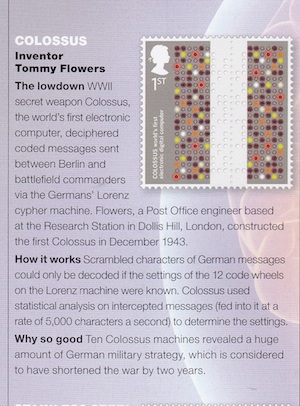
Hi: The Royal Mail has at last revealed details of their plans for a commemorative postage stamp featuring Colossus. I have known of this plan for some time as I was commissioned (in confidence) last year to write a section on Tommy Flowers for the chapter in the next Royal Mail Year Book about the new stamp series. (A rather brief press release by Royal Mail itself indicates that "each of the eight special stamps depict key inventions created by British inventors over the last century: Colossus, World Wide Web, Catseyes, Fibre Optics, Stainless Steel, Carbon Fibre, DNA Sequencing, i-limb" - see http://www.royalmail.com/personal/stamps-collectibles-gifts/look-forward-int....) The attached picture and text in fact comes from a scanned copy of the February 2015 British Philatelic Bulletin, rather than directly from the Royal Mail., which I received today. I had not seen the design of the stamp before, so only now - to my annoyance - do I find that it describes Colossus as “the first electronic digital computer” - my own text takes care to use the phrase “the first programmable electronic digital computer”. I have pointed out this problem to the Royal Mail, but have been told that it is too late for it to be corrected - the stamps are to be issued next month. (I have learned that the Royal Mail were given some rather poor advice, so I don’t blame them.) However I am nevertheless delighted that Colossus is being commemorated by the Royal Mail, and by the growing public recognition especially here in the UK of Tommy Flowers’ great contribution. Cheers Brian Randell [cid:658FA3BF-3CAE-483D-AECD-25F48014D3A1]

That is exciting! Brian, here in the US such commemorative postage stamps are usually available in a 'proof' form. Do you know how those of us on the other side of the pond might acquire such, if they are printed? On Sun, Feb 1, 2015 at 2:42 AM, Brian Randell <brian.randell@newcastle.ac.uk
wrote:
Hi:
The Royal Mail has at last revealed details of their plans for a commemorative postage stamp featuring Colossus. I have known of this plan for some time as I was commissioned (in confidence) last year to write a section on Tommy Flowers for the chapter in the next Royal Mail Year Book about the new stamp series. (A rather brief press release by Royal Mail itself indicates that "each of the eight special stamps depict key inventions created by British inventors over the last century: Colossus, World Wide Web, Catseyes, Fibre Optics, Stainless Steel, Carbon Fibre, DNA Sequencing, i-limb" - see http://www.royalmail.com/personal/stamps-collectibles-gifts/look-forward-int... .)
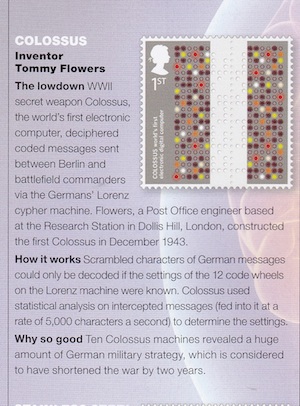
The attached picture and text in fact comes from a scanned copy of the February 2015 British Philatelic Bulletin, rather than directly from the Royal Mail., which I received today. I had not seen the design of the stamp before, so only now - to my annoyance - do I find that it describes Colossus as “the first electronic digital computer” - my own text takes care to use the phrase “the first programmable electronic digital computer”.
I have pointed out this problem to the Royal Mail, but have been told that it is too late for it to be corrected - the stamps are to be issued next month. (I have learned that the Royal Mail were given some rather poor advice, so I don’t blame them.)
However I am nevertheless delighted that Colossus is being commemorated by the Royal Mail, and by the growing public recognition especially here in the UK of Tommy Flowers’ great contribution.
Cheers
Brian Randell
_______________________________________________ This email is relayed from members@sigcis.org, the email discussion list of SHOT SIGCIS. Opinions expressed here are those of the member posting and are not reviewed, edited, or endorsed by SIGCIS. The list archives are at http://sigcis.org/pipermail/members/ and you can change your subscription options at http://sigcis.org/mailman/listinfo/members
-- Ian S. King, MSIS, MSCS Ph.D. Candidate The Information School University of Washington An optimist sees a glass half full. A pessimist sees it half empty. An engineer sees it twice as large as it needs to be.

You should contact the UK Philatelic Bureau at http://www.royalmail.com/personal/stamps-collectibles-gifts/stamp-range Roger Johnson From: members-bounces@sigcis.org [mailto:members-bounces@sigcis.org] On Behalf Of Ian S. King Sent: 01 February 2015 18:08 To: Brian Randell Cc: Sigcis Subject: Re: [SIGCIS-Members] Royal Mail Postage Stamp commemorating Colossus That is exciting! Brian, here in the US such commemorative postage stamps are usually available in a 'proof' form. Do you know how those of us on the other side of the pond might acquire such, if they are printed? On Sun, Feb 1, 2015 at 2:42 AM, Brian Randell <brian.randell@newcastle.ac.uk<mailto:brian.randell@newcastle.ac.uk>> wrote: Hi: The Royal Mail has at last revealed details of their plans for a commemorative postage stamp featuring Colossus. I have known of this plan for some time as I was commissioned (in confidence) last year to write a section on Tommy Flowers for the chapter in the next Royal Mail Year Book about the new stamp series. (A rather brief press release by Royal Mail itself indicates that "each of the eight special stamps depict key inventions created by British inventors over the last century: Colossus, World Wide Web, Catseyes, Fibre Optics, Stainless Steel, Carbon Fibre, DNA Sequencing, i-limb" - see http://www.royalmail.com/personal/stamps-collectibles-gifts/look-forward-int....) The attached picture and text in fact comes from a scanned copy of the February 2015 British Philatelic Bulletin, rather than directly from the Royal Mail., which I received today. I had not seen the design of the stamp before, so only now - to my annoyance - do I find that it describes Colossus as “the first electronic digital computer” - my own text takes care to use the phrase “the first programmable electronic digital computer”. I have pointed out this problem to the Royal Mail, but have been told that it is too late for it to be corrected - the stamps are to be issued next month. (I have learned that the Royal Mail were given some rather poor advice, so I don’t blame them.) However I am nevertheless delighted that Colossus is being commemorated by the Royal Mail, and by the growing public recognition especially here in the UK of Tommy Flowers’ great contribution. Cheers Brian Randell [cid:image001.jpg@01D03E62.62B376B0] _______________________________________________ This email is relayed from members@sigcis.org<mailto:members@sigcis.org>, the email discussion list of SHOT SIGCIS. Opinions expressed here are those of the member posting and are not reviewed, edited, or endorsed by SIGCIS. The list archives are at http://sigcis.org/pipermail/members/ and you can change your subscription options at http://sigcis.org/mailman/listinfo/members -- Ian S. King, MSIS, MSCS Ph.D. Candidate The Information School University of Washington An optimist sees a glass half full. A pessimist sees it half empty. An engineer sees it twice as large as it needs to be.
Thanks everyone, for the replies both public and private. I had no idea that the Royal Mail had discovered the Internet. :-) On Sun, Feb 1, 2015 at 1:02 PM, Roger Johnson <rgj@dcs.bbk.ac.uk> wrote:
You should contact the UK Philatelic Bureau at http://www.royalmail.com/personal/stamps-collectibles-gifts/stamp-range
Roger Johnson
*From:* members-bounces@sigcis.org [mailto:members-bounces@sigcis.org] *On Behalf Of *Ian S. King *Sent:* 01 February 2015 18:08 *To:* Brian Randell *Cc:* Sigcis *Subject:* Re: [SIGCIS-Members] Royal Mail Postage Stamp commemorating Colossus
That is exciting! Brian, here in the US such commemorative postage stamps are usually available in a 'proof' form. Do you know how those of us on the other side of the pond might acquire such, if they are printed?
On Sun, Feb 1, 2015 at 2:42 AM, Brian Randell < brian.randell@newcastle.ac.uk> wrote:
Hi:
The Royal Mail has at last revealed details of their plans for a commemorative postage stamp featuring Colossus. I have known of this plan for some time as I was commissioned (in confidence) last year to write a section on Tommy Flowers for the chapter in the next Royal Mail Year Book about the new stamp series. (A rather brief press release by Royal Mail itself indicates that "each of the eight special stamps depict key inventions created by British inventors over the last century: Colossus, World Wide Web, Catseyes, Fibre Optics, Stainless Steel, Carbon Fibre, DNA Sequencing, i-limb" - see http://www.royalmail.com/personal/stamps-collectibles-gifts/look-forward-int... .)
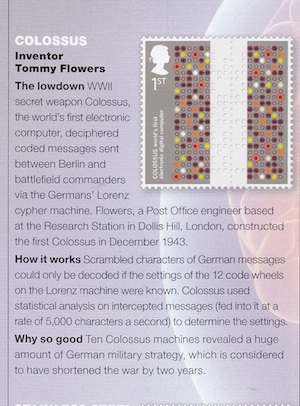
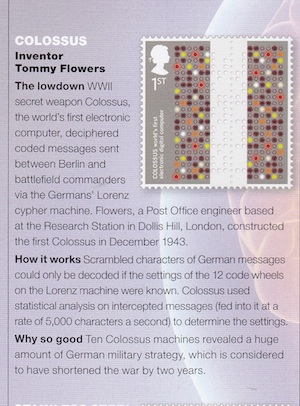
The attached picture and text in fact comes from a scanned copy of the February 2015 British Philatelic Bulletin, rather than directly from the Royal Mail., which I received today. I had not seen the design of the stamp before, so only now - to my annoyance - do I find that it describes Colossus as “the first electronic digital computer” - my own text takes care to use the phrase “the first programmable electronic digital computer”.
I have pointed out this problem to the Royal Mail, but have been told that it is too late for it to be corrected - the stamps are to be issued next month. (I have learned that the Royal Mail were given some rather poor advice, so I don’t blame them.)
However I am nevertheless delighted that Colossus is being commemorated by the Royal Mail, and by the growing public recognition especially here in the UK of Tommy Flowers’ great contribution.
Cheers
Brian Randell
_______________________________________________ This email is relayed from members@sigcis.org, the email discussion list of SHOT SIGCIS. Opinions expressed here are those of the member posting and are not reviewed, edited, or endorsed by SIGCIS. The list archives are at http://sigcis.org/pipermail/members/ and you can change your subscription options at http://sigcis.org/mailman/listinfo/members
--
Ian S. King, MSIS, MSCS Ph.D. Candidate The Information School University of Washington
An optimist sees a glass half full. A pessimist sees it half empty. An engineer sees it twice as large as it needs to be.
-- Ian S. King, MSIS, MSCS Ph.D. Candidate The Information School University of Washington An optimist sees a glass half full. A pessimist sees it half empty. An engineer sees it twice as large as it needs to be.
participants (3)
-
 Brian Randell
 -
 Ian S. King
 -
 Roger Johnson