book announcement: Cybernetic Revolutionaries

Dear SIGCIS colleagues: Just a short note to announce the publication of my book Cybernetic Revolutionaries: Technology and Politics in Allende’s Chile, which was just released from MIT Press. I am pasting the back cover blurb below. More information about the book is available at: http://cyberneticrevolutionaries.com. Best wishes for the holidays, Eden ---- Book Summary: In Cybernetic Revolutionaries, Eden Medina tells the history of two intersecting utopian visions, one political and one technological. The first was Chile’s experiment with peaceful socialist change under Salvador Allende; the second was the simultaneous attempt to build a computer system that would manage Chile’s economy. Neither vision was fully realized—Allende’s government ended with a violent military coup; the system, known as Project Cybersyn, was never completely implemented—but they hold lessons for today about the relationship between technology and politics. Drawing on extensive archival material and interviews, Medina examines the cybernetic system envisioned by the Chilean government—which was to feature holistic system design, decentralized management, human-computer interaction, a national telex network, near real-time control of the growing industrial sector, and modeling of the behavior of dynamic systems. She also describes, and documents with photographs, the network’s Star Trek-like operations room, which featured swivel chairs with armrest control panels, a wall of screens displaying data, and flashing red lights to indicate economic emergencies. Studying Project Cybersyn today helps us understand not only the technological ambitions of a government in the midst of political change but also the limitations of the Chilean revolution. This history further shows how human attempts to combine the political and the technological with the goal of creating a more just society can open new technological, intellectual, and political possibilities. Technologies, Medina writes, are historical texts; when we read them we are reading history. -- Eden Medina Assistant Professor of Informatics Adjunct Assistant Professor of History School of Informatics and Computing Indiana University, Bloomington edenm@indiana.edu<mailto:edenm@indiana.edu> www.edenmedina.com<http://www.edenmedina.com> Learn about "Cybernetic Revolutionaries: Technology and Politics in Allende's Chile" (MIT Press, 2011) @ www.cyberneticrevolutionaries.com<http://www.cyberneticrevolutionaries.com/>

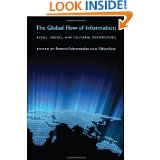
Dear SIGCIS colleagues, I am please to note that two books edited by me have been released recently. The short descriptions and details are below: 1. Product Details <http://www.amazon.com/Global-Flow-Information-Perspectives-Technology/dp/0814748112/ref=sr_1_1?s=books&ie=UTF8&qid=1323734434&sr=1-1> *The Global Flow of Information: Legal, Social, and Cultural Perspectives (Ex Machina: Law, Technology, and Society)* <http://www.amazon.com/Global-Flow-Information-Perspectives-Technology/dp/0814748112/ref=sr_1_1?s=books&ie=UTF8&qid=1323734434&sr=1-1>by Ramesh Subramanian and Eddan Katz (New York University Press, NY, Aug 8, 2011) *Book Description* Series: *Ex Machina: Law, Technology, and Society*| Publication Date: *August 8, 2011* The Internet has been integral to the globalization of a range of goods and production, from intellectual property and scientific research to political discourse and cultural symbols. Yet the ease with which it allows information to flow at a global level presents enormous regulatory challenges. Understanding if, when, and how the law should regulate online, international flows of information requires a firm grasp of past, present, and future patterns of information flow, and their political, economic, social, and cultural consequences. In /The Global Flow of Information/, specialists from law, economics, public policy, international studies, and other disciplines probe the issues that lie at the intersection of globalization, law, and technology, and pay particular attention to the wider contextual question of Internet regulation in a globalized world. While individual essays examine everything from the pharmaceutical industry to television to “information warfare” against suspected enemies of the state, all contributors address the fundamental question of whether or not the flow of information across national borders can be controlled, and what role the law should play in regulating global information flows. Ex Machina series Contributors: Frederick M. Abbott, C. Edwin Baker, Jack M. Balkin, Dan L. Burk, Miguel Angel Centeno, Dorothy E. Denning, James Der Derian, Daniel W. Drezner, Jeremy M. Kaplan, Eddan Katz, Stanley N. Katz, Lawrence Liang, Eli Noam, John G. Palfrey, Jr., Victoria Reyes, and Ramesh Subramanian 2. Product Details <http://www.amazon.com/Access-Knowledge-India-Intellectual-Development/dp/1849665265/ref=sr_1_2?s=books&ie=UTF8&qid=1323734434&sr=1-2> *Access to Knowledge in India: New Research on Intellectual Property, Innovation and Development* <http://www.amazon.com/Access-Knowledge-India-Intellectual-Development/dp/1849665265/ref=sr_1_2?s=books&ie=UTF8&qid=1323734434&sr=1-2> by Ramesh Subramanian and Lea Shaver (Bloomsbury Academic Publishing, UK, Dec 15, 2011) *Book Description* ISBN-10:***1849665265***| ISBN-13:***978-1849665261*| Publication Date: *December 15, 2011* This is the third volume in our Access to Knowledge series. India is a $1 trillion economy which nevertheless struggles with a very high poverty rate and very low access to knowledge for almost seventy percent of its population which lives in rural areas. This volume features four parts on current issues facing intellectual property, development policy (especially rural development policy) and associated innovation, from the Indian perspective. Each chapter is authored by scholars taking an interdisciplinary approach and affiliated to Indian or American universities and Indian think-tanks. Each examines a policy area that significantly impacts access to knowledge. These include information and communications technology for development; the Indian digital divide; networking rural areas; copyright and comparative business models in music; free and open source software; patent reform and access to medicines; the role of the Indian government in promoting access to knowledge internationally and domestically. Best regards, -Ramesh Subramanian ------------------------------------------------------------------------------------ Ramesh Subramanian, Ph.D. Gabriel Ferrucci Professor of Information Systems Quinnipiac University 275 Mount Carmel Avenue Hamden, CT 06518. Email: rameshs@quinnipiac.edu Web: http://www.quinnipiac.edu/x1288.xml?Person=23345&type=5 & Visiting Fellow, Information Society Project Yale Law School 127 Wall Street New Haven, CT 06511. Email: ramesh.subramanian@yale.edu Web: http://www.law.yale.edu/intellectuallife/9841.htm

participants (2)
-
 Medina, Eden
 -
 Subramanian, Ramesh Prof.