Tree diagrams in computer science and other fields (i.e. genealogy)

Dear Colleagues, A little query sent across the lockdowns and quarantines: Can anyone recommend scholarship on the tree-style diagrams that circulate both in computer science and a wide range of other fields, for example, genealogy, kinship? Is there any good work on the history of these diagrams, their intersection, and what they might say about possible links in styles of reasoning across fields that might, otherwise, seem remote? Thanks for your thoughts, b -- Bernard Dionysius Geoghegan Senior Lecturer in the History and Theory of Digital Media Chair of the UG Assessment Board, Digital Culture www.bernardg.com Department of Digital Humanities King's College London The Strand Building Room S3.08 WC2R 2LS Office: +44 (0)20 7848 4750

Interesting question! I'm looking forward to hearing the responses. The first thing that comes to my mind is the section in Johanna Drucker's 2014 book _Graphesis_ entitled "Interpreting Visualization :: Visualizing Interpretation." All best, Johannah Rodgers On Thu, Mar 26, 2020 at 4:06 PM Bernard Geoghegan < bernardgeoghegan2010@u.northwestern.edu> wrote:
Dear Colleagues,
A little query sent across the lockdowns and quarantines: Can anyone recommend scholarship on the tree-style diagrams that circulate both in computer science and a wide range of other fields, for example, genealogy, kinship? Is there any good work on the history of these diagrams, their intersection, and what they might say about possible links in styles of reasoning across fields that might, otherwise, seem remote?
Thanks for your thoughts,
b
--
Bernard Dionysius Geoghegan
Senior Lecturer in the History and Theory of Digital Media
Chair of the UG Assessment Board, Digital Culture
www.bernardg.com
Department of Digital Humanities
King's College London
The Strand Building
Room S3.08
WC2R 2LS
Office: +44 (0)20 7848 4750 _______________________________________________ This email is relayed from members at sigcis.org, the email discussion list of SHOT SIGCIS. Opinions expressed here are those of the member posting and are not reviewed, edited, or endorsed by SIGCIS. The list archives are at http://lists.sigcis.org/pipermail/members-sigcis.org/ and you can change your subscription options at http://lists.sigcis.org/listinfo.cgi/members-sigcis.org
-- johannahrodgers@gmail.com www.johannahrodgers.net

Dear Bernie, If by trees in CS you mean at least in part the abstract data type, Knuth gives a short history and bibliography on pp. 406-7 of the first volume of The Art of Computer Programming, the section beginning with "Trees have of course been in existence since the third day of creation..." On p. 459, he gives a little more on the history of trees as CS data structures in particular. Happy to send photos of these pages if they'd be of use! I think the files are too big to not get bounced by the list though. Sincerely, Jeff ________________________________ From: Members <members-bounces@lists.sigcis.org> on behalf of Bernard Geoghegan <bernardgeoghegan2010@u.northwestern.edu> Sent: Thursday, March 26, 2020 4:05 PM To: Sigcis <members@sigcis.org> Subject: [SIGCIS-Members] Tree diagrams in computer science and other fields (i.e. genealogy) Dear Colleagues, A little query sent across the lockdowns and quarantines: Can anyone recommend scholarship on the tree-style diagrams that circulate both in computer science and a wide range of other fields, for example, genealogy, kinship? Is there any good work on the history of these diagrams, their intersection, and what they might say about possible links in styles of reasoning across fields that might, otherwise, seem remote? Thanks for your thoughts, b -- Bernard Dionysius Geoghegan Senior Lecturer in the History and Theory of Digital Media Chair of the UG Assessment Board, Digital Culture www.bernardg.com Department of Digital Humanities King's College London The Strand Building Room S3.08 WC2R 2LS Office: +44 (0)20 7848 4750

Bernard, Johanna Drucker’s Graphesis <https://www.hup.harvard.edu/catalog.php?isbn=9780674724938> has a brief section (pp. 95-105) on the history of tree diagrams in humanistic inquiry, which includes a handful of potentially useful citations. Hope this helps, Brian — Brian Justie b1@ucla.edu PhD Student, Department of Information Studies Researcher, UCLA Labor Center
On Mar 26, 2020, at 2:03 PM, Jeff Scott Nagy <jsnagy@stanford.edu> wrote:
Dear Bernie,
If by trees in CS you mean at least in part the abstract data type, Knuth gives a short history and bibliography on pp. 406-7 of the first volume of The Art of Computer Programming, the section beginning with "Trees have of course been in existence since the third day of creation..." On p. 459, he gives a little more on the history of trees as CS data structures in particular.
Happy to send photos of these pages if they'd be of use! I think the files are too big to not get bounced by the list though.
Sincerely, Jeff
From: Members <members-bounces@lists.sigcis.org> on behalf of Bernard Geoghegan <bernardgeoghegan2010@u.northwestern.edu> Sent: Thursday, March 26, 2020 4:05 PM To: Sigcis <members@sigcis.org> Subject: [SIGCIS-Members] Tree diagrams in computer science and other fields (i.e. genealogy)
Dear Colleagues,
A little query sent across the lockdowns and quarantines: Can anyone recommend scholarship on the tree-style diagrams that circulate both in computer science and a wide range of other fields, for example, genealogy, kinship? Is there any good work on the history of these diagrams, their intersection, and what they might say about possible links in styles of reasoning across fields that might, otherwise, seem remote?
Thanks for your thoughts, b
-- Bernard Dionysius Geoghegan Senior Lecturer in the History and Theory of Digital Media Chair of the UG Assessment Board, Digital Culture www.bernardg.com
Department of Digital Humanities King's College London The Strand Building Room S3.08 WC2R 2LS
Office: +44 (0)20 7848 4750 _______________________________________________ This email is relayed from members at sigcis.org, the email discussion list of SHOT SIGCIS. Opinions expressed here are those of the member posting and are not reviewed, edited, or endorsed by SIGCIS. The list archives are at http://lists.sigcis.org/pipermail/members-sigcis.org/ and you can change your subscription options at http://lists.sigcis.org/listinfo.cgi/members-sigcis.org

Hi Bernard, I second Matthew's reference to Manuel Lima, *The Book of Trees <https://www.papress.com/html/product.details.dna?isbn=9781616892180>*, an art-historical treatment of just this question, including a taxonomy of kinds of trees. And Theodora's reference to her own work! I have an article discussing the development of trees and graphs as mathematical objects and calculation devices in comparison/connection with the graphical practices of organic chemists circa the late 19th century and 1960s: - Evan Hepler-Smith, “Paper Chemistry: François Dagognet and the Chemical Graph,” *Ambix* 65, no. 1 (2018): 76–98, https://doi.org/10.1080/00026980.2017.1418232. (Preprint linked on my website <http://evanheplersmith.com/publications>; I can send a PDF of the published version to anyone interested.) Alexander et al., *A Pattern Language* also seems relevant to this question, though not specifically about trees. (Although Alexander's earlier essay "A City is Not a Tree" might be.) Evan On Thu, Mar 26, 2020 at 2:21 PM BRIAN JUSTIE <b1@ucla.edu> wrote:
Bernard, Johanna Drucker’s *Graphesis* <https://www.hup.harvard.edu/catalog.php?isbn=9780674724938> has a brief section (pp. 95-105) on the history of tree diagrams in humanistic inquiry, which includes a handful of potentially useful citations. Hope this helps, Brian
— Brian Justie *b1@ucla.edu <b1@ucla.edu> *
PhD Student, Department of Information Studies Researcher, UCLA Labor Center
On Mar 26, 2020, at 2:03 PM, Jeff Scott Nagy <jsnagy@stanford.edu> wrote:
Dear Bernie,
If by trees in CS you mean at least in part the abstract data type, Knuth gives a short history and bibliography on pp. 406-7 of the first volume of *The Art of Computer Programming*, the section beginning with "Trees have of course been in existence since the third day of creation..." On p. 459, he gives a little more on the history of trees as CS data structures in particular.
Happy to send photos of these pages if they'd be of use! I think the files are too big to not get bounced by the list though.
Sincerely, Jeff
------------------------------ *From:* Members <members-bounces@lists.sigcis.org> on behalf of Bernard Geoghegan <bernardgeoghegan2010@u.northwestern.edu> *Sent:* Thursday, March 26, 2020 4:05 PM *To:* Sigcis <members@sigcis.org> *Subject:* [SIGCIS-Members] Tree diagrams in computer science and other fields (i.e. genealogy)
Dear Colleagues,
A little query sent across the lockdowns and quarantines: Can anyone recommend scholarship on the tree-style diagrams that circulate both in computer science and a wide range of other fields, for example, genealogy, kinship? Is there any good work on the history of these diagrams, their intersection, and what they might say about possible links in styles of reasoning across fields that might, otherwise, seem remote?
Thanks for your thoughts, b
-- Bernard Dionysius Geoghegan Senior Lecturer in the History and Theory of Digital Media Chair of the UG Assessment Board, Digital Culture www.bernardg.com
Department of Digital Humanities King's College London The Strand Building Room S3.08 WC2R 2LS
Office: +44 (0)20 7848 4750 _______________________________________________ This email is relayed from members at sigcis.org, the email discussion list of SHOT SIGCIS. Opinions expressed here are those of the member posting and are not reviewed, edited, or endorsed by SIGCIS. The list archives are at http://lists.sigcis.org/pipermail/members-sigcis.org/ and you can change your subscription options at http://lists.sigcis.org/listinfo.cgi/members-sigcis.org
_______________________________________________ This email is relayed from members at sigcis.org, the email discussion list of SHOT SIGCIS. Opinions expressed here are those of the member posting and are not reviewed, edited, or endorsed by SIGCIS. The list archives are at http://lists.sigcis.org/pipermail/members-sigcis.org/ and you can change your subscription options at http://lists.sigcis.org/listinfo.cgi/members-sigcis.org
-- Evan Hepler-Smith evan.heplersmith@gmail.com 339.203.1096 evanheplersmith.com

I just want to say how much I am enjoying this fascinating thread! And that I hope everyone is safe and comfortable in these difficult days. Barbara From: Members <members-bounces@lists.sigcis.org> on behalf of Evan Hepler-Smith <evan.heplersmith@gmail.com> Reply-To: "evan.heplersmith@gmail.com" <evan.heplersmith@gmail.com> Date: Thursday, March 26, 2020 at 2:44 PM To: BRIAN JUSTIE <b1@ucla.edu> Cc: Sigcis <members@sigcis.org> Subject: Re: [SIGCIS-Members] Tree diagrams in computer science and other fields (i.e. genealogy) Hi Bernard, I second Matthew's reference to Manuel Lima, The Book of Trees<https://nam04.safelinks.protection.outlook.com/?url=https%3A%2F%2Fwww.papress.com%2Fhtml%2Fproduct.details.dna%3Fisbn%3D9781616892180&data=01%7C01%7Cbbwalker%40unr.edu%7C4f213bc663ab4ea2bcee08d7d1cee137%7C523b4bfc0ebd4c03b2b96f6a17fd31d8%7C1&sdata=ZaS4hAEL5Mmrnfq3%2FQbw5DG2%2BxhJhJO2ksgHlzaKxh8%3D&reserved=0>, an art-historical treatment of just this question, including a taxonomy of kinds of trees. And Theodora's reference to her own work! I have an article discussing the development of trees and graphs as mathematical objects and calculation devices in comparison/connection with the graphical practices of organic chemists circa the late 19th century and 1960s: * Evan Hepler-Smith, “Paper Chemistry: François Dagognet and the Chemical Graph,” Ambix 65, no. 1 (2018): 76–98, https://doi.org/10.1080/00026980.2017.1418232<https://nam04.safelinks.protection.outlook.com/?url=https%3A%2F%2Fdoi.org%2F10.1080%2F00026980.2017.1418232&data=01%7C01%7Cbbwalker%40unr.edu%7C4f213bc663ab4ea2bcee08d7d1cee137%7C523b4bfc0ebd4c03b2b96f6a17fd31d8%7C1&sdata=uAu1S09fJETxMtrK1VPe%2BOIIcypfY4vj%2Fmu7SoUyCaM%3D&reserved=0>. (Preprint linked on my website<https://nam04.safelinks.protection.outlook.com/?url=http%3A%2F%2Fevanheplersmith.com%2Fpublications&data=01%7C01%7Cbbwalker%40unr.edu%7C4f213bc663ab4ea2bcee08d7d1cee137%7C523b4bfc0ebd4c03b2b96f6a17fd31d8%7C1&sdata=DSZWrsTCreW5X%2FsCw17DlWtlDZW0cULSTliQgWz%2FLUM%3D&reserved=0>; I can send a PDF of the published version to anyone interested.) Alexander et al., A Pattern Language also seems relevant to this question, though not specifically about trees. (Although Alexander's earlier essay "A City is Not a Tree" might be.) Evan On Thu, Mar 26, 2020 at 2:21 PM BRIAN JUSTIE <b1@ucla.edu<mailto:b1@ucla.edu>> wrote: Bernard, Johanna Drucker’s Graphesis<https://nam04.safelinks.protection.outlook.com/?url=https%3A%2F%2Fwww.hup.harvard.edu%2Fcatalog.php%3Fisbn%3D9780674724938&data=01%7C01%7Cbbwalker%40unr.edu%7C4f213bc663ab4ea2bcee08d7d1cee137%7C523b4bfc0ebd4c03b2b96f6a17fd31d8%7C1&sdata=CxrfpPgH0Hy50qa3gpyM0C09YrjAZ9rQye1Fgc4DJnM%3D&reserved=0> has a brief section (pp. 95-105) on the history of tree diagrams in humanistic inquiry, which includes a handful of potentially useful citations. Hope this helps, Brian — Brian Justie b1@ucla.edu<mailto:b1@ucla.edu> PhD Student, Department of Information Studies Researcher, UCLA Labor Center On Mar 26, 2020, at 2:03 PM, Jeff Scott Nagy <jsnagy@stanford.edu<mailto:jsnagy@stanford.edu>> wrote: Dear Bernie, If by trees in CS you mean at least in part the abstract data type, Knuth gives a short history and bibliography on pp. 406-7 of the first volume of The Art of Computer Programming, the section beginning with "Trees have of course been in existence since the third day of creation..." On p. 459, he gives a little more on the history of trees as CS data structures in particular. Happy to send photos of these pages if they'd be of use! I think the files are too big to not get bounced by the list though. Sincerely, Jeff ________________________________ From: Members <members-bounces@lists.sigcis.org<mailto:members-bounces@lists.sigcis.org>> on behalf of Bernard Geoghegan <bernardgeoghegan2010@u.northwestern.edu<mailto:bernardgeoghegan2010@u.northwestern.edu>> Sent: Thursday, March 26, 2020 4:05 PM To: Sigcis <members@sigcis.org<mailto:members@sigcis.org>> Subject: [SIGCIS-Members] Tree diagrams in computer science and other fields (i.e. genealogy) Dear Colleagues, A little query sent across the lockdowns and quarantines: Can anyone recommend scholarship on the tree-style diagrams that circulate both in computer science and a wide range of other fields, for example, genealogy, kinship? Is there any good work on the history of these diagrams, their intersection, and what they might say about possible links in styles of reasoning across fields that might, otherwise, seem remote? Thanks for your thoughts, b -- Bernard Dionysius Geoghegan Senior Lecturer in the History and Theory of Digital Media Chair of the UG Assessment Board, Digital Culture www.bernardg.com<https://nam04.safelinks.protection.outlook.com/?url=http%3A%2F%2Fwww.bernardg.com%2F&data=01%7C01%7Cbbwalker%40unr.edu%7C4f213bc663ab4ea2bcee08d7d1cee137%7C523b4bfc0ebd4c03b2b96f6a17fd31d8%7C1&sdata=yLB6VHlxKqZi7vL89I%2BouusWyg6cZzCDBmHevi%2FXThc%3D&reserved=0> Department of Digital Humanities King's College London The Strand Building Room S3.08 WC2R 2LS Office: +44 (0)20 7848 4750 _______________________________________________ This email is relayed from members at sigcis.org<https://nam04.safelinks.protection.outlook.com/?url=http%3A%2F%2Fsigcis.org%2F&data=01%7C01%7Cbbwalker%40unr.edu%7C4f213bc663ab4ea2bcee08d7d1cee137%7C523b4bfc0ebd4c03b2b96f6a17fd31d8%7C1&sdata=%2BBtssgWbSlIanxGfgPy2EKNlGeDWNeFbLVADv%2Ft6nrM%3D&reserved=0>, the email discussion list of SHOT SIGCIS. Opinions expressed here are those of the member posting and are not reviewed, edited, or endorsed by SIGCIS. The list archives are at http://lists.sigcis.org/pipermail/members-sigcis.org/<https://nam04.safelinks.protection.outlook.com/?url=http%3A%2F%2Flists.sigcis.org%2Fpipermail%2Fmembers-sigcis.org%2F&data=01%7C01%7Cbbwalker%40unr.edu%7C4f213bc663ab4ea2bcee08d7d1cee137%7C523b4bfc0ebd4c03b2b96f6a17fd31d8%7C1&sdata=k%2FKpl7LMbRFjFujTjmDSteOjKL17wUth8ctvPYaxY2s%3D&reserved=0> and you can change your subscription options at http://lists.sigcis.org/listinfo.cgi/members-sigcis.org<https://nam04.safelinks.protection.outlook.com/?url=http%3A%2F%2Flists.sigcis.org%2Flistinfo.cgi%2Fmembers-sigcis.org&data=01%7C01%7Cbbwalker%40unr.edu%7C4f213bc663ab4ea2bcee08d7d1cee137%7C523b4bfc0ebd4c03b2b96f6a17fd31d8%7C1&sdata=jF1tdtxMnyUniq8%2B09QM7pt%2FZogJQQA%2FRXSO62AmRGE%3D&reserved=0> _______________________________________________ This email is relayed from members at sigcis.org<https://nam04.safelinks.protection.outlook.com/?url=http%3A%2F%2Fsigcis.org%2F&data=01%7C01%7Cbbwalker%40unr.edu%7C4f213bc663ab4ea2bcee08d7d1cee137%7C523b4bfc0ebd4c03b2b96f6a17fd31d8%7C1&sdata=%2BBtssgWbSlIanxGfgPy2EKNlGeDWNeFbLVADv%2Ft6nrM%3D&reserved=0>, the email discussion list of SHOT SIGCIS. Opinions expressed here are those of the member posting and are not reviewed, edited, or endorsed by SIGCIS. The list archives are at http://lists.sigcis.org/pipermail/members-sigcis.org/<https://nam04.safelinks.protection.outlook.com/?url=http%3A%2F%2Flists.sigcis.org%2Fpipermail%2Fmembers-sigcis.org%2F&data=01%7C01%7Cbbwalker%40unr.edu%7C4f213bc663ab4ea2bcee08d7d1cee137%7C523b4bfc0ebd4c03b2b96f6a17fd31d8%7C1&sdata=k%2FKpl7LMbRFjFujTjmDSteOjKL17wUth8ctvPYaxY2s%3D&reserved=0> and you can change your subscription options at http://lists.sigcis.org/listinfo.cgi/members-sigcis.org<https://nam04.safelinks.protection.outlook.com/?url=http%3A%2F%2Flists.sigcis.org%2Flistinfo.cgi%2Fmembers-sigcis.org&data=01%7C01%7Cbbwalker%40unr.edu%7C4f213bc663ab4ea2bcee08d7d1cee137%7C523b4bfc0ebd4c03b2b96f6a17fd31d8%7C1&sdata=jF1tdtxMnyUniq8%2B09QM7pt%2FZogJQQA%2FRXSO62AmRGE%3D&reserved=0> -- Evan Hepler-Smith evan.heplersmith@gmail.com<mailto:evan.heplersmith@gmail.com> 339.203.1096 evanheplersmith.com<https://nam04.safelinks.protection.outlook.com/?url=http%3A%2F%2Fevanheplersmith.com%2F&data=01%7C01%7Cbbwalker%40unr.edu%7C4f213bc663ab4ea2bcee08d7d1cee137%7C523b4bfc0ebd4c03b2b96f6a17fd31d8%7C1&sdata=awTCzXgED2oQ51g7I2s7UXWDvkDNK9clhjPrlQfQFUY%3D&reserved=0>

+1!! On Fri, Mar 27, 2020 at 3:27 AM Barbara B Walker <bbwalker@unr.edu> wrote:
I just want to say how much I am enjoying this fascinating thread!
And that I hope everyone is safe and comfortable in these difficult days.
Barbara
*From: *Members <members-bounces@lists.sigcis.org> on behalf of Evan Hepler-Smith <evan.heplersmith@gmail.com> *Reply-To: *"evan.heplersmith@gmail.com" <evan.heplersmith@gmail.com> *Date: *Thursday, March 26, 2020 at 2:44 PM *To: *BRIAN JUSTIE <b1@ucla.edu> *Cc: *Sigcis <members@sigcis.org> *Subject: *Re: [SIGCIS-Members] Tree diagrams in computer science and other fields (i.e. genealogy)
Hi Bernard,
I second Matthew's reference to Manuel Lima, *The Book of Trees <https://nam04.safelinks.protection.outlook.com/?url=https%3A%2F%2Fwww.papress.com%2Fhtml%2Fproduct.details.dna%3Fisbn%3D9781616892180&data=01%7C01%7Cbbwalker%40unr.edu%7C4f213bc663ab4ea2bcee08d7d1cee137%7C523b4bfc0ebd4c03b2b96f6a17fd31d8%7C1&sdata=ZaS4hAEL5Mmrnfq3%2FQbw5DG2%2BxhJhJO2ksgHlzaKxh8%3D&reserved=0>*, an art-historical treatment of just this question, including a taxonomy of kinds of trees. And Theodora's reference to her own work!
I have an article discussing the development of trees and graphs as mathematical objects and calculation devices in comparison/connection with the graphical practices of organic chemists circa the late 19th century and 1960s:
- Evan Hepler-Smith, “Paper Chemistry: François Dagognet and the Chemical Graph,” * Ambix* 65, no. 1 (2018): 76–98, https://doi.org/10.1080/00026980.2017.1418232 <https://nam04.safelinks.protection.outlook.com/?url=https%3A%2F%2Fdoi.org%2F10.1080%2F00026980.2017.1418232&data=01%7C01%7Cbbwalker%40unr.edu%7C4f213bc663ab4ea2bcee08d7d1cee137%7C523b4bfc0ebd4c03b2b96f6a17fd31d8%7C1&sdata=uAu1S09fJETxMtrK1VPe%2BOIIcypfY4vj%2Fmu7SoUyCaM%3D&reserved=0> .
(Preprint linked on my website <https://nam04.safelinks.protection.outlook.com/?url=http%3A%2F%2Fevanheplersmith.com%2Fpublications&data=01%7C01%7Cbbwalker%40unr.edu%7C4f213bc663ab4ea2bcee08d7d1cee137%7C523b4bfc0ebd4c03b2b96f6a17fd31d8%7C1&sdata=DSZWrsTCreW5X%2FsCw17DlWtlDZW0cULSTliQgWz%2FLUM%3D&reserved=0>; I can send a PDF of the published version to anyone interested.)
Alexander et al., *A Pattern Language* also seems relevant to this question, though not specifically about trees. (Although Alexander's earlier essay "A City is Not a Tree" might be.)
Evan
On Thu, Mar 26, 2020 at 2:21 PM BRIAN JUSTIE <b1@ucla.edu> wrote:
Bernard,
Johanna Drucker’s *Graphesis* <https://nam04.safelinks.protection.outlook.com/?url=https%3A%2F%2Fwww.hup.harvard.edu%2Fcatalog.php%3Fisbn%3D9780674724938&data=01%7C01%7Cbbwalker%40unr.edu%7C4f213bc663ab4ea2bcee08d7d1cee137%7C523b4bfc0ebd4c03b2b96f6a17fd31d8%7C1&sdata=CxrfpPgH0Hy50qa3gpyM0C09YrjAZ9rQye1Fgc4DJnM%3D&reserved=0> has a brief section (pp. 95-105) on the history of tree diagrams in humanistic inquiry, which includes a handful of potentially useful citations.
Hope this helps,
Brian
— Brian Justie *b1@ucla.edu <b1@ucla.edu> *
PhD Student, Department of Information Studies
Researcher, UCLA Labor Center
On Mar 26, 2020, at 2:03 PM, Jeff Scott Nagy <jsnagy@stanford.edu> wrote:
Dear Bernie,
If by trees in CS you mean at least in part the abstract data type, Knuth gives a short history and bibliography on pp. 406-7 of the first volume of *The Art of Computer Programming*, the section beginning with "Trees have of course been in existence since the third day of creation..." On p. 459, he gives a little more on the history of trees as CS data structures in particular.
Happy to send photos of these pages if they'd be of use! I think the files are too big to not get bounced by the list though.
Sincerely,
Jeff
------------------------------
*From:* Members <members-bounces@lists.sigcis.org> on behalf of Bernard Geoghegan <bernardgeoghegan2010@u.northwestern.edu> *Sent:* Thursday, March 26, 2020 4:05 PM *To:* Sigcis <members@sigcis.org> *Subject:* [SIGCIS-Members] Tree diagrams in computer science and other fields (i.e. genealogy)
Dear Colleagues,
A little query sent across the lockdowns and quarantines: Can anyone recommend scholarship on the tree-style diagrams that circulate both in computer science and a wide range of other fields, for example, genealogy, kinship? Is there any good work on the history of these diagrams, their intersection, and what they might say about possible links in styles of reasoning across fields that might, otherwise, seem remote?
Thanks for your thoughts,
b
--
Bernard Dionysius Geoghegan
Senior Lecturer in the History and Theory of Digital Media
Chair of the UG Assessment Board, Digital Culture
Department of Digital Humanities
King's College London
The Strand Building
Room S3.08
WC2R 2LS
Office: +44 (0)20 7848 4750
_______________________________________________ This email is relayed from members at sigcis.org <https://nam04.safelinks.protection.outlook.com/?url=http%3A%2F%2Fsigcis.org%2F&data=01%7C01%7Cbbwalker%40unr.edu%7C4f213bc663ab4ea2bcee08d7d1cee137%7C523b4bfc0ebd4c03b2b96f6a17fd31d8%7C1&sdata=%2BBtssgWbSlIanxGfgPy2EKNlGeDWNeFbLVADv%2Ft6nrM%3D&reserved=0>, the email discussion list of SHOT SIGCIS. Opinions expressed here are those of the member posting and are not reviewed, edited, or endorsed by SIGCIS. The list archives are at http://lists.sigcis.org/pipermail/members-sigcis.org/ <https://nam04.safelinks.protection.outlook.com/?url=http%3A%2F%2Flists.sigcis.org%2Fpipermail%2Fmembers-sigcis.org%2F&data=01%7C01%7Cbbwalker%40unr.edu%7C4f213bc663ab4ea2bcee08d7d1cee137%7C523b4bfc0ebd4c03b2b96f6a17fd31d8%7C1&sdata=k%2FKpl7LMbRFjFujTjmDSteOjKL17wUth8ctvPYaxY2s%3D&reserved=0> and you can change your subscription options at http://lists.sigcis.org/listinfo.cgi/members-sigcis.org <https://nam04.safelinks.protection.outlook.com/?url=http%3A%2F%2Flists.sigcis.org%2Flistinfo.cgi%2Fmembers-sigcis.org&data=01%7C01%7Cbbwalker%40unr.edu%7C4f213bc663ab4ea2bcee08d7d1cee137%7C523b4bfc0ebd4c03b2b96f6a17fd31d8%7C1&sdata=jF1tdtxMnyUniq8%2B09QM7pt%2FZogJQQA%2FRXSO62AmRGE%3D&reserved=0>
_______________________________________________ This email is relayed from members at sigcis.org <https://nam04.safelinks.protection.outlook.com/?url=http%3A%2F%2Fsigcis.org%2F&data=01%7C01%7Cbbwalker%40unr.edu%7C4f213bc663ab4ea2bcee08d7d1cee137%7C523b4bfc0ebd4c03b2b96f6a17fd31d8%7C1&sdata=%2BBtssgWbSlIanxGfgPy2EKNlGeDWNeFbLVADv%2Ft6nrM%3D&reserved=0>, the email discussion list of SHOT SIGCIS. Opinions expressed here are those of the member posting and are not reviewed, edited, or endorsed by SIGCIS. The list archives are at http://lists.sigcis.org/pipermail/members-sigcis.org/ <https://nam04.safelinks.protection.outlook.com/?url=http%3A%2F%2Flists.sigcis.org%2Fpipermail%2Fmembers-sigcis.org%2F&data=01%7C01%7Cbbwalker%40unr.edu%7C4f213bc663ab4ea2bcee08d7d1cee137%7C523b4bfc0ebd4c03b2b96f6a17fd31d8%7C1&sdata=k%2FKpl7LMbRFjFujTjmDSteOjKL17wUth8ctvPYaxY2s%3D&reserved=0> and you can change your subscription options at http://lists.sigcis.org/listinfo.cgi/members-sigcis.org <https://nam04.safelinks.protection.outlook.com/?url=http%3A%2F%2Flists.sigcis.org%2Flistinfo.cgi%2Fmembers-sigcis.org&data=01%7C01%7Cbbwalker%40unr.edu%7C4f213bc663ab4ea2bcee08d7d1cee137%7C523b4bfc0ebd4c03b2b96f6a17fd31d8%7C1&sdata=jF1tdtxMnyUniq8%2B09QM7pt%2FZogJQQA%2FRXSO62AmRGE%3D&reserved=0>
--
Evan Hepler-Smith
evan.heplersmith@gmail.com 339.203.1096
evanheplersmith.com <https://nam04.safelinks.protection.outlook.com/?url=http%3A%2F%2Fevanheplersmith.com%2F&data=01%7C01%7Cbbwalker%40unr.edu%7C4f213bc663ab4ea2bcee08d7d1cee137%7C523b4bfc0ebd4c03b2b96f6a17fd31d8%7C1&sdata=awTCzXgED2oQ51g7I2s7UXWDvkDNK9clhjPrlQfQFUY%3D&reserved=0> _______________________________________________ This email is relayed from members at sigcis.org, the email discussion list of SHOT SIGCIS. Opinions expressed here are those of the member posting and are not reviewed, edited, or endorsed by SIGCIS. The list archives are at http://lists.sigcis.org/pipermail/members-sigcis.org/ and you can change your subscription options at http://lists.sigcis.org/listinfo.cgi/members-sigcis.org
-- Drs. Joris J. van Zundert Researcher & Developer in Humanities Computing Dept. of Literary Studies Huygens Institute for the History of the Netherlands Royal Netherlands Academy of Arts and Sciences joris.van.zundert@huygens.knaw.nl @jorisvanzundert +31624461051 https://jorisvanzundert.net/ https://www.huygens.knaw.nl/vanzundert/?lang=en visiting address Oudezijds Achterburgwal 185 1012 DK Amsterdam The Netherlands postal address P.O. Box 10855 1001 EW Amsterdam The Netherlands -- Jack Sparrow: I thought you were supposed to keep to the code. Mr. Gibbs: We figured they were more actual guidelines.
Dear All, Thanks for this extraordinary feedback on the tree-like, arborescent, and dendritic. Every time I feel myself in what I think is a lonely scholarly cul-de-sac, I send a quick note to this list, and I find the research branching off in every possible direction, with roots springing far back into myriad soils. While juggling a quarantined child and grocery deliveries, I made a quick and dirty bibliography of your wonderful recommendations, below. By the time you receive this, there may be a few more I’ve added but didn’t get to include here. I’ve also managed to track down most of the PDFs—please contact me directly, off-list, if you’d like some help getting your hands on the PDFs. Warmly, b Alexander, Christopher. “A City Is Not a Tree.” Architectural Forum, 1965. ———. A City Is Not a Tree: 50th Anniversary Edition. Sustasis Press/Off The Common Books, 2017. Deleuze, Gilles, and Félix Guattari. A Thousand Plateaus: Capitalism and Schizophrenia. Translated by Brian Massumi. Minneapolis: University of Minnesota Press, 1987. Drucker, Johanna. Graphesis: Visual Forms of Knowledge Production. MetaLABprojects. Cambridge, Massachusetts: Harvard University Press, 2014. FIshwick, Paul. “Computing as Model-Based Empirical Science,” 205–212. SIGSIM PADS ’14. Denver, Colorado, USA: Association for Computing Machinery, 2014. https://doi.org/10.1145/2601381.2601391. Hacking, Ian. “Trees of Logic, Tress of Porphyry.” In Advancements of Learning: Essays in Honour of Paolo Rossi, edited by John Heilbron, 219–61. Florence: Leo S. Olschki, 2007. Hepler-Smith, Evan. “Paper Chemistry: François Dagognet and the Chemical Graph.” Ambix 65, no. 1 (2018): 76–98. https://doi.org/10.1080/00026980.2017.1418232. Knuth, Donald E. The Art of Computer Programming, Volume 4A: Combinatorial Algorithms, Part 1. 1 edition. Upper Saddle River, NJ: Addison-Wesley Professional, 2011. Knuth, Donald Ervin. The Art of Computer Programming. Volume 1, Fundamental Algorithms. 3rd ed. Place of publication not identified: Addison Wesley, 1997. Lima, Manuel. Book of Trees: Visualizing Branches of Knowledge. New York: Princeton Architectural Press, 2014. ———, ed. Visual Complexity: Mapping Patterns of Information. New York: Princeton Architectural Press, 2011. Mackenzie, Adrian. Machine Learners: Archaeology of a Data Practice. The MIT Press Ser. Cambridge: MIT Press, 2017. Mcgoldrick, Monica. Genograms: Assessment and Intervention. 2nd Revised edition edition. New York: W. W. Norton & Co., 1999. Moretti, Franco. Graphs, Maps, Trees: Abstract Models for a Literary History. London: Verso, 2005. Rosenberg, Daniel, and Anthony Grafton. Cartographies of Time. 1st ed. New York: Princeton Architectural Press, 2010. Vardouli, Theodora. “Graphing Theory : New Mathematics, Design, and the Participatory Turn.” Thesis, Massachusetts Institute of Technology, 2017. https://dspace.mit.edu/handle/1721.1/113917. ———. “Skeletons, Shapes, and the Shift from Surface to Structure in Architectural Geometry.” Nexus Network Journal, 2020. https://doi.org/10.1007/s00004-020-00478-0. -- Bernard Dionysius Geoghegan Senior Lecturer in the History and Theory of Digital Media Chair of the UG Assessment Board, Digital Culture www.bernardg.com Department of Digital Humanities King's College London The Strand Building Room S3.08 WC2R 2LS Office: +44 (0)20 7848 4750 From: Members <members-bounces@lists.sigcis.org> on behalf of Joris van Zundert <joris.van.zundert@huygens.knaw.nl> Date: Friday, 27 March 2020 at 11:56 To: Barbara B Walker <bbwalker@unr.edu> Cc: Sigcis <members@sigcis.org> Subject: Re: [SIGCIS-Members] Tree diagrams in computer science and other fields (i.e. genealogy) +1!! On Fri, Mar 27, 2020 at 3:27 AM Barbara B Walker <bbwalker@unr.edu> wrote: I just want to say how much I am enjoying this fascinating thread! And that I hope everyone is safe and comfortable in these difficult days. Barbara From: Members <members-bounces@lists.sigcis.org> on behalf of Evan Hepler-Smith <evan.heplersmith@gmail.com> Reply-To: "evan.heplersmith@gmail.com" <evan.heplersmith@gmail.com> Date: Thursday, March 26, 2020 at 2:44 PM To: BRIAN JUSTIE <b1@ucla.edu> Cc: Sigcis <members@sigcis.org> Subject: Re: [SIGCIS-Members] Tree diagrams in computer science and other fields (i.e. genealogy) Hi Bernard, I second Matthew's reference to Manuel Lima, The Book of Trees, an art-historical treatment of just this question, including a taxonomy of kinds of trees. And Theodora's reference to her own work! I have an article discussing the development of trees and graphs as mathematical objects and calculation devices in comparison/connection with the graphical practices of organic chemists circa the late 19th century and 1960s: Evan Hepler-Smith, “Paper Chemistry: François Dagognet and the Chemical Graph,” Ambix 65, no. 1 (2018): 76–98, https://doi.org/10.1080/00026980.2017.1418232. (Preprint linked on my website; I can send a PDF of the published version to anyone interested.) Alexander et al., A Pattern Language also seems relevant to this question, though not specifically about trees. (Although Alexander's earlier essay "A City is Not a Tree" might be.) Evan On Thu, Mar 26, 2020 at 2:21 PM BRIAN JUSTIE <b1@ucla.edu> wrote: Bernard, Johanna Drucker’s Graphesis has a brief section (pp. 95-105) on the history of tree diagrams in humanistic inquiry, which includes a handful of potentially useful citations. Hope this helps, Brian — Brian Justie b1@ucla.edu PhD Student, Department of Information Studies Researcher, UCLA Labor Center On Mar 26, 2020, at 2:03 PM, Jeff Scott Nagy <jsnagy@stanford.edu> wrote: Dear Bernie, If by trees in CS you mean at least in part the abstract data type, Knuth gives a short history and bibliography on pp. 406-7 of the first volume of The Art of Computer Programming, the section beginning with "Trees have of course been in existence since the third day of creation..." On p. 459, he gives a little more on the history of trees as CS data structures in particular. Happy to send photos of these pages if they'd be of use! I think the files are too big to not get bounced by the list though. Sincerely, Jeff From: Members <members-bounces@lists.sigcis.org> on behalf of Bernard Geoghegan <bernardgeoghegan2010@u.northwestern.edu> Sent: Thursday, March 26, 2020 4:05 PM To: Sigcis <members@sigcis.org> Subject: [SIGCIS-Members] Tree diagrams in computer science and other fields (i.e. genealogy) Dear Colleagues, A little query sent across the lockdowns and quarantines: Can anyone recommend scholarship on the tree-style diagrams that circulate both in computer science and a wide range of other fields, for example, genealogy, kinship? Is there any good work on the history of these diagrams, their intersection, and what they might say about possible links in styles of reasoning across fields that might, otherwise, seem remote? Thanks for your thoughts, b -- Bernard Dionysius Geoghegan Senior Lecturer in the History and Theory of Digital Media Chair of the UG Assessment Board, Digital Culture www.bernardg.com Department of Digital Humanities King's College London The Strand Building Room S3.08 WC2R 2LS Office: +44 (0)20 7848 4750 _______________________________________________ This email is relayed from members at sigcis.org, the email discussion list of SHOT SIGCIS. Opinions expressed here are those of the member posting and are not reviewed, edited, or endorsed by SIGCIS. The list archives are at http://lists.sigcis.org/pipermail/members-sigcis.org/ and you can change your subscription options at http://lists.sigcis.org/listinfo.cgi/members-sigcis.org _______________________________________________ This email is relayed from members at sigcis.org, the email discussion list of SHOT SIGCIS. Opinions expressed here are those of the member posting and are not reviewed, edited, or endorsed by SIGCIS. The list archives are at http://lists.sigcis.org/pipermail/members-sigcis.org/ and you can change your subscription options at http://lists.sigcis.org/listinfo.cgi/members-sigcis.org -- Evan Hepler-Smith evan.heplersmith@gmail.com 339.203.1096 evanheplersmith.com _______________________________________________ This email is relayed from members at sigcis.org, the email discussion list of SHOT SIGCIS. Opinions expressed here are those of the member posting and are not reviewed, edited, or endorsed by SIGCIS. The list archives are at http://lists.sigcis.org/pipermail/members-sigcis.org/ and you can change your subscription options at http://lists.sigcis.org/listinfo.cgi/members-sigcis.org -- Drs. Joris J. van Zundert Researcher & Developer in Humanities Computing Dept. of Literary Studies Huygens Institute for the History of the Netherlands Royal Netherlands Academy of Arts and Sciences joris.van.zundert@huygens.knaw.nl @jorisvanzundert +31624461051 https://jorisvanzundert.net/ https://www.huygens.knaw.nl/vanzundert/?lang=en visiting address Oudezijds Achterburgwal 185 1012 DK Amsterdam The Netherlands postal address P.O. Box 10855 1001 EW Amsterdam The Netherlands -- Jack Sparrow: I thought you were supposed to keep to the code. Mr. Gibbs: We figured they were more actual guidelines. _______________________________________________ This email is relayed from members at sigcis.org, the email discussion list of SHOT SIGCIS. Opinions expressed here are those of the member posting and are not reviewed, edited, or endorsed by SIGCIS. The list archives are at http://lists.sigcis.org/pipermail/members-sigcis.org/ and you can change your subscription options at http://lists.sigcis.org/listinfo.cgi/members-sigcis.org

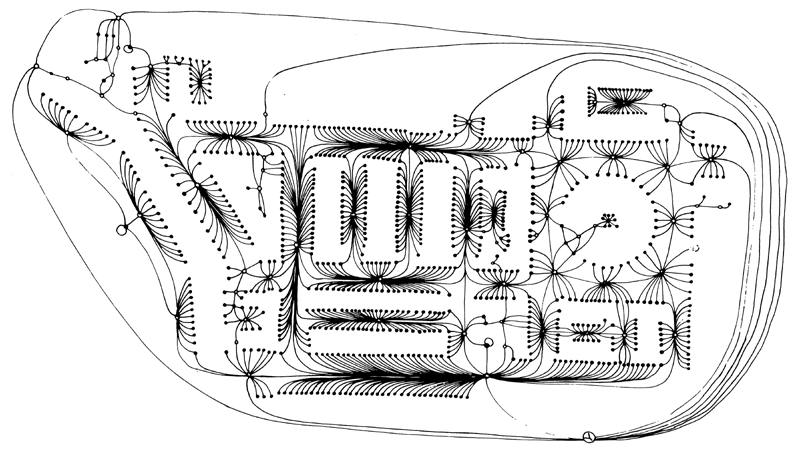
Yes, Alexander's article, "A City is Not a Tree," was quite explicit about this kind of formalist modeling of pedestrian flows through architecture and urban spaces. Alexander tells us that trees are not good! As far as I know, he didn't continue in that vein for too long, but Bill Hillier and Julienne Hanson at UCL developed an analytic tool they called "space syntax" (as elaborated in their book, _The social logic of space_ (1984) and illustrated with a bunch of graphs and tree diagrams, like the attached) that took "tree diagram reasoning" in architecture to another level. Best, -Warren Warren SACK Chair + Professor, Film + Digital Media, University of California, Santa Cruz Editorial Group Member, *Computational Culture: A Journal of Software Studies* Book: *The Software Arts* (MIT Press, 2019) https://mitpress.mit.edu/books/software-arts On Thu, Mar 26, 2020 at 2:44 PM Evan Hepler-Smith < evan.heplersmith@gmail.com> wrote:
Hi Bernard,
I second Matthew's reference to Manuel Lima, *The Book of Trees <https://www.papress.com/html/product.details.dna?isbn=9781616892180>*, an art-historical treatment of just this question, including a taxonomy of kinds of trees. And Theodora's reference to her own work!
I have an article discussing the development of trees and graphs as mathematical objects and calculation devices in comparison/connection with the graphical practices of organic chemists circa the late 19th century and 1960s:
- Evan Hepler-Smith, “Paper Chemistry: François Dagognet and the Chemical Graph,” *Ambix* 65, no. 1 (2018): 76–98, https://doi.org/10.1080/00026980.2017.1418232.
(Preprint linked on my website <http://evanheplersmith.com/publications>; I can send a PDF of the published version to anyone interested.)
Alexander et al., *A Pattern Language* also seems relevant to this question, though not specifically about trees. (Although Alexander's earlier essay "A City is Not a Tree" might be.)
Evan
On Thu, Mar 26, 2020 at 2:21 PM BRIAN JUSTIE <b1@ucla.edu> wrote:
Bernard, Johanna Drucker’s *Graphesis* <https://www.hup.harvard.edu/catalog.php?isbn=9780674724938> has a brief section (pp. 95-105) on the history of tree diagrams in humanistic inquiry, which includes a handful of potentially useful citations. Hope this helps, Brian
— Brian Justie *b1@ucla.edu <b1@ucla.edu> *
PhD Student, Department of Information Studies Researcher, UCLA Labor Center
On Mar 26, 2020, at 2:03 PM, Jeff Scott Nagy <jsnagy@stanford.edu> wrote:
Dear Bernie,
If by trees in CS you mean at least in part the abstract data type, Knuth gives a short history and bibliography on pp. 406-7 of the first volume of *The Art of Computer Programming*, the section beginning with "Trees have of course been in existence since the third day of creation..." On p. 459, he gives a little more on the history of trees as CS data structures in particular.
Happy to send photos of these pages if they'd be of use! I think the files are too big to not get bounced by the list though.
Sincerely, Jeff
------------------------------ *From:* Members <members-bounces@lists.sigcis.org> on behalf of Bernard Geoghegan <bernardgeoghegan2010@u.northwestern.edu> *Sent:* Thursday, March 26, 2020 4:05 PM *To:* Sigcis <members@sigcis.org> *Subject:* [SIGCIS-Members] Tree diagrams in computer science and other fields (i.e. genealogy)
Dear Colleagues,
A little query sent across the lockdowns and quarantines: Can anyone recommend scholarship on the tree-style diagrams that circulate both in computer science and a wide range of other fields, for example, genealogy, kinship? Is there any good work on the history of these diagrams, their intersection, and what they might say about possible links in styles of reasoning across fields that might, otherwise, seem remote?
Thanks for your thoughts, b
-- Bernard Dionysius Geoghegan Senior Lecturer in the History and Theory of Digital Media Chair of the UG Assessment Board, Digital Culture www.bernardg.com
Department of Digital Humanities King's College London The Strand Building Room S3.08 WC2R 2LS
Office: +44 (0)20 7848 4750 _______________________________________________ This email is relayed from members at sigcis.org, the email discussion list of SHOT SIGCIS. Opinions expressed here are those of the member posting and are not reviewed, edited, or endorsed by SIGCIS. The list archives are at http://lists.sigcis.org/pipermail/members-sigcis.org/ and you can change your subscription options at http://lists.sigcis.org/listinfo.cgi/members-sigcis.org
_______________________________________________ This email is relayed from members at sigcis.org, the email discussion list of SHOT SIGCIS. Opinions expressed here are those of the member posting and are not reviewed, edited, or endorsed by SIGCIS. The list archives are at http://lists.sigcis.org/pipermail/members-sigcis.org/ and you can change your subscription options at http://lists.sigcis.org/listinfo.cgi/members-sigcis.org
-- Evan Hepler-Smith evan.heplersmith@gmail.com 339.203.1096 evanheplersmith.com _______________________________________________ This email is relayed from members at sigcis.org, the email discussion list of SHOT SIGCIS. Opinions expressed here are those of the member posting and are not reviewed, edited, or endorsed by SIGCIS. The list archives are at http://lists.sigcis.org/pipermail/members-sigcis.org/ and you can change your subscription options at http://lists.sigcis.org/listinfo.cgi/members-sigcis.org

Knuth vol. 4A is all about tree diagrams with bits of history here and there. His Christmas lecture series videos also are a lot about trees. On 3/26/2020 2:20 PM, BRIAN JUSTIE wrote:
Bernard, Johanna Drucker’s /Graphesis/ <https://www.hup.harvard.edu/catalog.php?isbn=9780674724938>//has a brief section (pp. 95-105) on the history of tree diagrams in humanistic inquiry, which includes a handful of potentially useful citations. Hope this helps, Brian
— Brian Justie /b1@ucla.edu <mailto:b1@ucla.edu> /
PhD Student, Department of Information Studies Researcher, UCLA Labor Center
On Mar 26, 2020, at 2:03 PM, Jeff Scott Nagy <jsnagy@stanford.edu <mailto:jsnagy@stanford.edu>> wrote:
Dear Bernie,
If by trees in CS you mean at least in part the abstract data type, Knuth gives a short history and bibliography on pp. 406-7 of the first volume of/The Art of Computer Programming/, the section beginning with "Trees have of course been in existence since the third day of creation..."On p. 459, he gives a little more on the history of trees as CS data structures in particular.
Happy to send photos of these pages if they'd be of use! I think the files are too big to not get bounced by the list though.
Sincerely, Jeff
------------------------------------------------------------------------ *From:*Members <members-bounces@lists.sigcis.org <mailto:members-bounces@lists.sigcis.org>> on behalf of Bernard Geoghegan <bernardgeoghegan2010@u.northwestern.edu <mailto:bernardgeoghegan2010@u.northwestern.edu>> *Sent:*Thursday, March 26, 2020 4:05 PM *To:*Sigcis <members@sigcis.org <mailto:members@sigcis.org>> *Subject:*[SIGCIS-Members] Tree diagrams in computer science and other fields (i.e. genealogy) Dear Colleagues,
A little query sent across the lockdowns and quarantines: Can anyone recommend scholarship on the tree-style diagrams that circulate both in computer science and a wide range of other fields, for example, genealogy, kinship? Is there any good work on the history of these diagrams, their intersection, and what they might say about possible links in styles of reasoning across fields that might, otherwise, seem remote?
Thanks for your thoughts, b
-- Bernard Dionysius Geoghegan Senior Lecturer in the History and Theory of Digital Media Chair of the UG Assessment Board, Digital Culture www.bernardg.com <http://www.bernardg.com>
Department of Digital Humanities King's College London The Strand Building Room S3.08 WC2R 2LS
Office: +44 (0)20 7848 4750 _______________________________________________ This email is relayed from members at sigcis.org <http://sigcis.org>, the email discussion list of SHOT SIGCIS. Opinions expressed here are those of the member posting and are not reviewed, edited, or endorsed by SIGCIS. The list archives are at http://lists.sigcis.org/pipermail/members-sigcis.org/ and you can change your subscription options at http://lists.sigcis.org/listinfo.cgi/members-sigcis.org
_______________________________________________ This email is relayed from members at sigcis.org, the email discussion list of SHOT SIGCIS. Opinions expressed here are those of the member posting and are not reviewed, edited, or endorsed by SIGCIS. The list archives are at http://lists.sigcis.org/pipermail/members-sigcis.org/ and you can change your subscription options at http://lists.sigcis.org/listinfo.cgi/members-sigcis.org

Manuel Lima's *The Book of Trees: Visualizing Branches of Knowledge* <https://www.amazon.com/Book-Trees-Visualizing-Branches-Knowledge/dp/1616892188> is another good starting point; Anthony Grafton's *Cartographies of Time <https://www.amazon.com/Cartographies-Time-Timeline-Anthony-Grafton/dp/B00ANYTMUM>*, exploring linearity in temporal thinking, is probably germane, too (apologies for the Amazon links). Deleuze & Guattari make much of the comparison between rhizomatic & arborescent form, too, if you're amenable to that perspective. On Thu, Mar 26, 2020 at 5:03 PM Jeff Scott Nagy <jsnagy@stanford.edu> wrote:
Dear Bernie,
If by trees in CS you mean at least in part the abstract data type, Knuth gives a short history and bibliography on pp. 406-7 of the first volume of *The Art of Computer Programming*, the section beginning with "Trees have of course been in existence since the third day of creation..." On p. 459, he gives a little more on the history of trees as CS data structures in particular.
Happy to send photos of these pages if they'd be of use! I think the files are too big to not get bounced by the list though.
Sincerely, Jeff
------------------------------ *From:* Members <members-bounces@lists.sigcis.org> on behalf of Bernard Geoghegan <bernardgeoghegan2010@u.northwestern.edu> *Sent:* Thursday, March 26, 2020 4:05 PM *To:* Sigcis <members@sigcis.org> *Subject:* [SIGCIS-Members] Tree diagrams in computer science and other fields (i.e. genealogy)
Dear Colleagues,
A little query sent across the lockdowns and quarantines: Can anyone recommend scholarship on the tree-style diagrams that circulate both in computer science and a wide range of other fields, for example, genealogy, kinship? Is there any good work on the history of these diagrams, their intersection, and what they might say about possible links in styles of reasoning across fields that might, otherwise, seem remote?
Thanks for your thoughts,
b
--
Bernard Dionysius Geoghegan
Senior Lecturer in the History and Theory of Digital Media
Chair of the UG Assessment Board, Digital Culture
www.bernardg.com
Department of Digital Humanities
King's College London
The Strand Building
Room S3.08
WC2R 2LS
Office: +44 (0)20 7848 4750 _______________________________________________ This email is relayed from members at sigcis.org, the email discussion list of SHOT SIGCIS. Opinions expressed here are those of the member posting and are not reviewed, edited, or endorsed by SIGCIS. The list archives are at http://lists.sigcis.org/pipermail/members-sigcis.org/ and you can change your subscription options at http://lists.sigcis.org/listinfo.cgi/members-sigcis.org
-- @matthewbattles <http://twitter.com/matthewbattles> associate director, metaLAB (at) harvard <http://metalab.harvard.edu/>|berkman klein center for internet & society <http://cyber.law.harvard.edu> *While we're active in many places, most often, we're physically located on Wampanoag and Massachusett lands.*

Hi Bernard, Fantastic question, following this thread with eager interest! May I suggest some of my work as an account specific to design and architecture: My MIT dissertation<https://dspace.mit.edu/handle/1721.1/113917> was on graphs (trees, lattices, networks etc) as inscriptions in postwar design theory and early computer-aided design research. The book manuscript is still in progress so for something more contained than a dissertation, I am also sending a publicly available link<https://link.springer.com/epdf/10.1007/s00004-020-00478-0?author_access_token=wCB6mtsi8O7RuGSAekAgNfe4RwlQNchNByi7wbcMAY6TNWrtJiCdh8IEGcrdNhtiVf23c5drU19EoQtxLY3cZE-hA-FeaZtgaW53quXSGowp03c0H2Celz6HpFjJBEyMrQ0DVCoZo28YLSg_0iCQKA==> to an article I just published on this topic in Nexus. All best and hope you and yours are staying safe! Theodora -- Theodora Vardouli Assistant Professor | Peter Guo-hua Fu School of Architecture | McGill University 815 Sherbrooke Street West, Montréal Québec, Canada H3A 0C2 | 514.398.6709 @McGill<https://www.mcgill.ca/architecture/people-0/faculty/vardouli> | openarchitectures.com<http://openarchitectures.com/> Computer Architectures: Constructing the Common Ground<https://www.crcpress.com/Computer-Architectures-Constructing-the-Common-Ground/Vardouli-Touloumi/p/book/9780815396529> On Mar 26, 2020, at 4:06 PM, Bernard Geoghegan <bernardgeoghegan2010@u.northwestern.edu<mailto:bernardgeoghegan2010@u.northwestern.edu>> wrote: Dear Colleagues, A little query sent across the lockdowns and quarantines: Can anyone recommend scholarship on the tree-style diagrams that circulate both in computer science and a wide range of other fields, for example, genealogy, kinship? Is there any good work on the history of these diagrams, their intersection, and what they might say about possible links in styles of reasoning across fields that might, otherwise, seem remote? Thanks for your thoughts, b -- Bernard Dionysius Geoghegan Senior Lecturer in the History and Theory of Digital Media Chair of the UG Assessment Board, Digital Culture www.bernardg.com<http://www.bernardg.com> Department of Digital Humanities King's College London The Strand Building Room S3.08 WC2R 2LS Office: +44 (0)20 7848 4750 _______________________________________________ This email is relayed from members at sigcis.org<http://sigcis.org>, the email discussion list of SHOT SIGCIS. Opinions expressed here are those of the member posting and are not reviewed, edited, or endorsed by SIGCIS. The list archives are at http://lists.sigcis.org/pipermail/members-sigcis.org/ and you can change your subscription options at http://lists.sigcis.org/listinfo.cgi/members-sigcis.org

Hello, I don't imagine it is a better reference than those already supplied. However I recall a presentation by noted Canadian philosopher Ian Hacking on the history and uses of tree diagrams including in logic and genealogy. It was a sideline for him and I think it may have been more speculative than rigorous but perhaps of some interest. A quick search suggests he published the results in an essay "Trees of logic, trees of porphyry" in Advancements of Learning Essays in honour of Paolo Rossi, 2007, ( https://www.worldcat.org/title/advancements-of-learning-essays-in-honour-of-... ) -- Yours Truly, Allan Olley, PhD http://individual.utoronto.ca/fofound/ On Thu, 26 Mar 2020, Bernard Geoghegan wrote:
Dear Colleagues,
A little query sent across the lockdowns and quarantines: Can anyone recommend scholarship on the tree-style diagrams that circulate both in computer science and a wide range of other fields, for example, genealogy, kinship? Is there any good work on the history of these diagrams, their intersection, and what they might say about possible links in styles of reasoning across fields that might, otherwise, seem remote?
Thanks for your thoughts,
b
--
Bernard Dionysius Geoghegan
Senior Lecturer in the History and Theory of Digital Media
Chair of the UG Assessment Board, Digital Culture
www.bernardg.com
Department of Digital Humanities
King's College London
The Strand Building
Room S3.08
WC2R 2LS
Office: +44 (0)20 7848 4750

Work has been done on attack trees in red teaming and vulnerability analysis that was inspired by work using trees for fault tolerance analysis. These trees have some unique features by using multiple variables per node to estimate decision making and the number of links per node or the ‘bushiness’ of the graph segment to estimate the richness of an attack surface.
On Mar 26, 2020, at 8:00 PM, Allan Olley <allan.olley@utoronto.ca> wrote:
Hello, I don't imagine it is a better reference than those already supplied. However I recall a presentation by noted Canadian philosopher Ian Hacking on the history and uses of tree diagrams including in logic and genealogy. It was a sideline for him and I think it may have been more speculative than rigorous but perhaps of some interest. A quick search suggests he published the results in an essay "Trees of logic, trees of porphyry" in Advancements of Learning Essays in honour of Paolo Rossi, 2007, ( https://www.worldcat.org/title/advancements-of-learning-essays-in-honour-of-... )
-- Yours Truly, Allan Olley, PhD
http://individual.utoronto.ca/fofound/
On Thu, 26 Mar 2020, Bernard Geoghegan wrote:
Dear Colleagues,
A little query sent across the lockdowns and quarantines: Can anyone recommend scholarship on the tree-style diagrams that circulate both in computer science and a wide range of other fields, for example, genealogy, kinship? Is there any good work on the history of these diagrams, their intersection, and what they might say about possible links in styles of reasoning across fields that might, otherwise, seem remote?
Thanks for your thoughts, b
-- Bernard Dionysius Geoghegan Senior Lecturer in the History and Theory of Digital Media Chair of the UG Assessment Board, Digital Culture www.bernardg.com
Department of Digital Humanities King's College London The Strand Building Room S3.08 WC2R 2LS
Office: +44 (0)20 7848 4750
_______________________________________________ This email is relayed from members at sigcis.org, the email discussion list of SHOT SIGCIS. Opinions expressed here are those of the member posting and are not reviewed, edited, or endorsed by SIGCIS. The list archives are at http://lists.sigcis.org/pipermail/members-sigcis.org/ and you can change your subscription options at http://lists.sigcis.org/listinfo.cgi/members-sigcis.org
participants (13)
-
 Allan Olley
 -
 Barbara B Walker
 -
 Bernard Geoghegan
 -
 BRIAN JUSTIE
 -
 dave walden
 -
 Evan Hepler-Smith
 -
 Jeff Scott Nagy
 -
 Johannah Rodgers
 -
 John Lowry
 -
 Joris van Zundert
 -
 Matthew Battles
 -
 Theodora Vardouli, Prof.
 -
 Warren Sack