"Just Code" Registration Closes in Two days, Oct. 16th

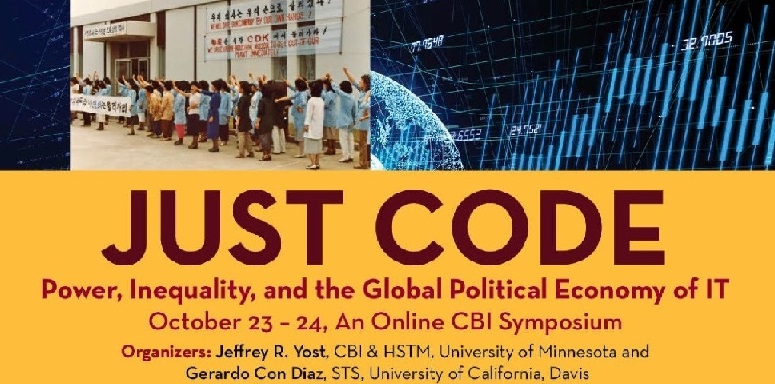
Dear SIGCIS Colleagues, Many thanks to all of you who have registered for the Charles Babbage Institute's "Just Code" Online Symposium! Con and I are so excited about the event/program! It is composed of a tremendously talented, interdisciplinary (history, sociology, anthro., STS, media studies, philosophy, comm.) group of scholars presenting on IT and societal inequality across time, place, and culture. Our speakers are from universities spanning the world, while our many registrants extend geographic diversity even further, Faculty and grad. student registrants--from China, India, Malaysia, Japan, Australia, New Zealand, UK, Russia, France, The Netherlands, Denmark, and Germany to Portugal, Estonia, S. Korea, Singapore, Greece, Egypt,, Israel, Kuwait, Brazil, Mexico, Canada, U.S, and many other countries--make this truly a global event! While well over 95 percent are from universities, we also have registrants from museums, libraries, national and international government bodies (United Nations, U.S. Dept. of Energy, etc.), as well as data scientists, artists, and activists. *If you have not registered yet, we hope you will join us for some tremendous scholarship and engaging dialogue. Please register TODAY, registration is free (name, email, affiliation; takes 15 or 20 seconds) and closes in 2 days. Registering by the deadline (Fri. Oct. 16th) is the ONLY way to attend.* The program is below or accessible at the site link below. In addition to the papers and discussion, we are delighted that (Mahoney Prize committee member) Rice Univ. History Prof. Elizabeth Petrick will be announcing this year's SIGCIS CHM Michael S. Mahoney Book Prize Recipient at the "Just Code" Symposium. Best, Jeff and Con Just Code: Power, Inequality, and the Global Political Economy of IT" <https://justcode.cbi.umn.edu/home> examines how code—construed broadly from AI, software, and systems to bodies of law, policy, and practice—structures and reinforces power relations. Just Code will explore the ways that individuals and institutions use algorithms and computer systems to establish, legitimize, and reinforce widespread social, material, commercial, and cultural inequalities and power imbalances*.* *"Just Code" <https://justcode.cbi.umn.edu/registration>*Free Registration <https://justcode.cbi.umn.edu/registration> *(required to attend, deadline Fri. Oct. 16th)* [image: CBI Just Code jpeg 2 top half B.jpg] Just Code: Power, Inequality, and the Global Political Economy of IT *An Online Symposium of the Charles Babbage Institute for Computing, Information & Culture* Friday, Oct 23rd (All times Central/Minneapolis)*9:30 to 9:45 am *Opening Remarks and Acknowledging Sponsors/Co-Sponsors Jeffrey Yost *9:45 to 11:20 am * Keynote Session I: Coding Power Chair: Jeffrey Yost, Charles Babbage Institute (CBI) and History of Science, Technology and Medicine, University of Minnesota Mar Hicks, Lewis College of Human Sciences, Illinois Institute of Technology. “Computers as Colonizers: British Computing Companies and Indian Technological Resistance, 1955-1975.” Stephanie A. Dick, History and Sociology of Science, University of Pennsylvania. “NYSIIS, and the Introduction of Modern Digital Computing to Domestic Policing.” *11:30 am to 12:45 pm * Reinvention and Resistance Chair: Honghong Tinn, History of Science, Technology, and Medicine, University of Minnesota Colette Perold, Assistant Professor, Media Studies department at the University of Colorado Boulder, "Assembling the Continental Computer: IBM’s Resurgence in Cold-War Brazil." Hector Beltran, Department of Anthropology, MIT. “Code Work: Thinking with the System in México.” Shreeharsh Kelkar, Interdisciplinary Studies, University of California, Berkeley. “Reinventing Expertise in the Age of Platforms: Technology Reformers and the Platformization of Institutions.” 12:45 pm to 1:30 pm - Lunch Break *1:30 to 2:20 pm * Labor and Politics Chair: Stephanie Dick, History and Sociology of Science, University of Pennsylvania Devika Narayan, Department of Sociology, University of Minnesota. “Between the Cloud and a Hard Place: Asset-Light Computing and the New World of Off-Shore Labor.” Corinna Schlombs, Department of History, Rochester Institute of Technology. “US Labor Unions, Automation, and Technical Unemployment: Fighting for Whose Justice?” Gerardo Con Diaz, Science and Technology Studies, University of California, Davis, "Prometheus's Patents: Owning Medical Algorithms in the 21st Century.” *2:25 to 3:40 pm* Education, Work, and Culture Chair: Sally Kohlstedt, History of Science, Technology, and Medicine, University of Minnesota Kate Miltner, Centre for Research in Digital Education, University of Edinburgh. “Everyone Can Code? (Re)producing Inequalities at an American Coding Academy.” Elizabeth Semler, HSTM, UMN. “Employee Handbooks, Company Calendars, and In/Equality at Midwest Computing Companies.” Jeffrey R. Yost, Charles Babbage Institute and HSTM, University of Minnesota. “Reassessing the Iconic and Unbundling the Ironic: IBM System Engineering, Gender, and Antitrust." *3:50 to 5:15 pm * Keynote Session II: Government and Corporate Surveillance in Comparative Economic Contexts Chair: Gerardo Con Diaz, University of California, Davis and Jeffrey R. Yost, CBI and HSTM, University of Minnesota Ya-Wen Lei, Department of Sociology, Harvard University. “Delivering Discontent: Platform Architecture, Labor Control, and Contention in China.” Josh Lauer, College of Liberal Arts, University of New Hampshire & Professor Ken Lipartito, Steven J. Green School of International and Public Affairs, Florida International University. “Infrastructures of Extraction: Surveillance Technologies in the Modern Economy.” ------------------------------ Saturday, Oct. 24th (All times are Central) Brief Day Two Welcome, Jeffrey Yost *9:30 to 11:00 am * Keynote Session III: Social and Environmental Control Through Computers Chair: Gerardo Con Diaz, University of California, Davis Jennifer Alexander, History of Science, Technology, and Medicine, University of Minnesota. “The Mask of Sanity: Manipulation and Psychopathology at the Human-Computer Interface.” Theo Dryer, AI Now Institute at New York University, AI Now Institute at New York University. “Streams of Data, Streams of Water: Encoding Water Policy and Environmental Racism.” *11:10* CHM/Michael S. Mahoney Prize Winner Announcement-Elizabeth Petrick, Rice, Univ. *11:15-12:40* Law, Environment, and Policy Chair: Elizabeth Petrick, Department of History, Rice University Shun-Ling Chen, Institute Jurisprudentiae, Academia Sinica. “The Politics of Openness in the Age of the Cloud and AI.” Hamid Ekbia, Hamilton Lugar School of Global and International Studies, Indiana University. “Algorithmic Collusion: Legal Challenges and Social Risks.” 12:40 to 1:30 - Lunch Break *1:30 to 2:45 pm* Interfaces and Infrastructures Chair: Corinna Schlombs, Department of History, Rochester Institute of Technology Elizabeth Petrick, Department of History, Rice University. “Spanning Space and Time Barriers: Computerized Conferencing, Disability, and Citizenship.” Chigusa Kita, Department of Informatics, Kyoto University. “Character Codes and Local Writing Cultures.” Andoni Ibarra, Department of Logic and Philosophy of Science, University of the Basque Country, UPV/EHU & Dr. Raúl Tabarés Gutiérrez, Investigator, TECNALIA Research & Innovation. “Conversational Interfaces: Epistemic Opacity and the Disruptive Construction of Digital Power.” *"Injustice wears the same harsh face wherever it shows itself."*-Ralph Ellison Jeffrey R. Yost, Ph.D. Director, Charles Babbage Institute Research Professor, Program in the History of Science, Technology, and Medicine 222 21st Avenue South University of Minnesota Minneapolis, MN 55455 612 624 5050 Phone 612 625 8054 Fax
participants (1)
-
 Jeffrey Yost