
Dear SIGCIS members, I am planning to publish a book on handwritten programming code (means: written without computer, only with pencil and paper). That kind of „programming“ has been manily practiced in the 1970s and 1980s when kids without own computers planned their programs on paper to type them in later (at school, in computer ware houses, at friends, …) But that kind of programming is as old as programmable computers themselves, I guess. Every programmer surely had written short algorithms as drafts by hand or had corrected and commented program printouts by hand. Handwritten code, I think, today is almost extinguished. So the book will show today’s computational scientist that special kind of programming history and will also give a slightly insight into how the programmer anticipates the work of machine works while he is trying to think as the machine that runs his/her code. The book will show such handwritten codes and code fragments (of any programming language) as scans, gives informations about the author, date of origin, programming language, computer where it was typed in (if so) and a about the planned function of the code or fragment. If the system and language are available and the code is readable and (sort of) complete, it will be tested and a screenshot of the output will addet to the text. The book will be published in 2017 and there will be an exhibition at the „Heinz Nixdorf MuseumsForum“ in Paderborn (Germany) - one of the largest computer museums in Europe. WHAT DO I NEED FROM YOU? 1. Original paper* with handwritten code or reprintable scans of such papers (300 dpi, color, TIFF, with the edges of the paper in the picture). 2. A permission to reprint that code from its author. 3. Informations about the origin of the paper (author name, date of origin, programming language and system, if remembered: anecdotes about that code and its genesis) * If you want your paper to be shown at the exhibition at „Heinz Nixdorf MuseumsForum“ in 2017 you have to send in the original. Before you send in anything please contact me (se below)! Sent-in original papers will be scanned and kept safely until they are not needed anymore and than will be returened to the owner. Shipping fees from the sender to me can’t be refunded, since the project is completely unsalaried. But those who’s code has been reprinted or shown at the exhibition will get a free copy of the book. The book with the working title „Papier-Maschinen“ (engl. „Paper Machines“) will be published in summer 2017 in our series „Computerarchäologie“ (engl.: „Computer Archaeology“) at the German „Projekt-Verlag"). If you need more informations do not hesitate to contact me at: email@computerarchaeologie.de or visit our Facebook page: https://www.facebook.com/computerarchaeologie I would appreciate it if you would spread my call for „paper“! thanks, Stefan Hoeltgen --- Dr. Stefan Höltgen Humboldt-Universität zu Berlin Institut für Musikwissenschaft und Medienwissenschaft Fachgebiet Medienwissenschaft Zimmer 2.33 Georgenstraße 47 D-10117 Berlin Studienfachberater für Medienwissenschaft Telefon: (+49) (0)30 2093-66-185 Telefax: (+49) (0)30 2093-66-181 (Sekretariat) Mobil: (+49) (0)173 9025982 E-Mail: stefan.hoeltgen@hu-berlin.de Web: http://u.hu-berlin.de/hoeltgen Sprechstunde: Mittwochs, 13-14 Uhr

Hi Stefan, What a fabulous project! I have two people I can put you in touch with locally in Australia who – while schoolboys -- wrote their code for microcomputer games on paper (often at school) before being able to enter it in the computer. One actually sold (signed) paper copies of his code, which he’d run off roneo’ed copies of (after sneaking into the school principal’s office to use the copier…) I will see what I can sort out for you. Regards, Melanie From: Members [mailto:members-bounces@lists.sigcis.org] On Behalf Of "Dr. Stefan Höltgen" Sent: Wednesday, 2 September 2015 6:03 PM To: members@lists.sigcis.org Subject: [SIGCIS-Members] Call for "paper" Dear SIGCIS members, I am planning to publish a book on handwritten programming code (means: written without computer, only with pencil and paper). That kind of „programming“ has been manily practiced in the 1970s and 1980s when kids without own computers planned their programs on paper to type them in later (at school, in computer ware houses, at friends, …) But that kind of programming is as old as programmable computers themselves, I guess. Every programmer surely had written short algorithms as drafts by hand or had corrected and commented program printouts by hand. Handwritten code, I think, today is almost extinguished. So the book will show today’s computational scientist that special kind of programming history and will also give a slightly insight into how the programmer anticipates the work of machine works while he is trying to think as the machine that runs his/her code. The book will show such handwritten codes and code fragments (of any programming language) as scans, gives informations about the author, date of origin, programming language, computer where it was typed in (if so) and a about the planned function of the code or fragment. If the system and language are available and the code is readable and (sort of) complete, it will be tested and a screenshot of the output will addet to the text. The book will be published in 2017 and there will be an exhibition at the „Heinz Nixdorf MuseumsForum“ in Paderborn (Germany) - one of the largest computer museums in Europe. WHAT DO I NEED FROM YOU? 1. Original paper* with handwritten code or reprintable scans of such papers (300 dpi, color, TIFF, with the edges of the paper in the picture). 2. A permission to reprint that code from its author. 3. Informations about the origin of the paper (author name, date of origin, programming language and system, if remembered: anecdotes about that code and its genesis) * If you want your paper to be shown at the exhibition at „Heinz Nixdorf MuseumsForum“ in 2017 you have to send in the original. Before you send in anything please contact me (se below)! Sent-in original papers will be scanned and kept safely until they are not needed anymore and than will be returened to the owner. Shipping fees from the sender to me can’t be refunded, since the project is completely unsalaried. But those who’s code has been reprinted or shown at the exhibition will get a free copy of the book. The book with the working title „Papier-Maschinen“ (engl. „Paper Machines“) will be published in summer 2017 in our series „Computerarchäologie“ (engl.: „Computer Archaeology“) at the German „Projekt-Verlag"). If you need more informations do not hesitate to contact me at: email@computerarchaeologie.de<mailto:email@computerarchaeologie.de> or visit our Facebook page: https://www.facebook.com/computerarchaeologie I would appreciate it if you would spread my call for „paper“! thanks, Stefan Hoeltgen --- Dr. Stefan Höltgen Humboldt-Universität zu Berlin Institut für Musikwissenschaft und Medienwissenschaft Fachgebiet Medienwissenschaft Zimmer 2.33 Georgenstraße 47 D-10117 Berlin Studienfachberater für Medienwissenschaft Telefon: (+49) (0)30 2093-66-185 Telefax: (+49) (0)30 2093-66-181 (Sekretariat) Mobil: (+49) (0)173 9025982 E-Mail: stefan.hoeltgen@hu-berlin.de<mailto:stefan.hoeltgen@hu-berlin.de> Web: http://u.hu-berlin.de/hoeltgen Sprechstunde: Mittwochs, 13-14 Uhr

Hi Stefan, I guess I’d respectfully disagree with the premise that hand coding was mainly used by kids without computers in the 1970’s and 1980’s. Before the widespread availability of full screen, computer based text editors with cursor control, such as VI and EMACS, I’d say, a fair percentage, if not a majority of professionals used coding forms to write the initial drafts of their programs. Some shops were card based, the coding forms were handed to clerks, who operated the card punches. Do a google image search for “coding form” and you’ll find quite an array of examples, mostly for machines and languages that kids didn’t have access to, or any particular interest in. One other tool of the “old days" that has fallen into relative disuse is the flow chart. I haven’t seen very many of those drawn up to describe program flow in recent years, even though there still is great value in doing it. regards, Mike Willegal
On Sep 2, 2015, at 7:27 AM, Melanie Swalwell <melanie.swalwell@flinders.edu.au> wrote:
Hi Stefan,
What a fabulous project! <> I have two people I can put you in touch with locally in Australia who – while schoolboys -- wrote their code for microcomputer games on paper (often at school) before being able to enter it in the computer. One actually sold (signed) paper copies of his code, which he’d run off roneo’ed copies of (after sneaking into the school principal’s office to use the copier…)
I will see what I can sort out for you.
Regards,
Melanie
From: Members [mailto:members-bounces@lists.sigcis.org] On Behalf Of "Dr. Stefan Höltgen" Sent: Wednesday, 2 September 2015 6:03 PM To: members@lists.sigcis.org Subject: [SIGCIS-Members] Call for "paper"
Dear SIGCIS members,
I am planning to publish a book on handwritten programming code (means: written without computer, only with pencil and paper). That kind of „programming“ has been manily practiced in the 1970s and 1980s when kids without own computers planned their programs on paper to type them in later (at school, in computer ware houses, at friends, …) But that kind of programming is as old as programmable computers themselves, I guess. Every programmer surely had written short algorithms as drafts by hand or had corrected and commented program printouts by hand. Handwritten code, I think, today is almost extinguished. So the book will show today’s computational scientist that special kind of programming history and will also give a slightly insight into how the programmer anticipates the work of machine works while he is trying to think as the machine that runs his/her code.
The book will show such handwritten codes and code fragments (of any programming language) as scans, gives informations about the author, date of origin, programming language, computer where it was typed in (if so) and a about the planned function of the code or fragment. If the system and language are available and the code is readable and (sort of) complete, it will be tested and a screenshot of the output will addet to the text.
The book will be published in 2017 and there will be an exhibition at the „Heinz Nixdorf MuseumsForum“ in Paderborn (Germany) - one of the largest computer museums in Europe.
WHAT DO I NEED FROM YOU?
1. Original paper* with handwritten code or reprintable scans of such papers (300 dpi, color, TIFF, with the edges of the paper in the picture). 2. A permission to reprint that code from its author. 3. Informations about the origin of the paper (author name, date of origin, programming language and system, if remembered: anecdotes about that code and its genesis)
* If you want your paper to be shown at the exhibition at „Heinz Nixdorf MuseumsForum“ in 2017 you have to send in the original.
Before you send in anything please contact me (se below)!
Sent-in original papers will be scanned and kept safely until they are not needed anymore and than will be returened to the owner. Shipping fees from the sender to me can’t be refunded, since the project is completely unsalaried. But those who’s code has been reprinted or shown at the exhibition will get a free copy of the book.
The book with the working title „Papier-Maschinen“ (engl. „Paper Machines“) will be published in summer 2017 in our series „Computerarchäologie“ (engl.: „Computer Archaeology“) at the German „Projekt-Verlag").
If you need more informations do not hesitate to contact me at: email@computerarchaeologie.de <mailto:email@computerarchaeologie.de> or visit our Facebook page: https://www.facebook.com/computerarchaeologie <https://www.facebook.com/computerarchaeologie>
I would appreciate it if you would spread my call for „paper“!
thanks, Stefan Hoeltgen --- Dr. Stefan Höltgen Humboldt-Universität zu Berlin Institut für Musikwissenschaft und Medienwissenschaft Fachgebiet Medienwissenschaft Zimmer 2.33 Georgenstraße 47 D-10117 Berlin
Studienfachberater für Medienwissenschaft
Telefon: (+49) (0)30 2093-66-185 Telefax: (+49) (0)30 2093-66-181 (Sekretariat) Mobil: (+49) (0)173 9025982
E-Mail: stefan.hoeltgen@hu-berlin.de <mailto:stefan.hoeltgen@hu-berlin.de> Web: http://u.hu-berlin.de/hoeltgen <http://u.hu-berlin.de/hoeltgen>
Sprechstunde: Mittwochs, 13-14 Uhr
_______________________________________________ This email is relayed from members at sigcis.org, the email discussion list of SHOT SIGCIS. Opinions expressed here are those of the member posting and are not reviewed, edited, or endorsed by SIGCIS. The list archives are at http://lists.sigcis.org/pipermail/members-sigcis.org/ and you can change your subscription options at http://lists.sigcis.org/listinfo.cgi/members-sigcis.org
Hi Mike, flow charts I wanted to exclude since they are no symbolic but iconic forms of algorithmic writing and „programmer thinking“. Thanks for the hint with the „coding forms“. In fact I did not want to forget them since many single-board learning computers used them as sheets for the programmer to write down his/her code. So I would be very happy to get such forms (oder or newer ones) too for the book. best, Stefan
Am 02.09.2015 um 14:09 schrieb Mike Willegal <mike@willegal.net>:
Hi Stefan,
I guess I’d respectfully disagree with the premise that hand coding was mainly used by kids without computers in the 1970’s and 1980’s. Before the widespread availability of full screen, computer based text editors with cursor control, such as VI and EMACS, I’d say, a fair percentage, if not a majority of professionals used coding forms to write the initial drafts of their programs. Some shops were card based, the coding forms were handed to clerks, who operated the card punches. Do a google image search for “coding form” and you’ll find quite an array of examples, mostly for machines and languages that kids didn’t have access to, or any particular interest in.
One other tool of the “old days" that has fallen into relative disuse is the flow chart. I haven’t seen very many of those drawn up to describe program flow in recent years, even though there still is great value in doing it.
regards, Mike Willegal
On Sep 2, 2015, at 7:27 AM, Melanie Swalwell <melanie.swalwell@flinders.edu.au <mailto:melanie.swalwell@flinders.edu.au>> wrote:
Hi Stefan,
What a fabulous project! <> I have two people I can put you in touch with locally in Australia who – while schoolboys -- wrote their code for microcomputer games on paper (often at school) before being able to enter it in the computer. One actually sold (signed) paper copies of his code, which he’d run off roneo’ed copies of (after sneaking into the school principal’s office to use the copier…)
I will see what I can sort out for you.
Regards,
Melanie
From: Members [mailto:members-bounces@lists.sigcis.org <mailto:members-bounces@lists.sigcis.org>] On Behalf Of "Dr. Stefan Höltgen" Sent: Wednesday, 2 September 2015 6:03 PM To: members@lists.sigcis.org <mailto:members@lists.sigcis.org> Subject: [SIGCIS-Members] Call for "paper"
Dear SIGCIS members,
I am planning to publish a book on handwritten programming code (means: written without computer, only with pencil and paper). That kind of „programming“ has been manily practiced in the 1970s and 1980s when kids without own computers planned their programs on paper to type them in later (at school, in computer ware houses, at friends, …) But that kind of programming is as old as programmable computers themselves, I guess. Every programmer surely had written short algorithms as drafts by hand or had corrected and commented program printouts by hand. Handwritten code, I think, today is almost extinguished. So the book will show today’s computational scientist that special kind of programming history and will also give a slightly insight into how the programmer anticipates the work of machine works while he is trying to think as the machine that runs his/her code.
The book will show such handwritten codes and code fragments (of any programming language) as scans, gives informations about the author, date of origin, programming language, computer where it was typed in (if so) and a about the planned function of the code or fragment. If the system and language are available and the code is readable and (sort of) complete, it will be tested and a screenshot of the output will addet to the text.
The book will be published in 2017 and there will be an exhibition at the „Heinz Nixdorf MuseumsForum“ in Paderborn (Germany) - one of the largest computer museums in Europe.
WHAT DO I NEED FROM YOU?
1. Original paper* with handwritten code or reprintable scans of such papers (300 dpi, color, TIFF, with the edges of the paper in the picture). 2. A permission to reprint that code from its author. 3. Informations about the origin of the paper (author name, date of origin, programming language and system, if remembered: anecdotes about that code and its genesis)
* If you want your paper to be shown at the exhibition at „Heinz Nixdorf MuseumsForum“ in 2017 you have to send in the original.
Before you send in anything please contact me (se below)!
Sent-in original papers will be scanned and kept safely until they are not needed anymore and than will be returened to the owner. Shipping fees from the sender to me can’t be refunded, since the project is completely unsalaried. But those who’s code has been reprinted or shown at the exhibition will get a free copy of the book.
The book with the working title „Papier-Maschinen“ (engl. „Paper Machines“) will be published in summer 2017 in our series „Computerarchäologie“ (engl.: „Computer Archaeology“) at the German „Projekt-Verlag").
If you need more informations do not hesitate to contact me at: email@computerarchaeologie.de <mailto:email@computerarchaeologie.de> or visit our Facebook page: https://www.facebook.com/computerarchaeologie <https://www.facebook.com/computerarchaeologie>
I would appreciate it if you would spread my call for „paper“!
thanks, Stefan Hoeltgen --- Dr. Stefan Höltgen Humboldt-Universität zu Berlin Institut für Musikwissenschaft und Medienwissenschaft Fachgebiet Medienwissenschaft Zimmer 2.33 Georgenstraße 47 D-10117 Berlin
Studienfachberater für Medienwissenschaft
Telefon: (+49) (0)30 2093-66-185 Telefax: (+49) (0)30 2093-66-181 (Sekretariat) Mobil: (+49) (0)173 9025982
E-Mail: stefan.hoeltgen@hu-berlin.de <mailto:stefan.hoeltgen@hu-berlin.de> Web: http://u.hu-berlin.de/hoeltgen <http://u.hu-berlin.de/hoeltgen>
Sprechstunde: Mittwochs, 13-14 Uhr
_______________________________________________ This email is relayed from members at sigcis.org <http://sigcis.org/>, the email discussion list of SHOT SIGCIS. Opinions expressed here are those of the member posting and are not reviewed, edited, or endorsed by SIGCIS. The list archives are at http://lists.sigcis.org/pipermail/members-sigcis.org/ <http://lists.sigcis.org/pipermail/members-sigcis.org/> and you can change your subscription options at http://lists.sigcis.org/listinfo.cgi/members-sigcis.org <http://lists.sigcis.org/listinfo.cgi/members-sigcis.org>
This email is relayed from members at sigcis.org, the email discussion list of SHOT SIGCIS. Opinions expressed here are those of the member posting and are not reviewed, edited, or endorsed by SIGCIS. The list archives are at http://lists.sigcis.org/pipermail/members-sigcis.org/ and you can change your subscription options at http://lists.sigcis.org/listinfo.cgi/members-sigcis.org
Mit freundlichen Grüßen Stefan Höltgen --- Dr. Stefan Höltgen Humboldt-Universität zu Berlin Institut für Musikwissenschaft und Medienwissenschaft Fachgebiet Medienwissenschaft Zimmer 2.33 Georgenstraße 47 D-10117 Berlin Studienfachberater für Medienwissenschaft Telefon: (+49) (0)30 2093-66-185 Telefax: (+49) (0)30 2093-66-181 (Sekretariat) Mobil: (+49) (0)173 9025982 E-Mail: stefan.hoeltgen@hu-berlin.de Web: http://u.hu-berlin.de/hoeltgen Sprechstunde: Mittwochs, 13-14 Uhr

Stefan, you might be missing a relevant aspect of early hand-written programs by excluding flowcharts. They weren't just for planning, but also for encoding programs in a form isomorphic to the actual code. In many large organizations, programmers would create very detailed and explicit flowcharts by hand, essentially writing the entire program in a rich, formal, graphical language. Then they would pass flowcharts on to "coders" who would transcribe the operations into a programming language (without necessarily understanding the algorithms). It was a direct translation. From there the coding forms would go to staff who keypunched the program onto cards or, occasionally, paper tape. Mike is correct that many others besides kids wrote programs by hand. This was necessary when access to computers and keypunches was limited. Students, adult hobbyists, researchers, and many others did this. (I might still have some old handwritten code myself.) Students especially had to have their programs ready to keypunch when it was their turn to sit down and type. No thinking at the keypunch! Another setting in which this was common was in universities that did not yet have computers. A colleague from India took an entire Fortran programming class with no computer available (this was decades ago, of course). Students wrote programs by hand and turned them in to the professor, who "ran" them in his head. (BTW, calling programmers "coders," as is common nowadays, still grates on the nerves of some of us old timers. A coder was someone who transcribed program logic without understanding it.) Sounds like a very interesting book! Bill ________________________________ From: Members [members-bounces@lists.sigcis.org] on behalf of "Dr. Stefan Höltgen" [stefan.hoeltgen@hu-berlin.de] Sent: Wednesday, September 02, 2015 8:20 AM To: Mike Willegal; members@lists.sigcis.org Subject: Re: [SIGCIS-Members] Call for "paper" Hi Mike, flow charts I wanted to exclude since they are no symbolic but iconic forms of algorithmic writing and „programmer thinking“. Thanks for the hint with the „coding forms“. In fact I did not want to forget them since many single-board learning computers used them as sheets for the programmer to write down his/her code. So I would be very happy to get such forms (oder or newer ones) too for the book. best, Stefan Am 02.09.2015 um 14:09 schrieb Mike Willegal <mike@willegal.net<mailto:mike@willegal.net>>: Hi Stefan, I guess I’d respectfully disagree with the premise that hand coding was mainly used by kids without computers in the 1970’s and 1980’s. Before the widespread availability of full screen, computer based text editors with cursor control, such as VI and EMACS, I’d say, a fair percentage, if not a majority of professionals used coding forms to write the initial drafts of their programs. Some shops were card based, the coding forms were handed to clerks, who operated the card punches. Do a google image search for “coding form” and you’ll find quite an array of examples, mostly for machines and languages that kids didn’t have access to, or any particular interest in. One other tool of the “old days" that has fallen into relative disuse is the flow chart. I haven’t seen very many of those drawn up to describe program flow in recent years, even though there still is great value in doing it. regards, Mike Willegal On Sep 2, 2015, at 7:27 AM, Melanie Swalwell <melanie.swalwell@flinders.edu.au<mailto:melanie.swalwell@flinders.edu.au>> wrote: Hi Stefan, What a fabulous project! I have two people I can put you in touch with locally in Australia who – while schoolboys -- wrote their code for microcomputer games on paper (often at school) before being able to enter it in the computer. One actually sold (signed) paper copies of his code, which he’d run off roneo’ed copies of (after sneaking into the school principal’s office to use the copier…) I will see what I can sort out for you. Regards, Melanie From: Members [mailto:members-bounces@lists.sigcis.org] On Behalf Of "Dr. Stefan Höltgen" Sent: Wednesday, 2 September 2015 6:03 PM To: members@lists.sigcis.org<mailto:members@lists.sigcis.org> Subject: [SIGCIS-Members] Call for "paper" Dear SIGCIS members, I am planning to publish a book on handwritten programming code (means: written without computer, only with pencil and paper). That kind of „programming“ has been manily practiced in the 1970s and 1980s when kids without own computers planned their programs on paper to type them in later (at school, in computer ware houses, at friends, …) But that kind of programming is as old as programmable computers themselves, I guess. Every programmer surely had written short algorithms as drafts by hand or had corrected and commented program printouts by hand. Handwritten code, I think, today is almost extinguished. So the book will show today’s computational scientist that special kind of programming history and will also give a slightly insight into how the programmer anticipates the work of machine works while he is trying to think as the machine that runs his/her code. The book will show such handwritten codes and code fragments (of any programming language) as scans, gives informations about the author, date of origin, programming language, computer where it was typed in (if so) and a about the planned function of the code or fragment. If the system and language are available and the code is readable and (sort of) complete, it will be tested and a screenshot of the output will addet to the text. The book will be published in 2017 and there will be an exhibition at the „Heinz Nixdorf MuseumsForum“ in Paderborn (Germany) - one of the largest computer museums in Europe. WHAT DO I NEED FROM YOU? 1. Original paper* with handwritten code or reprintable scans of such papers (300 dpi, color, TIFF, with the edges of the paper in the picture). 2. A permission to reprint that code from its author. 3. Informations about the origin of the paper (author name, date of origin, programming language and system, if remembered: anecdotes about that code and its genesis) * If you want your paper to be shown at the exhibition at „Heinz Nixdorf MuseumsForum“ in 2017 you have to send in the original. Before you send in anything please contact me (se below)! Sent-in original papers will be scanned and kept safely until they are not needed anymore and than will be returened to the owner. Shipping fees from the sender to me can’t be refunded, since the project is completely unsalaried. But those who’s code has been reprinted or shown at the exhibition will get a free copy of the book. The book with the working title „Papier-Maschinen“ (engl. „Paper Machines“) will be published in summer 2017 in our series „Computerarchäologie“ (engl.: „Computer Archaeology“) at the German „Projekt-Verlag"). If you need more informations do not hesitate to contact me at: email@computerarchaeologie.de<mailto:email@computerarchaeologie.de> or visit our Facebook page: https://www.facebook.com/computerarchaeologie I would appreciate it if you would spread my call for „paper“! thanks, Stefan Hoeltgen --- Dr. Stefan Höltgen Humboldt-Universität zu Berlin Institut für Musikwissenschaft und Medienwissenschaft Fachgebiet Medienwissenschaft Zimmer 2.33 Georgenstraße 47 D-10117 Berlin Studienfachberater für Medienwissenschaft Telefon: (+49) (0)30 2093-66-185 Telefax: (+49) (0)30 2093-66-181 (Sekretariat) Mobil: (+49) (0)173 9025982 E-Mail: stefan.hoeltgen@hu-berlin.de<mailto:stefan.hoeltgen@hu-berlin.de> Web: http://u.hu-berlin.de/hoeltgen Sprechstunde: Mittwochs, 13-14 Uhr _______________________________________________ This email is relayed from members at sigcis.org<http://sigcis.org/>, the email discussion list of SHOT SIGCIS. Opinions expressed here are those of the member posting and are not reviewed, edited, or endorsed by SIGCIS. The list archives are at http://lists.sigcis.org/pipermail/members-sigcis.org/ and you can change your subscription options at http://lists.sigcis.org/listinfo.cgi/members-sigcis.org _______________________________________________ This email is relayed from members at sigcis.org<http://sigcis.org>, the email discussion list of SHOT SIGCIS. Opinions expressed here are those of the member posting and are not reviewed, edited, or endorsed by SIGCIS. The list archives are at http://lists.sigcis.org/pipermail/members-sigcis.org/ and you can change your subscription options at http://lists.sigcis.org/listinfo.cgi/members-sigcis.org Mit freundlichen Grüßen Stefan Höltgen --- Dr. Stefan Höltgen Humboldt-Universität zu Berlin Institut für Musikwissenschaft und Medienwissenschaft Fachgebiet Medienwissenschaft Zimmer 2.33 Georgenstraße 47 D-10117 Berlin Studienfachberater für Medienwissenschaft Telefon: (+49) (0)30 2093-66-185 Telefax: (+49) (0)30 2093-66-181 (Sekretariat) Mobil: (+49) (0)173 9025982 E-Mail: stefan.hoeltgen@hu-berlin.de<mailto:stefan.hoeltgen@hu-berlin.de> Web: http://u.hu-berlin.de/hoeltgen Sprechstunde: Mittwochs, 13-14 Uhr

I have a vague, perhaps wrong, memory of Woz's autobiography saying he wrote code in notebooks for machines he was imagining. Sent from my iPad

Woz still has his Apple II hardware and software design notes… in a binder, on paper, handwritten. He has shown them to me. The most obvious observation on this theme is that in the days of “cards and paper” computing, with its limited memory and a code-exeute-debug cycle measured in days, people took much longer to code and were more deliberate in writing software. In theory, people could write better software. In practice, programmers often just spent hours and hours waiting with nothing to do. (A related issue: modern-day programmers often explain their lack of apparent activity at times by saying “I’m compiling right now.” Managers invariably accept this as sensible and valid… even though it’s a running joke among programmers that the benefit of this explanation is that it really just gives them a bit of downtime to relax). A general observation about card and paper computing in the 1960s: Bob Bemer, I think (paraphrase): "Computers cost $600 an hour; your time (as a programmer) costs $12 an hour. Guess what we’re optimising for?” Dag -- Dag Spicer Senior Curator Computer History Museum Editorial Board, IEEE Annals of the History of Computing 1401 North Shoreline Boulevard Mountain View, CA 94043-1311 Tel: +1 650 810 1035 Fax: +1 650 810 1055 On Sep 2, 2015, at 6:38 AM, dave.walden.family@gmail.com<mailto:dave.walden.family@gmail.com> wrote: I have a vague, perhaps wrong, memory of Woz's autobiography saying he wrote code in notebooks for machines he was imagining. Sent from my iPad _______________________________________________ This email is relayed from members at sigcis.org<http://sigcis.org>, the email discussion list of SHOT SIGCIS. Opinions expressed here are those of the member posting and are not reviewed, edited, or endorsed by SIGCIS. The list archives are at http://lists.sigcis.org/pipermail/members-sigcis.org/ and you can change your subscription options at http://lists.sigcis.org/listinfo.cgi/members-sigcis.org

Quite an interesting project. But I must concur with others here about the more general use of 'paper programming'. When I took my first programming class (FORTRAN) in the 1970s, we were taught the formal method of flowcharting and coding sheets with the understanding that this was how the 'real world' works. By the time I was in the 'real world', video display terminals and editor programs had supplanted those techniques (in confirmation of a previous statement), at least in the places where I found 'real work'. However, I'll also mention that when I was an undergrad, I worked on a project where I did not have regular access to the microcomputer on which my (data collection) code would run, nor any sort of development environment. So I was compelled to write assembly language, "hand-assemble" it into machine code (for example, calculating relative branches, establishing a symbol table and the like) and keying the resulting machine code into the computer's front panel. It actually worked pretty well, especially after I learned some 'real lessons' about relative branching. -- Ian On Wed, Sep 2, 2015 at 9:00 AM, Dag Spicer <dspicer@computerhistory.org> wrote:
Woz still has his Apple II hardware and software design notes… in a binder, on paper, handwritten. He has shown them to me. The most obvious observation on this theme is that in the days of “cards and paper” computing, with its limited memory and a code-exeute-debug cycle measured in days, people took much longer to code and were more deliberate in writing software. In theory, people could write better software. In practice, programmers often just spent hours and hours waiting with nothing to do. (A related issue: modern-day programmers often explain their lack of apparent activity at times by saying “I’m compiling right now.” Managers invariably accept this as sensible and valid… even though it’s a running joke among programmers that the benefit of this explanation is that it really just gives them a bit of downtime to relax).
A general observation about card and paper computing in the 1960s: Bob Bemer, I think (paraphrase): "Computers cost $600 an hour; your time (as a programmer) costs $12 an hour. Guess what we’re optimising for?”
Dag -- Dag Spicer Senior Curator Computer History Museum Editorial Board, IEEE Annals of the History of Computing 1401 North Shoreline Boulevard Mountain View, CA 94043-1311
Tel: +1 650 810 1035 Fax: +1 650 810 1055
On Sep 2, 2015, at 6:38 AM, dave.walden.family@gmail.com<mailto: dave.walden.family@gmail.com> wrote:
I have a vague, perhaps wrong, memory of Woz's autobiography saying he wrote code in notebooks for machines he was imagining.
Sent from my iPad
_______________________________________________ This email is relayed from members at sigcis.org<http://sigcis.org>, the email discussion list of SHOT SIGCIS. Opinions expressed here are those of the member posting and are not reviewed, edited, or endorsed by SIGCIS. The list archives are at http://lists.sigcis.org/pipermail/members-sigcis.org/ and you can change your subscription options at http://lists.sigcis.org/listinfo.cgi/members-sigcis.org
_______________________________________________ This email is relayed from members at sigcis.org, the email discussion list of SHOT SIGCIS. Opinions expressed here are those of the member posting and are not reviewed, edited, or endorsed by SIGCIS. The list archives are at http://lists.sigcis.org/pipermail/members-sigcis.org/ and you can change your subscription options at http://lists.sigcis.org/listinfo.cgi/members-sigcis.org
-- Ian S. King, MSIS, MSCS, Ph.D. Candidate The Information School <http://ischool.uw.edu> Dissertation: "Why the Conversation Mattered: Constructing a Sociotechnical Narrative Through a Design Lens Archivist, Voices From the Rwanda Tribunal <http://tribunalvoices.org> Value Sensitive Design Research Lab <http://vsdesign.org> University of Washington There is an old Vulcan saying: "Only Nixon could go to China."

Stefan, It may be marginal or anecdotical for your project’s point of view, but you may take a look at Henri Boucher’s paper on the beginnings of computing in French defense, published in the Annals of the History of Computing in 1989-1990 *. A young Navy engineer in charge of missile development in the early 1950s, Henri Boucher inquired about stored-program computers; he obtained both technical documents from IBM France on the IBM 701 (not marketed in Europe), and a subscription to the Transactions of the IRE, where he read descriptions of the latest American machines. In order to become familiar with these new devices, and to be able to chose the most appropriate when it would eventually be possible in France, Boucher systematically undertook to write programs on paper for machines he never saw in real. As Boucher has kept every piece of paper he collected since that time, regarding computers, he may even still possess his early programming attempts. Best, Pierre Mounier-Kuhn CNRS & Université Paris-Sorbonne L’Emergence d’une science: l’informatique http://koyre.ehess.fr/docannexe/file/400/cv_mounier_kuhn.pdf http://koyre.ehess.fr/docannexe/file/1203/mounier_kuhn_cv_anglais.pdf * Boucher , Henri. "Informatics in the Defense Industry," Annals of the History of Computing 12, no. 4 (1990): 227-240. ----- Mail original ----- De: "Ian S. King" <isking@uw.edu> À: "Dag Spicer" <dspicer@computerhistory.org> Cc: email@computerarchaeologie.de, members@lists.sigcis.org Envoyé: Mercredi 2 Septembre 2015 18:13:51 Objet: Re: [SIGCIS-Members] Call for "paper" Quite an interesting project. But I must concur with others here about the more general use of 'paper programming'. When I took my first programming class (FORTRAN) in the 1970s, we were taught the formal method of flowcharting and coding sheets with the understanding that this was how the 'real world' works. By the time I was in the 'real world', video display terminals and editor programs had supplanted those techniques (in confirmation of a previous statement), at least in the places where I found 'real work'. However, I'll also mention that when I was an undergrad, I worked on a project where I did not have regular access to the microcomputer on which my (data collection) code would run, nor any sort of development environment. So I was compelled to write assembly language, "hand-assemble" it into machine code (for example, calculating relative branches, establishing a symbol table and the like) and keying the resulting machine code into the computer's front panel. It actually worked pretty well, especially after I learned some 'real lessons' about relative branching. -- Ian On Wed, Sep 2, 2015 at 9:00 AM, Dag Spicer < dspicer@computerhistory.org > wrote: Woz still has his Apple II hardware and software design notes… in a binder, on paper, handwritten. He has shown them to me. The most obvious observation on this theme is that in the days of “cards and paper” computing, with its limited memory and a code-exeute-debug cycle measured in days, people took much longer to code and were more deliberate in writing software. In theory, people could write better software. In practice, programmers often just spent hours and hours waiting with nothing to do. (A related issue: modern-day programmers often explain their lack of apparent activity at times by saying “I’m compiling right now.” Managers invariably accept this as sensible and valid… even though it’s a running joke among programmers that the benefit of this explanation is that it really just gives them a bit of downtime to relax). A general observation about card and paper computing in the 1960s: Bob Bemer, I think (paraphrase): "Computers cost $600 an hour; your time (as a programmer) costs $12 an hour. Guess what we’re optimising for?” Dag -- Dag Spicer Senior Curator Computer History Museum Editorial Board, IEEE Annals of the History of Computing 1401 North Shoreline Boulevard Mountain View, CA 94043-1311 Tel: +1 650 810 1035 Fax: +1 650 810 1055 On Sep 2, 2015, at 6:38 AM, dave.walden.family@gmail.com <mailto: dave.walden.family@gmail.com > wrote: I have a vague, perhaps wrong, memory of Woz's autobiography saying he wrote code in notebooks for machines he was imagining. Sent from my iPad _______________________________________________ This email is relayed from members at sigcis.org < http://sigcis.org >, the email discussion list of SHOT SIGCIS. Opinions expressed here are those of the member posting and are not reviewed, edited, or endorsed by SIGCIS. The list archives are at http://lists.sigcis.org/pipermail/members-sigcis.org/ and you can change your subscription options at http://lists.sigcis.org/listinfo.cgi/members-sigcis.org _______________________________________________ This email is relayed from members at sigcis.org , the email discussion list of SHOT SIGCIS. Opinions expressed here are those of the member posting and are not reviewed, edited, or endorsed by SIGCIS. The list archives are at http://lists.sigcis.org/pipermail/members-sigcis.org/ and you can change your subscription options at http://lists.sigcis.org/listinfo.cgi/members-sigcis.org -- Ian S. King, MSIS, MSCS, Ph.D. Candidate The Information School Dissertation: "Why the Conversation Mattered: Constructing a Sociotechnical Narrative Through a Design Lens Archivist, Voices From the Rwanda Tribunal Value Sensitive Design Research Lab University of Washington There is an old Vulcan saying: "Only Nixon could go to China." _______________________________________________ This email is relayed from members at sigcis.org, the email discussion list of SHOT SIGCIS. Opinions expressed here are those of the member posting and are not reviewed, edited, or endorsed by SIGCIS. The list archives are at http://lists.sigcis.org/pipermail/members-sigcis.org/ and you can change your subscription options at http://lists.sigcis.org/listinfo.cgi/members-sigcis.org
A few days ago, Edgar Daylight mentioned his interview of Michael Jackson to this list. The book came today from Amazon. On pages 7 and 8 Jackson describes having Christopher Strachey as a math teacher at Harrow and how Strachey invented a tiny programming language for which Jackson and the others coded little routines on paper. Sent from my iPad On Sep 2, 2015, at 12:28 PM, Pierre MOUNIER-KUHN <mounier@msh-paris.fr> wrote:
Stefan,
It may be marginal or anecdotical for your project’s point of view, but you may take a look at Henri Boucher’s paper on the beginnings of computing in French defense, published in the Annals of the History of Computing in 1989-1990 *. A young Navy engineer in charge of missile development in the early 1950s, Henri Boucher inquired about stored-program computers; he obtained both technical documents from IBM France on the IBM 701 (not marketed in Europe), and a subscription to the Transactions of the IRE, where he read descriptions of the latest American machines. In order to become familiar with these new devices, and to be able to chose the most appropriate when it would eventually be possible in France, Boucher systematically undertook to write programs on paper for machines he never saw in real.
As Boucher has kept every piece of paper he collected since that time, regarding computers, he may even still possess his early programming attempts.
Best, Pierre Mounier-Kuhn
CNRS & Université Paris-Sorbonne L’Emergence d’une science: l’informatique http://koyre.ehess.fr/docannexe/file/400/cv_mounier_kuhn.pdf http://koyre.ehess.fr/docannexe/file/1203/mounier_kuhn_cv_anglais.pdf
* Boucher, Henri. "Informatics in the Defense Industry," Annals of the History of Computing 12, no. 4 (1990): 227-240.
De: "Ian S. King" <isking@uw.edu> À: "Dag Spicer" <dspicer@computerhistory.org> Cc: email@computerarchaeologie.de, members@lists.sigcis.org Envoyé: Mercredi 2 Septembre 2015 18:13:51 Objet: Re: [SIGCIS-Members] Call for "paper"
Quite an interesting project. But I must concur with others here about the more general use of 'paper programming'. When I took my first programming class (FORTRAN) in the 1970s, we were taught the formal method of flowcharting and coding sheets with the understanding that this was how the 'real world' works. By the time I was in the 'real world', video display terminals and editor programs had supplanted those techniques (in confirmation of a previous statement), at least in the places where I found 'real work'.
However, I'll also mention that when I was an undergrad, I worked on a project where I did not have regular access to the microcomputer on which my (data collection) code would run, nor any sort of development environment. So I was compelled to write assembly language, "hand-assemble" it into machine code (for example, calculating relative branches, establishing a symbol table and the like) and keying the resulting machine code into the computer's front panel. It actually worked pretty well, especially after I learned some 'real lessons' about relative branching. -- Ian
On Wed, Sep 2, 2015 at 9:00 AM, Dag Spicer <dspicer@computerhistory.org> wrote: Woz still has his Apple II hardware and software design notes… in a binder, on paper, handwritten. He has shown them to me. The most obvious observation on this theme is that in the days of “cards and paper” computing, with its limited memory and a code-exeute-debug cycle measured in days, people took much longer to code and were more deliberate in writing software. In theory, people could write better software. In practice, programmers often just spent hours and hours waiting with nothing to do. (A related issue: modern-day programmers often explain their lack of apparent activity at times by saying “I’m compiling right now.” Managers invariably accept this as sensible and valid… even though it’s a running joke among programmers that the benefit of this explanation is that it really just gives them a bit of downtime to relax).
A general observation about card and paper computing in the 1960s: Bob Bemer, I think (paraphrase): "Computers cost $600 an hour; your time (as a programmer) costs $12 an hour. Guess what we’re optimising for?”
Dag -- Dag Spicer Senior Curator Computer History Museum Editorial Board, IEEE Annals of the History of Computing 1401 North Shoreline Boulevard Mountain View, CA 94043-1311
Tel: +1 650 810 1035 Fax: +1 650 810 1055
On Sep 2, 2015, at 6:38 AM, dave.walden.family@gmail.com<mailto:dave.walden.family@gmail.com> wrote:
I have a vague, perhaps wrong, memory of Woz's autobiography saying he wrote code in notebooks for machines he was imagining.
Sent from my iPad
_______________________________________________ This email is relayed from members at sigcis.org<http://sigcis.org>, the email discussion list of SHOT SIGCIS. Opinions expressed here are those of the member posting and are not reviewed, edited, or endorsed by SIGCIS. The list archives are at http://lists.sigcis.org/pipermail/members-sigcis.org/ and you can change your subscription options at http://lists.sigcis.org/listinfo.cgi/members-sigcis.org
_______________________________________________ This email is relayed from members at sigcis.org, the email discussion list of SHOT SIGCIS. Opinions expressed here are those of the member posting and are not reviewed, edited, or endorsed by SIGCIS. The list archives are at http://lists.sigcis.org/pipermail/members-sigcis.org/ and you can change your subscription options at http://lists.sigcis.org/listinfo.cgi/members-sigcis.org
-- Ian S. King, MSIS, MSCS, Ph.D. Candidate The Information School Dissertation: "Why the Conversation Mattered: Constructing a Sociotechnical Narrative Through a Design Lens
Archivist, Voices From the Rwanda Tribunal Value Sensitive Design Research Lab
University of Washington
There is an old Vulcan saying: "Only Nixon could go to China."
_______________________________________________ This email is relayed from members at sigcis.org, the email discussion list of SHOT SIGCIS. Opinions expressed here are those of the member posting and are not reviewed, edited, or endorsed by SIGCIS. The list archives are at http://lists.sigcis.org/pipermail/members-sigcis.org/ and you can change your subscription options at http://lists.sigcis.org/listinfo.cgi/members-sigcis.org
_______________________________________________ This email is relayed from members at sigcis.org, the email discussion list of SHOT SIGCIS. Opinions expressed here are those of the member posting and are not reviewed, edited, or endorsed by SIGCIS. The list archives are at http://lists.sigcis.org/pipermail/members-sigcis.org/ and you can change your subscription options at http://lists.sigcis.org/listinfo.cgi/members-sigcis.org
In Severo Ornstein's wonderful memoir, Computing in the Middle Ages: A View from the Trenches, Severo tells about Howie Briscoe, who had worked on Whirlwind computer, teaching him (Severo) to program for Whirlwind all on paper and nowhere near the Whirlwind computer. Eventualy Severo joined the Whirlwind project. Sent from my iPad On Sep 2, 2015, at 12:28 PM, Pierre MOUNIER-KUHN <mounier@msh-paris.fr> wrote:
Stefan,
It may be marginal or anecdotical for your project’s point of view, but you may take a look at Henri Boucher’s paper on the beginnings of computing in French defense, published in the Annals of the History of Computing in 1989-1990 *. A young Navy engineer in charge of missile development in the early 1950s, Henri Boucher inquired about stored-program computers; he obtained both technical documents from IBM France on the IBM 701 (not marketed in Europe), and a subscription to the Transactions of the IRE, where he read descriptions of the latest American machines. In order to become familiar with these new devices, and to be able to chose the most appropriate when it would eventually be possible in France, Boucher systematically undertook to write programs on paper for machines he never saw in real.
As Boucher has kept every piece of paper he collected since that time, regarding computers, he may even still possess his early programming attempts.
Best, Pierre Mounier-Kuhn
CNRS & Université Paris-Sorbonne L’Emergence d’une science: l’informatique http://koyre.ehess.fr/docannexe/file/400/cv_mounier_kuhn.pdf http://koyre.ehess.fr/docannexe/file/1203/mounier_kuhn_cv_anglais.pdf
* Boucher, Henri. "Informatics in the Defense Industry," Annals of the History of Computing 12, no. 4 (1990): 227-240.
De: "Ian S. King" <isking@uw.edu> À: "Dag Spicer" <dspicer@computerhistory.org> Cc: email@computerarchaeologie.de, members@lists.sigcis.org Envoyé: Mercredi 2 Septembre 2015 18:13:51 Objet: Re: [SIGCIS-Members] Call for "paper"
Quite an interesting project. But I must concur with others here about the more general use of 'paper programming'. When I took my first programming class (FORTRAN) in the 1970s, we were taught the formal method of flowcharting and coding sheets with the understanding that this was how the 'real world' works. By the time I was in the 'real world', video display terminals and editor programs had supplanted those techniques (in confirmation of a previous statement), at least in the places where I found 'real work'.
However, I'll also mention that when I was an undergrad, I worked on a project where I did not have regular access to the microcomputer on which my (data collection) code would run, nor any sort of development environment. So I was compelled to write assembly language, "hand-assemble" it into machine code (for example, calculating relative branches, establishing a symbol table and the like) and keying the resulting machine code into the computer's front panel. It actually worked pretty well, especially after I learned some 'real lessons' about relative branching. -- Ian
On Wed, Sep 2, 2015 at 9:00 AM, Dag Spicer <dspicer@computerhistory.org> wrote: Woz still has his Apple II hardware and software design notes… in a binder, on paper, handwritten. He has shown them to me. The most obvious observation on this theme is that in the days of “cards and paper” computing, with its limited memory and a code-exeute-debug cycle measured in days, people took much longer to code and were more deliberate in writing software. In theory, people could write better software. In practice, programmers often just spent hours and hours waiting with nothing to do. (A related issue: modern-day programmers often explain their lack of apparent activity at times by saying “I’m compiling right now.” Managers invariably accept this as sensible and valid… even though it’s a running joke among programmers that the benefit of this explanation is that it really just gives them a bit of downtime to relax).
A general observation about card and paper computing in the 1960s: Bob Bemer, I think (paraphrase): "Computers cost $600 an hour; your time (as a programmer) costs $12 an hour. Guess what we’re optimising for?”
Dag -- Dag Spicer Senior Curator Computer History Museum Editorial Board, IEEE Annals of the History of Computing 1401 North Shoreline Boulevard Mountain View, CA 94043-1311
Tel: +1 650 810 1035 Fax: +1 650 810 1055
On Sep 2, 2015, at 6:38 AM, dave.walden.family@gmail.com<mailto:dave.walden.family@gmail.com> wrote:
I have a vague, perhaps wrong, memory of Woz's autobiography saying he wrote code in notebooks for machines he was imagining.
Sent from my iPad
_______________________________________________ This email is relayed from members at sigcis.org<http://sigcis.org>, the email discussion list of SHOT SIGCIS. Opinions expressed here are those of the member posting and are not reviewed, edited, or endorsed by SIGCIS. The list archives are at http://lists.sigcis.org/pipermail/members-sigcis.org/ and you can change your subscription options at http://lists.sigcis.org/listinfo.cgi/members-sigcis.org
_______________________________________________ This email is relayed from members at sigcis.org, the email discussion list of SHOT SIGCIS. Opinions expressed here are those of the member posting and are not reviewed, edited, or endorsed by SIGCIS. The list archives are at http://lists.sigcis.org/pipermail/members-sigcis.org/ and you can change your subscription options at http://lists.sigcis.org/listinfo.cgi/members-sigcis.org
-- Ian S. King, MSIS, MSCS, Ph.D. Candidate The Information School Dissertation: "Why the Conversation Mattered: Constructing a Sociotechnical Narrative Through a Design Lens
Archivist, Voices From the Rwanda Tribunal Value Sensitive Design Research Lab
University of Washington
There is an old Vulcan saying: "Only Nixon could go to China."
_______________________________________________ This email is relayed from members at sigcis.org, the email discussion list of SHOT SIGCIS. Opinions expressed here are those of the member posting and are not reviewed, edited, or endorsed by SIGCIS. The list archives are at http://lists.sigcis.org/pipermail/members-sigcis.org/ and you can change your subscription options at http://lists.sigcis.org/listinfo.cgi/members-sigcis.org
_______________________________________________ This email is relayed from members at sigcis.org, the email discussion list of SHOT SIGCIS. Opinions expressed here are those of the member posting and are not reviewed, edited, or endorsed by SIGCIS. The list archives are at http://lists.sigcis.org/pipermail/members-sigcis.org/ and you can change your subscription options at http://lists.sigcis.org/listinfo.cgi/members-sigcis.org

It took the introduction of time sharing to break down the financial barrier to online programming and a lot of other creative activities where the main frames could be shared by many users at the same time. The earliest systems to bring this about was the JOSS system at RAND and an oscilloscope based numerical programing system at UC Berkely. JOSS was a very innovative design as a programming language and if RAND had had more sense about allowing it to be propagated with out tying it to the specialized terminal RAND developed for it, it might have beaten BASIC in popularity. The developers were a two person team of a systems programmer and a psychologist. If you have not seen the language take a look at it. A later advanced version of joss was used to development the first hospital information system at a hospital in Boston. On Wed, Sep 2, 2015 at 12:00 PM, Dag Spicer <dspicer@computerhistory.org> wrote:
Woz still has his Apple II hardware and software design notes… in a binder, on paper, handwritten. He has shown them to me. The most obvious observation on this theme is that in the days of “cards and paper” computing, with its limited memory and a code-exeute-debug cycle measured in days, people took much longer to code and were more deliberate in writing software. In theory, people could write better software. In practice, programmers often just spent hours and hours waiting with nothing to do. (A related issue: modern-day programmers often explain their lack of apparent activity at times by saying “I’m compiling right now.” Managers invariably accept this as sensible and valid… even though it’s a running joke among programmers that the benefit of this explanation is that it really just gives them a bit of downtime to relax).
A general observation about card and paper computing in the 1960s: Bob Bemer, I think (paraphrase): "Computers cost $600 an hour; your time (as a programmer) costs $12 an hour. Guess what we’re optimising for?”
Dag -- Dag Spicer Senior Curator Computer History Museum Editorial Board, IEEE Annals of the History of Computing 1401 North Shoreline Boulevard Mountain View, CA 94043-1311
Tel: +1 650 810 1035 Fax: +1 650 810 1055
On Sep 2, 2015, at 6:38 AM, dave.walden.family@gmail.com<mailto: dave.walden.family@gmail.com> wrote:
I have a vague, perhaps wrong, memory of Woz's autobiography saying he wrote code in notebooks for machines he was imagining.
Sent from my iPad
_______________________________________________ This email is relayed from members at sigcis.org<http://sigcis.org>, the email discussion list of SHOT SIGCIS. Opinions expressed here are those of the member posting and are not reviewed, edited, or endorsed by SIGCIS. The list archives are at http://lists.sigcis.org/pipermail/members-sigcis.org/ and you can change your subscription options at http://lists.sigcis.org/listinfo.cgi/members-sigcis.org
_______________________________________________ This email is relayed from members at sigcis.org, the email discussion list of SHOT SIGCIS. Opinions expressed here are those of the member posting and are not reviewed, edited, or endorsed by SIGCIS. The list archives are at http://lists.sigcis.org/pipermail/members-sigcis.org/ and you can change your subscription options at http://lists.sigcis.org/listinfo.cgi/members-sigcis.org
-- *please send messages to murray.turoff@gmail.com <murray.turoff@gmail.com> do not use @njit.edu <http://njit.edu> addressDistinguished Professor EmeritusInformation Systems, NJIThomepage: http://is.njit.edu/turoff <http://is.njit.edu/turoff>*
For more on the evolution of JOSS in Boston, see book page (not pdf page) 61 ("From JOSS to LOGO") at http://walden-family.com/bbn/bbn-print2.pdf Sent from my iPad On Sep 2, 2015, at 9:55 PM, Murray Turoff <murray.turoff@gmail.com> wrote:
It took the introduction of time sharing to break down the financial barrier to online programming and a lot of other creative activities where the main frames could be shared by many users at the same time. The earliest systems to bring this about was the JOSS system at RAND and an oscilloscope based numerical programing system at UC Berkely. JOSS was a very innovative design as a programming language and if RAND had had more sense about allowing it to be propagated with out tying it to the specialized terminal RAND developed for it, it might have beaten BASIC in popularity. The developers were a two person team of a systems programmer and a psychologist. If you have not seen the language take a look at it. A later advanced version of joss was used to development the first hospital information system at a hospital in Boston.
On Wed, Sep 2, 2015 at 12:00 PM, Dag Spicer <dspicer@computerhistory.org> wrote: Woz still has his Apple II hardware and software design notes… in a binder, on paper, handwritten. He has shown them to me. The most obvious observation on this theme is that in the days of “cards and paper” computing, with its limited memory and a code-exeute-debug cycle measured in days, people took much longer to code and were more deliberate in writing software. In theory, people could write better software. In practice, programmers often just spent hours and hours waiting with nothing to do. (A related issue: modern-day programmers often explain their lack of apparent activity at times by saying “I’m compiling right now.” Managers invariably accept this as sensible and valid… even though it’s a running joke among programmers that the benefit of this explanation is that it really just gives them a bit of downtime to relax).
A general observation about card and paper computing in the 1960s: Bob Bemer, I think (paraphrase): "Computers cost $600 an hour; your time (as a programmer) costs $12 an hour. Guess what we’re optimising for?”
Dag -- Dag Spicer Senior Curator Computer History Museum Editorial Board, IEEE Annals of the History of Computing 1401 North Shoreline Boulevard Mountain View, CA 94043-1311
Tel: +1 650 810 1035 Fax: +1 650 810 1055
On Sep 2, 2015, at 6:38 AM, dave.walden.family@gmail.com<mailto:dave.walden.family@gmail.com> wrote:
I have a vague, perhaps wrong, memory of Woz's autobiography saying he wrote code in notebooks for machines he was imagining.
Sent from my iPad
_______________________________________________ This email is relayed from members at sigcis.org<http://sigcis.org>, the email discussion list of SHOT SIGCIS. Opinions expressed here are those of the member posting and are not reviewed, edited, or endorsed by SIGCIS. The list archives are at http://lists.sigcis.org/pipermail/members-sigcis.org/ and you can change your subscription options at http://lists.sigcis.org/listinfo.cgi/members-sigcis.org
_______________________________________________ This email is relayed from members at sigcis.org, the email discussion list of SHOT SIGCIS. Opinions expressed here are those of the member posting and are not reviewed, edited, or endorsed by SIGCIS. The list archives are at http://lists.sigcis.org/pipermail/members-sigcis.org/ and you can change your subscription options at http://lists.sigcis.org/listinfo.cgi/members-sigcis.org
-- please send messages to murray.turoff@gmail.com do not use @njit.edu address
Distinguished Professor Emeritus Information Systems, NJIT homepage: http://is.njit.edu/turoff

I don't know if this is exactly what you're referring to, but when I was a CS undergrad at Pitt 1999-2003 we had to write code (pseudocode and otherwise) by hand and create flow charts on paper and whiteboards for class. I still print out code and annotate it or draw arrows on it sometimes, and also still very occasionally make a handwritten flowchart before writing my pseudocode and then a program (if the middle stage happens - I am not writing anything very complicated these days). Handwritten code is not entirely dead! Molly -- Molly C. Des Jardin, PhD Japanese Studies Librarian, University of Pennsylvania http://www.mollydesjardin.com @mdesjardin On Wed, Sep 2, 2015 at 8:09 AM, Mike Willegal <mike@willegal.net> wrote:
Hi Stefan,
I guess I’d respectfully disagree with the premise that hand coding was mainly used by kids without computers in the 1970’s and 1980’s. Before the widespread availability of full screen, computer based text editors with cursor control, such as VI and EMACS, I’d say, a fair percentage, if not a majority of professionals used coding forms to write the initial drafts of their programs. Some shops were card based, the coding forms were handed to clerks, who operated the card punches. Do a google image search for “coding form” and you’ll find quite an array of examples, mostly for machines and languages that kids didn’t have access to, or any particular interest in.
One other tool of the “old days" that has fallen into relative disuse is the flow chart. I haven’t seen very many of those drawn up to describe program flow in recent years, even though there still is great value in doing it.
regards, Mike Willegal
On Sep 2, 2015, at 7:27 AM, Melanie Swalwell <melanie.swalwell@flinders.edu.au> wrote:
Hi Stefan,
What a fabulous project!
I have two people I can put you in touch with locally in Australia who – while schoolboys -- wrote their code for microcomputer games on paper (often at school) before being able to enter it in the computer. One actually sold (signed) paper copies of his code, which he’d run off roneo’ed copies of (after sneaking into the school principal’s office to use the copier…)
I will see what I can sort out for you.
Regards,
Melanie
From: Members [mailto:members-bounces@lists.sigcis.org] On Behalf Of "Dr. Stefan Höltgen" Sent: Wednesday, 2 September 2015 6:03 PM To: members@lists.sigcis.org Subject: [SIGCIS-Members] Call for "paper"
Dear SIGCIS members,
I am planning to publish a book on handwritten programming code (means: written without computer, only with pencil and paper). That kind of „programming“ has been manily practiced in the 1970s and 1980s when kids without own computers planned their programs on paper to type them in later (at school, in computer ware houses, at friends, …) But that kind of programming is as old as programmable computers themselves, I guess. Every programmer surely had written short algorithms as drafts by hand or had corrected and commented program printouts by hand. Handwritten code, I think, today is almost extinguished. So the book will show today’s computational scientist that special kind of programming history and will also give a slightly insight into how the programmer anticipates the work of machine works while he is trying to think as the machine that runs his/her code.
The book will show such handwritten codes and code fragments (of any programming language) as scans, gives informations about the author, date of origin, programming language, computer where it was typed in (if so) and a about the planned function of the code or fragment. If the system and language are available and the code is readable and (sort of) complete, it will be tested and a screenshot of the output will addet to the text.
The book will be published in 2017 and there will be an exhibition at the „Heinz Nixdorf MuseumsForum“ in Paderborn (Germany) - one of the largest computer museums in Europe.
WHAT DO I NEED FROM YOU?
1. Original paper* with handwritten code or reprintable scans of such papers (300 dpi, color, TIFF, with the edges of the paper in the picture). 2. A permission to reprint that code from its author. 3. Informations about the origin of the paper (author name, date of origin, programming language and system, if remembered: anecdotes about that code and its genesis)
* If you want your paper to be shown at the exhibition at „Heinz Nixdorf MuseumsForum“ in 2017 you have to send in the original.
Before you send in anything please contact me (se below)!
Sent-in original papers will be scanned and kept safely until they are not needed anymore and than will be returened to the owner. Shipping fees from the sender to me can’t be refunded, since the project is completely unsalaried. But those who’s code has been reprinted or shown at the exhibition will get a free copy of the book.
The book with the working title „Papier-Maschinen“ (engl. „Paper Machines“) will be published in summer 2017 in our series „Computerarchäologie“ (engl.: „Computer Archaeology“) at the German „Projekt-Verlag").
If you need more informations do not hesitate to contact me at: email@computerarchaeologie.de or visit our Facebook page: https://www.facebook.com/computerarchaeologie
I would appreciate it if you would spread my call for „paper“!
thanks, Stefan Hoeltgen --- Dr. Stefan Höltgen Humboldt-Universität zu Berlin Institut für Musikwissenschaft und Medienwissenschaft Fachgebiet Medienwissenschaft Zimmer 2.33 Georgenstraße 47 D-10117 Berlin
Studienfachberater für Medienwissenschaft
Telefon: (+49) (0)30 2093-66-185 Telefax: (+49) (0)30 2093-66-181 (Sekretariat) Mobil: (+49) (0)173 9025982
E-Mail: stefan.hoeltgen@hu-berlin.de Web: http://u.hu-berlin.de/hoeltgen
Sprechstunde: Mittwochs, 13-14 Uhr
_______________________________________________ This email is relayed from members at sigcis.org, the email discussion list of SHOT SIGCIS. Opinions expressed here are those of the member posting and are not reviewed, edited, or endorsed by SIGCIS. The list archives are at http://lists.sigcis.org/pipermail/members-sigcis.org/ and you can change your subscription options at http://lists.sigcis.org/listinfo.cgi/members-sigcis.org
_______________________________________________ This email is relayed from members at sigcis.org, the email discussion list of SHOT SIGCIS. Opinions expressed here are those of the member posting and are not reviewed, edited, or endorsed by SIGCIS. The list archives are at http://lists.sigcis.org/pipermail/members-sigcis.org/ and you can change your subscription options at http://lists.sigcis.org/listinfo.cgi/members-sigcis.org

…just wanted to add that I made the very same experience when studying electrical engineering in the mid 1980’s at RWTH Aachen in Germany. I also vaguely remember that one of the written exams had to be done by ‚pen and paper‘ programming. So I wonder how long this method was practiced and how long the period of retention for written exams lasts in Germany — but with a little luck you may find materials from generations of students in the examination office’s archives of technical universities… ;-) Best, Claus
Am 02.09.2015 um 19:10 schrieb Molly Des Jardin <mdesjardin@gmail.com>:
when I was a CS undergrad at Pitt 1999-2003 we had to write code (pseudocode and otherwise) by hand and create flow charts on paper and whiteboards for class.
–– Dr. Claus Pias Leuphana University Lüneburg Wallstr. 3 D - 21335 Lüneburg Chair for History and Epistemology of Media (ICAM) http://www.leuphana.de/institute/icam.html Institute for Advanced Study in Media-Cultures of Computer Simulation (MECS) // Director http://mecs.leuphana.de Centre for Digital Cultures (CDC) // Director http://cdc.leuphana.com/about/ Digital Cultures Research Lab (DCRL) // PI http://cdc.leuphana.com/structure/digital-cultures-research-lab/
Chapter 2 of the Michael Jackson book has lots of discussion of coding and debugging on paper. It also quotes a boast by Dijkstra that none of the examples in his book have been tested on a computer. Sent from my iPad On Sep 2, 2015, at 1:39 PM, Claus Pias <pias@leuphana.de> wrote:
…just wanted to add that I made the very same experience when studying electrical engineering in the mid 1980’s at RWTH Aachen in Germany. I also vaguely remember that one of the written exams had to be done by ‚pen and paper‘ programming. So I wonder how long this method was practiced and how long the period of retention for written exams lasts in Germany — but with a little luck you may find materials from generations of students in the examination office’s archives of technical universities… ;-)
Best, Claus
Am 02.09.2015 um 19:10 schrieb Molly Des Jardin <mdesjardin@gmail.com>:
when I was a CS undergrad at Pitt 1999-2003 we had to write code (pseudocode and otherwise) by hand and create flow charts on paper and whiteboards for class.
––
Dr. Claus Pias Leuphana University Lüneburg Wallstr. 3 D - 21335 Lüneburg
Chair for History and Epistemology of Media (ICAM) http://www.leuphana.de/institute/icam.html
Institute for Advanced Study in Media-Cultures of Computer Simulation (MECS) // Director http://mecs.leuphana.de
Centre for Digital Cultures (CDC) // Director http://cdc.leuphana.com/about/
Digital Cultures Research Lab (DCRL) // PI http://cdc.leuphana.com/structure/digital-cultures-research-lab/ _______________________________________________ This email is relayed from members at sigcis.org, the email discussion list of SHOT SIGCIS. Opinions expressed here are those of the member posting and are not reviewed, edited, or endorsed by SIGCIS. The list archives are at http://lists.sigcis.org/pipermail/members-sigcis.org/ and you can change your subscription options at http://lists.sigcis.org/listinfo.cgi/members-sigcis.org

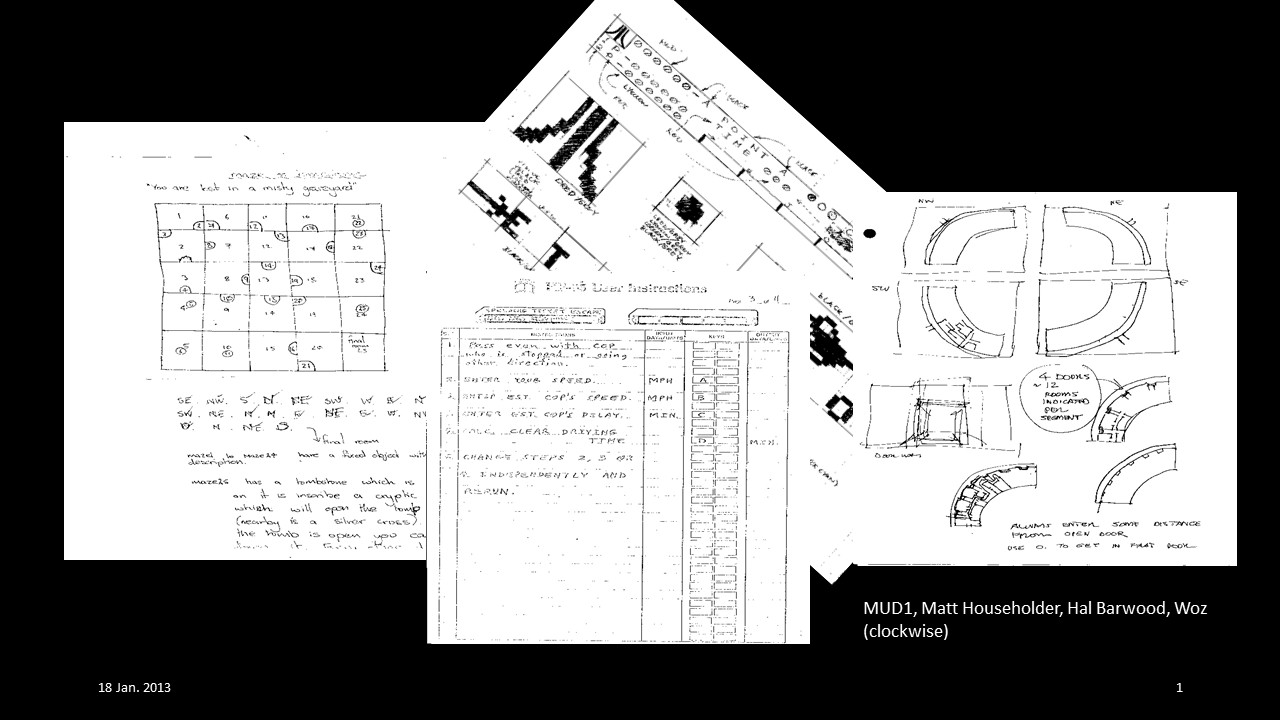
Stefan, Attached is a low-res image that shows several artifacts of programming on paper in the Stanford University Libraries’ collections. If it’s not clear from the slide caption, the image front and center is from the “Woz files” (Steve Wozniak’s files) in the Apple collection at Stanford, including some Apple II but mostly earlier files. That image is from a game about running traffic lights without being caught, if I recall correctly, c. 1976. The other images are (left) MUD1, (above) Matt Householder and (right) Hal Barwood. Householder’s papers include a lot of very nice examples of using graph paper to lay out computer graphics used in games. All of the examples are from the 1970s and 1980s. Best, Henry From: Members [mailto:members-bounces@lists.sigcis.org] On Behalf Of "Dr. Stefan Höltgen" Sent: Wednesday, September 02, 2015 1:33 AM To: members@lists.sigcis.org Subject: [SIGCIS-Members] Call for "paper" Dear SIGCIS members, I am planning to publish a book on handwritten programming code (means: written without computer, only with pencil and paper). That kind of „programming“ has been manily practiced in the 1970s and 1980s when kids without own computers planned their programs on paper to type them in later (at school, in computer ware houses, at friends, …) But that kind of programming is as old as programmable computers themselves, I guess. Every programmer surely had written short algorithms as drafts by hand or had corrected and commented program printouts by hand. Handwritten code, I think, today is almost extinguished. So the book will show today’s computational scientist that special kind of programming history and will also give a slightly insight into how the programmer anticipates the work of machine works while he is trying to think as the machine that runs his/her code. The book will show such handwritten codes and code fragments (of any programming language) as scans, gives informations about the author, date of origin, programming language, computer where it was typed in (if so) and a about the planned function of the code or fragment. If the system and language are available and the code is readable and (sort of) complete, it will be tested and a screenshot of the output will addet to the text. The book will be published in 2017 and there will be an exhibition at the „Heinz Nixdorf MuseumsForum“ in Paderborn (Germany) - one of the largest computer museums in Europe. WHAT DO I NEED FROM YOU? 1. Original paper* with handwritten code or reprintable scans of such papers (300 dpi, color, TIFF, with the edges of the paper in the picture). 2. A permission to reprint that code from its author. 3. Informations about the origin of the paper (author name, date of origin, programming language and system, if remembered: anecdotes about that code and its genesis) * If you want your paper to be shown at the exhibition at „Heinz Nixdorf MuseumsForum“ in 2017 you have to send in the original. Before you send in anything please contact me (se below)! Sent-in original papers will be scanned and kept safely until they are not needed anymore and than will be returened to the owner. Shipping fees from the sender to me can’t be refunded, since the project is completely unsalaried. But those who’s code has been reprinted or shown at the exhibition will get a free copy of the book. The book with the working title „Papier-Maschinen“ (engl. „Paper Machines“) will be published in summer 2017 in our series „Computerarchäologie“ (engl.: „Computer Archaeology“) at the German „Projekt-Verlag"). If you need more informations do not hesitate to contact me at: email@computerarchaeologie.de<mailto:email@computerarchaeologie.de> or visit our Facebook page: https://www.facebook.com/computerarchaeologie I would appreciate it if you would spread my call for „paper“! thanks, Stefan Hoeltgen --- Dr. Stefan Höltgen Humboldt-Universität zu Berlin Institut für Musikwissenschaft und Medienwissenschaft Fachgebiet Medienwissenschaft Zimmer 2.33 Georgenstraße 47 D-10117 Berlin Studienfachberater für Medienwissenschaft Telefon: (+49) (0)30 2093-66-185 Telefax: (+49) (0)30 2093-66-181 (Sekretariat) Mobil: (+49) (0)173 9025982 E-Mail: stefan.hoeltgen@hu-berlin.de<mailto:stefan.hoeltgen@hu-berlin.de> Web: http://u.hu-berlin.de/hoeltgen Sprechstunde: Mittwochs, 13-14 Uhr
participants (12)
-
 "Dr. Stefan Höltgen"
 -
 Claus Pias
 -
 Dag Spicer
 -
 dave.walden.family@gmail.com
 -
 Henry E Lowood
 -
 Ian S. King
 -
 McMillan, William W
 -
 Melanie Swalwell
 -
 Mike Willegal
 -
 Molly Des Jardin
 -
 Murray Turoff
 -
 Pierre MOUNIER-KUHN